
Apple
Apple · AI / ML · Filed Jul 17, 2026 · USPTO published Nov 12, 2026 · This week's release
Apple Patents Face Recognition Trained on Fake Masks to Spot People in Real Ones
Apple's patent application teaches face recognition to spot people behind masks by training on masks that were never actually worn.
- Publication number
- US 2026/0360182 A1(US20260360182A1)
- Applicant
- Apple Inc.
- Filed · Published
- Jul 17, 2026 · Nov 12, 2026
- Inventors
- Jingwen ZHU, Vinay SHARMA, Jonghoon JIN, Nitin GUPTA, Floris CHABERT, Hendrik DAHLKAMP, Muriel NAHMANI
- Status when we published
- Waiting for an examiner
- Document
- 20 claims
- US classification
- 382/118
- Parent application
- Continuation of 17/469,630 (filed Sep 8, 2021)(17469630)
What Apple's masked-face matching does at your door
A camera above a front door watches a visitor walk up the steps with a mask covering half their face. Most face recognition would shrug and call it a stranger.
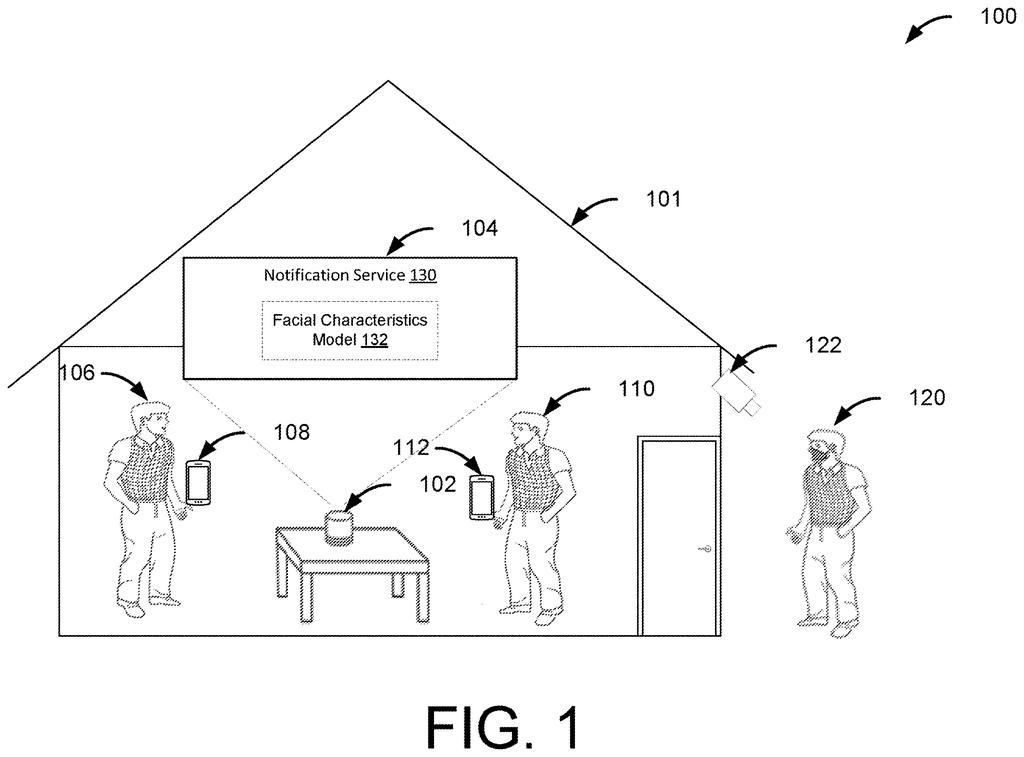
Apple's filing describes a way around that. Your phone's photo library already holds pictures of friends and family. The system picks the clear, uncovered ones and sends them to a home device, such as a smart speaker, to use as the reference. That device then compares them with what the door camera sees, mask or no mask.
The trick happens in training. The system paints fake masks onto ordinary photos, in different colors, textures and positions, so the software learns that a masked face and a bare face can belong to the same person. For you, that could mean an announcement that your friend has arrived instead of a vague alert about an unknown visitor.
… the trained model being trained to match a partially covered face of a particular person with a non-covered face of the particular person, and the trained model being trained to perform the match based at least in part on utilizing a simulated face covering to cover the partially covered face; …
Translation: The AI learns to link masked faces to unmasked ones by using fake digital masks during training.
How fake masks train Apple's face-matching model
The system has two halves: building a gallery of known people, then checking visitors against it. For the gallery, your phone picks photos of a contact from your photo library and sends the best ones to a home device (the filing mentions a smart speaker or a TV box). Photos where the face is covered are left out, so the reference set shows only uncovered faces.
Each photo becomes a faceprint, a long list of numbers (the filing gives 128 as an example) that describes facial features. A camera by the door sends its own images, the model makes a faceprint from them, and a similarity score says how likely the two are the same person. The filing uses cosine similarity, a standard way to measure how closely two lists of numbers match.
Training is the core idea. The system finds landmarks on a bare face, such as lip corners, nose and eyes, draws a boundary shape around the mouth area, and renders a fake mask there. The fake masks vary in:
- Color
- Texture
- Placement on the face
The model learns to give the masked and bare versions of the same person nearly the same faceprint. A separate face-quality check decides whether a face is clear enough to recognize at all, and the resulting notification can leave out the masked image.
What this means for home cameras and photo libraries
If you have a camera at your door, the practical gain is fewer vague "unknown person" alerts when a friend or relative shows up in a mask, scarf or sunglasses. The filing describes alerts as a spoken announcement from a speaker, a message on your phone, or a picture-in-picture video feed on a TV. It also describes settings that announce only people who are not in your contacts.
The design also means your photo library becomes the source of who counts as a known face. The filing describes encrypting images on their way to the home device, and says model training can happen on those devices too. Training on fake masks also saves the effort of collecting thousands of photos of people in real ones.
Apple's 19th filing we've tracked since July in our on-device AI privacy watchlist builds on work like limiting app server data and flagging sensitive video calls.
Source: US 2026/0360182 A1 at the USPTO (PDF). Full patent text and figures are in the official publication.
Get our take in your Top Stories
Liked this breakdown? Add Patentlyze as a preferred source on Google, and our plain-English take shows up more often in your Top Stories the next time Apple patent news breaks.
Add Patentlyze on Google
One click.
There are more where this came from
We read every patent application Big Tech publishes and send you the ones worth knowing. Plain English, free, every week.
The drawings · 7 sheets
7 drawing sheets from US 2026/0360182 A1 · click any drawing to enlarge


More from Apple
All 672 Apple patents →
More in AI vision
All 339 AI vision patents →
Google
Google Patents On-Device Facial Recognition for Home Security Cameras
Samsung
Samsung Patents an On-Device AI That Learns New Objects Without Forgetting Old Ones
Google
Google Patents a System That Hides Sensitive Objects From Its AI Before They're Processed
Nvidia
No comments yet