
Apple
Apple · Wearable · Filed Jul 17, 2026 · USPTO published Nov 12, 2026 · This week's release
Apple Files Patent for a Watch Where the Glass Curves Into the Case
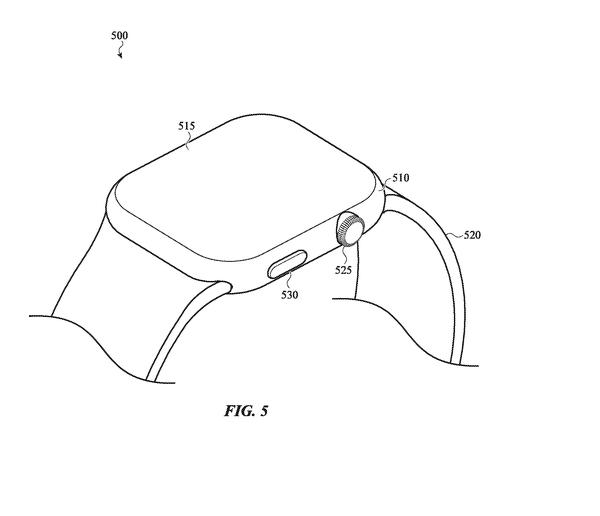
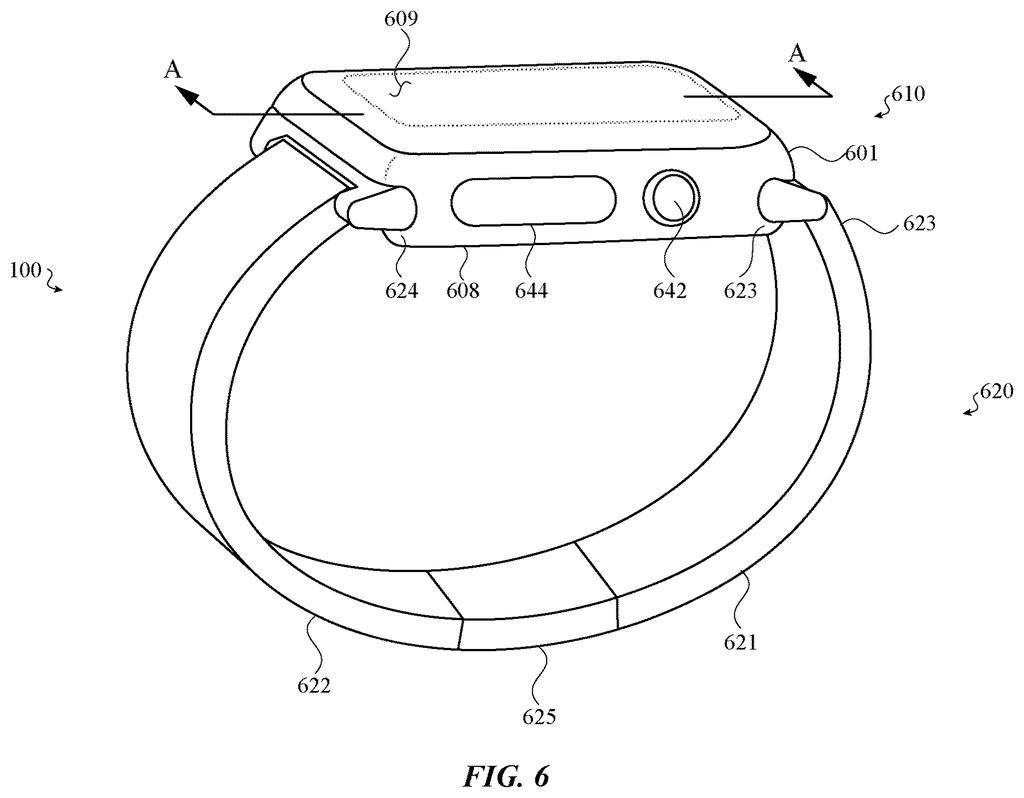
Apple's latest filing, part of a family that traces back to 2014, describes a wrist-worn device whose glass top curves down and meets the case in one continuous surface. It also covers a domed back plate that carries health sensors.
- Publication number
- US 2026/0358762 A1(US20260358762A1)
- Applicant
- Apple Inc.
- Filed · Published
- Jul 17, 2026 · Nov 12, 2026
- Inventors
- Fletcher R. Rothkopf, Jonathan Ive, Julian Hoenig, Rico Zorkendorfer
- Status when we published
- Waiting for an examiner
- Document
- 20 claims
- US classification
- 600/301
- Parent application
- Continuation of 18/119,175 (filed Mar 8, 2023)(18119175)
What Apple's curved-glass watch design covers
Traditional wristwatches handle a short list of jobs: they show the time and the date, and maybe run a stopwatch. Apple's filing starts from that limit and describes a wrist-worn device built to do much more, from estimating your heart rate to sensing how hard you press the screen.
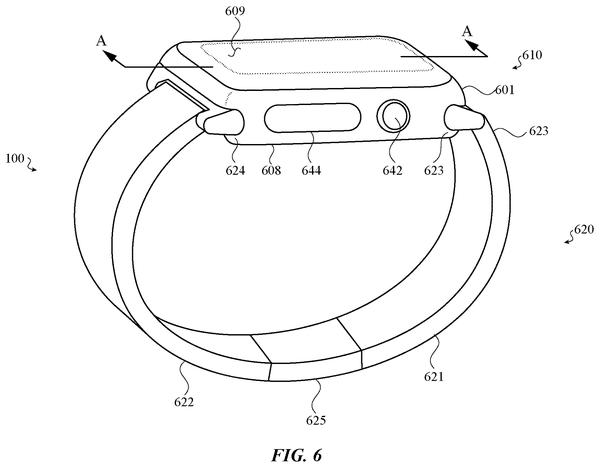
The claims focus on the physical build. The glass on top has a flat middle, larger than the screen beneath it, and a curved rim that rolls down into the side of the case, so your finger travels over one continuous surface. On the back, a domed cover sits over light sensors that shine into your skin to measure things like heart rate.
A third idea hides the watch's antenna in a groove inside the glass itself, tucked behind a dark border that keeps it out of sight.
a flat middle portion larger than the viewable area of the display; and a curved edge portion surrounding the flat middle portion and coinciding with the curved side portion along a perimeter of the cavity to form a continuous contoured surface.
Translation: The screen has a flat center and curved edges that blend smoothly into the sides of the watch body.
How the glass, case and back sensor fit together
The filing bundles three separate ideas, one for each independent claim. The first is the case-and-glass shape: a housing with a flat bottom, a curved side wall and a top opening that holds the display. A cover sits above it, with a flat middle larger than the visible screen and a curved edge that lines up with the side wall to form one contoured surface.
Dependent claims add detail. The curve can meet the flat parts tangentially (smoothly, with no step) and keep a constant radius. The opening can be rectangular with rounded corners, and the crown (the dial you turn) can sit above the case's centerline. Others describe a gasket on a ledge for a waterproof seal and a speaker port whose openings are offset so water cannot travel straight in.
The second idea is the back of the device. An opening in the bottom holds a biosensor module (a bundle of health sensors) under a rear cover with a convex, domed surface. Light sources shine into the body and a photodetector catches what bounces back. A processor turns that signal into a health metric shown on the display, and the module may be removable.
The third idea is the cover's hidden border: an opaque mask on the underside of the glass, with its inner edge inside the curved zone. Dependent claims place a ring-shaped antenna in a groove within that border and make the cover from sapphire.
… monitoring a user's physiological signals and providing health-related information based on those signals; communicating with other electronic devices or services; visually depicting data on a display; gather data form one or more sensors …
Translation: The device tracks your health data, talks to other gadgets, shows information on a screen, and collects sensor readings.
Why a watch's shape and seals still matter
For you, this is about the parts of a watch you live with every day: how the glass feels under your thumb, whether the case survives a swim or a shower, and how the back sits against your wrist while sensors read your pulse. Putting the antenna inside the glass and the sensors on a domed back plate are choices that shape comfort, water resistance and accuracy.
The description also lists force-sensitive touch, wireless charging, tap-to-pay and swappable bands as part of the device, but these claims stick to shape, seals and the sensor back. The filing continues a chain of earlier applications, the first with a 2014 filing date, so it reads as a refined claim set for a design that has had years to settle.
Apple has filed its 15th application we've tracked in Apple's health sensor work since May, adding to earlier applications like the grip-reading stylus and sleep-detecting earbuds.
Source: US 2026/0358762 A1 at the USPTO (PDF). Full patent text and figures are in the official publication.
Get our take in your Top Stories
Liked this breakdown? Add Patentlyze as a preferred source on Google, and our plain-English take shows up more often in your Top Stories the next time Apple patent news breaks.
Add Patentlyze on Google
One click.
There are more where this came from
We read every patent application Big Tech publishes and send you the ones worth knowing. Plain English, free, every week.
The drawings · 26 sheets
26 drawing sheets from US 2026/0358762 A1 · click any drawing to enlarge


Show the other 18 sheets


More from Apple
All 672 Apple patents →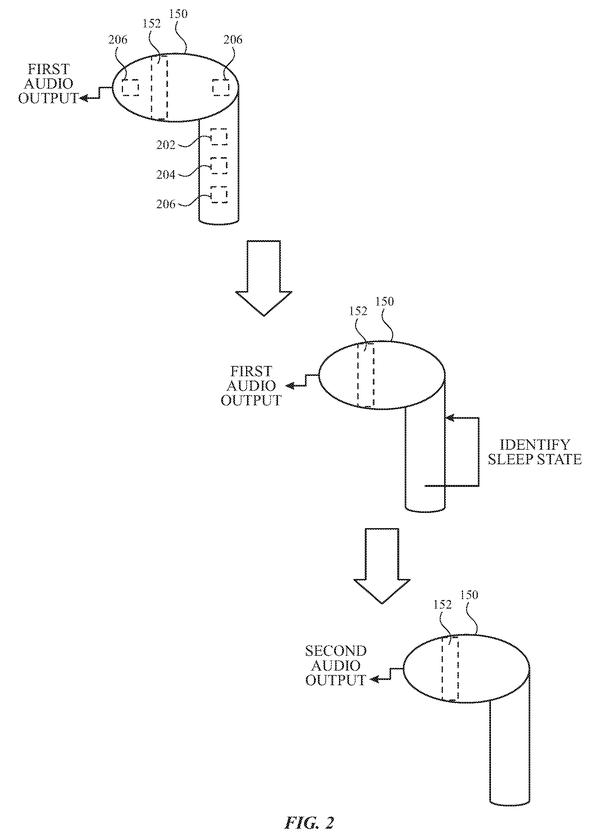

More in Hardware
All 2,316 Hardware patents →
Samsung
Samsung Patents a Fix for Thumbnails That Don't Match the Photo You Took
Samsung
Samsung Files Patent for a Walking Aid That Corrects Its Own Hip Readings
Qualcomm
Qualcomm Files Patent for Phone That Guides You to Your Car Through Your Watch
Samsung
No comments yet