
Apple
Apple · Energy · Filed Mar 12, 2026 · USPTO published Nov 19, 2026 · This week's release
Apple Files Patent for Wireless Chargers That Flag a Weak Power Adapter
A wireless charger plugged into a weak power adapter can crawl along while looking perfectly normal. Apple's filing describes a one-bit message that would let the charger tell on its own power source.
- Publication number
- US 2026/0370059 A1(US20260370059A1)
- Applicant
- Apple Inc.
- Filed · Published
- Mar 12, 2026 · Nov 19, 2026
- Inventors
- Daniel Ye, Jeffrey D. Louis, Wynand Louis Malan, Zaid A. AbuKhalaf
- Status when we published
- Waiting for an examiner
- Document
- 20 claims
- US classification
- 307/104
- Parent application
- Claims priority from a provisional application 63807105 (filed May 16, 2025)
What Apple's slow-charger warning actually does
Imagine you set your watch on a wireless charging puck before bed and wake up to find it only partly charged. The puck wasn't broken. It was plugged into a weak power adapter that couldn't feed it enough, and nothing ever told you.
This Apple patent application targets that blind spot. The charging puck works out how much power its adapter can really deliver, then tells the device sitting on top of it. That device can pick a charging mode that fits the situation, or show you a message such as “slow charger” so you know to swap the adapter.
The signal itself is tiny: a single bit, basically a yes or no, tucked into a message the two devices already trade.
receive, using the wireless power transfer coil, a data communication packet from the power transmitting device, wherein the data communication packet comprises an indication of whether a power supply for the power transmitting device is capable of supplying a load power supported by the power transmitting device; …
Translation: The phone gets a message about whether the wall plug can handle the charger's power needs.
How the charger reports a weak power brick
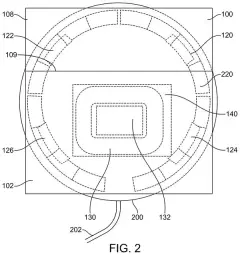
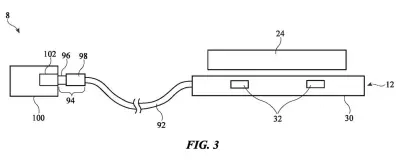
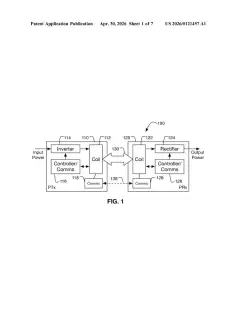
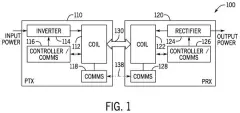
The filing covers three related pieces: the device being charged (the “receiver”), the charger (the “transmitter”), and a warning shown to the user. When the two meet, they run a short handshake in the style of the Qi standard (the common language wireless chargers and phones use to agree on terms). During that handshake the charger sends a capabilities packet, a small data message listing what it can do. Inside it sits a limited power supply bit: 0 means the adapter can feed the charger's full rated power, 1 means it can't.
The charger has several ways to find out. It can ask a USB adapter for its limits, read an identification signal from the adapter, or measure the voltage and current itself. It then compares the result with what it needs. The filing notes that an adapter must supply extra power to cover losses, so an 11 W adapter may fall short for a 10 W charger if efficiency is below 90%.
What the receiving device does with the answer is where the claims branch:
- It picks a power mode (the filing's examples are 5, 15 and 25 W) and tells the charger.
- It shows a notification that charging is running below the charger's maximum, such as “slow charger.”
- The charger itself can negotiate the mode and signal with a light, sound or vibration.
The packet also has a field giving one reason for a power limit, such as heat or a foreign object. Since it holds only one reason, the separate bit keeps a weak adapter from being hidden behind another cause.
The wireless power transmitting device may transmit to the wireless power receiving device an indication of whether the power supply is capable of supplying a maximum load power supported by the wireless power transmitting device.
Translation: The charger tells the device if the wall adapter is strong enough to run it at full speed.
What this means for your wireless charging habit
Slow charging is hard to diagnose. Your phone, watch or earbuds say they're charging, yet the percentage barely moves, and the cause may be a weak adapter you grabbed from a drawer. A clear “slow charger” message, or a device that picks a fitting power mode by itself, takes the guesswork out.
The filing describes the idea for many kinds of devices, including phones, tablets, watches and laptops, and for chargers shaped like a mat or puck. It means fewer people blaming the device when the adapter is the culprit, and a charger that sets sensible expectations instead of underperforming.
That makes this Apple's 694th filing we've tracked in our Apple coverage since May, adding to a run that includes a backward-compatible wireless charger and a phone that snaps in two halves.
Source: US 2026/0370059 A1 at the USPTO (PDF). Full patent text and figures are in the official publication.
Get our take in your Top Stories
Liked this breakdown? Add Patentlyze as a preferred source on Google, and our plain-English take shows up more often in your Top Stories the next time Apple patent news breaks.
Add Patentlyze on Google
One click.
There are more where this came from
We read every patent application Big Tech publishes and send you the ones worth knowing. Plain English, free, every week.
The drawings · 8 sheets
8 drawing sheets from US 2026/0370059 A1 · click any drawing to enlarge


More from Apple
All 748 Apple patents →
More in Energy
All 140 Energy patents →
Samsung
Samsung Patent Reveals Multiport Adapter That Prioritizes Laptop Power Over Accessories
Sony
Sony Patents a Camera That Maps Objects in 3D While Using Less Power
Samsung
Samsung Patents a Wireless Charger That Spots Metal Objects Before Fast Charging Starts
Samsung
No comments yet