
Apple
Apple · Energy · Filed May 13, 2026 · USPTO published Nov 19, 2026 · This week's release
Apple Files Patent for a Wireless Charger That Works With Both New and Old Devices
Apple has filed a patent application for a wireless charger that listens to how your device answers its first signal, then decides which of two charging methods to use.
- Publication number
- US 2026/0370060 A1(US20260370060A1)
- Applicant
- Apple Inc.
- Filed · Published
- May 13, 2026 · Nov 19, 2026
- Inventors
- Tzu-Jui LIN, Zaid A. ABUKHALAF, Alin I. GHERGHESCU, Stephen C. TERRY
- Status when we published
- Waiting for an examiner
- Document
- 13 claims
- US classification
- 307/104
- Parent application
- Claims priority from a provisional application 63998733 (filed Mar 6, 2026)
What Apple's two-language wireless charger does
Ever set an older gadget on a newer wireless charger and wondered whether the two would even understand each other? They have to, because wireless charging comes in more than one language, from a basic 5 watt mode to faster modes at 15 watts and above.
Apple's patent application describes a charger that sorts this out by itself. When you set a device down, the charger sends a short startup signal and listens. A device that knows the newer language answers that signal directly. A device that doesn't know it sends a different kind of message instead, and the charger takes that as its cue to switch to the other method.
The result is one charger that works out how to treat each device without you doing anything.
… a wireless power transmitter negotiates power transfer using different wireless charging protocols based on a received message from a wireless power receiver.
Translation: The charging pad switches between different protocols depending on what the device tells it.
How the charger sorts devices by their first reply
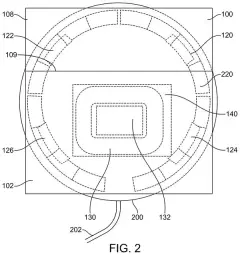
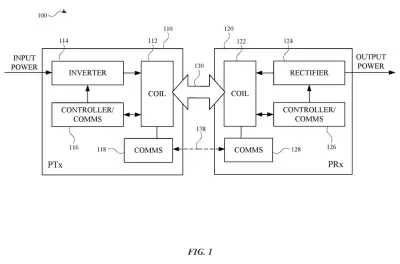
The claims cover a wireless power transmitter: a coil, an inverter (the circuit that turns incoming power into the alternating current the coil needs), and a controller. The interesting part is a short conversation at startup.
- The charger detects something nearby using small test pulses, called analog pings.
- It then sends a startup message as part of a digital ping, a stronger pulse that can even wake up a device with a dead battery. In the description, this message is a simple pattern of eight 1 bits.
- If the device replies with a message that answers the startup message (the description calls it a power session request, or HELLO), the charger negotiates using the first charging protocol. If the device sends something that does not answer it, such as a proprietary message, the charger negotiates using the second protocol.
The filing says the two protocols could be different standards, different versions of one standard (for example, Qi2 at 15 watts and above versus original Qi at 5 watts), or a public standard versus a manufacturer's own design.
After a HELLO, the charger answers with a status message that includes an error bit saying whether the two devices share a compatible standard. If they don't, it can cut power or ping again using a shared one. Power can start at 5 or 10 watts and rise to 15, 25 or more after negotiation, with a check for stray metal along the way.
Why one pad for old and new devices matters
The practical payoff is fewer charging surprises. Chargers, phones, watches and earbuds from different years all share the same pad shape, and this filing describes a way for the charger to sort them out automatically. You could keep using an older accessory on a newer charger, and a newer device could still get its faster speeds when it meets a charger that supports them.
The filing also describes the receiving device telling you, with a sound, a buzz or something on screen, when a charger can't support the standard it needs. That turns a mysterious why isn't this charging? moment into a clear answer. The text names Qi and Qi2 as examples, so it fits the broader job of keeping wireless charging backward compatible as speeds climb.
That makes this Apple's 693rd filing in our Apple coverage since May, adding to work like the snap-together phone and cleaner charger signals.
Source: US 2026/0370060 A1 at the USPTO (PDF). Full patent text and figures are in the official publication.
Get our take in your Top Stories
Liked this breakdown? Add Patentlyze as a preferred source on Google, and our plain-English take shows up more often in your Top Stories the next time Apple patent news breaks.
Add Patentlyze on Google
One click.
There are more where this came from
We read every patent application Big Tech publishes and send you the ones worth knowing. Plain English, free, every week.
The drawings · 13 sheets
13 drawing sheets from US 2026/0370060 A1 · click any drawing to enlarge


Show the other 5 sheets


More from Apple
All 748 Apple patents →
More in Energy
All 140 Energy patents →
Microsoft
Microsoft Patents a Laptop Charger That Reels in Its Own Cable
Samsung
Samsung Patents a Leg-Assist Wearable That Won't Power Up Until It's Strapped On Right
Samsung
Samsung Patents a Wireless Charger That Negotiates Voltage on Both Ends
Microsoft
No comments yet