
Sony
Sony · Display · Filed Jun 3, 2025 · USPTO published Nov 12, 2026 · This week's release
Sony Patents a Camera That Maps Objects in 3D While Using Less Power
Sony describes a depth camera that flashes coded light patterns at your hand and listens only for the pixels that change. That lets it keep measuring distance even while its own light is switched off.
- Publication number
- US 2026/0358116 A1(US20260358116A1)
- Applicant
- Sony Semiconductor Solutions Corporation
- Filed · Published
- Jun 3, 2025 · Nov 12, 2026
- Inventors
- Michael GASSNER, Marc OSSWALD
- Status when we published
- Waiting for an examiner
- Document
- 13 claims
- US classification
- 356/603
- Examiner
- PEREZ-GUZMAN, CARLOS GABRIEL (Art Unit 2877)
- Parent application
- National Stage Entry of PCT/EP2023/080927 (filed Nov 17, 2023)(PCTEP2023080927)
What Sony's change-sensing depth camera does
Imagine wearing a headset and waving your hands around to move virtual objects. For that to work, the headset has to know how far away your fingers are many times a second, without draining the battery.
Sony's patent describes a depth sensor that flashes light in a rapid sequence of patterns onto whatever it is looking at, such as your hand. Instead of recording full pictures, its camera only reports the pixels where the brightness changed. Each flicker of the pattern creates a recognizable burst of changes, and the system uses the timing of those bursts to work out how far away each part of your hand is.
The clever part is what happens between flashes. Ordinary room light also causes changes the sensor can pick up, so the device can keep estimating distance while its own light is off. That means less light to power and a faster stream of updates.
… deciding for each of the predetermined solid angles whether or not to illuminate the respective predetermined solid angle by projecting light into it …
Translation: It chooses whether to shine light onto specific small zones.
How the sensor reads light flashes as depth codes
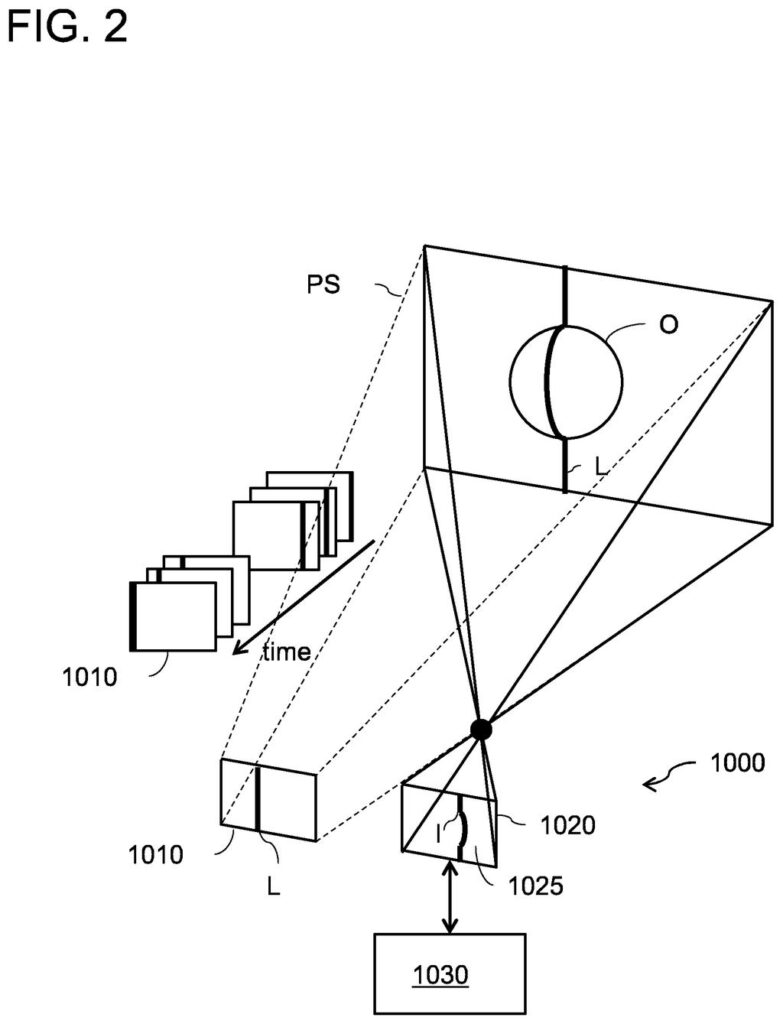
The device has three parts. A projector divides its view into a set number of slices (the filing's example uses eight) and, for each flash, decides slice by slice whether to shine light into it. It repeats this with different on and off combinations, so in the example five flashes give every slice its own five-digit code.
The receiver is an event camera: each pixel stays silent until the light it sees changes by more than a set threshold, then reports an event (its position, a timestamp, and whether it got brighter or dimmer). The control unit gathers all events in a time window, matches each pixel's sequence of events to the known codes, and uses triangulation (geometry based on the known spacing between projector and camera) to work out distance.
Room light also triggers events. When the projector is dark, the unit treats every event as coming from room light and builds a flat 2D view. When it is lit, it treats events as coming from the projector. A predictor module, which the filing says can use neural networks (software trained on examples), blends both and keeps a running estimate of the object, so depth keeps updating with the projector off.
Further claims add a second camera for stereo vision, and the filing says the pattern light can be infrared so it stays invisible.
… detects reflected light intensities from the object, including light from the projected patterns and ambient light …
Translation: It measures both the projected light bouncing back and the surrounding room light.
Why this matters for hand tracking and AR
For you, the payoff is hand tracking and depth sensing that cost less battery. The filing lists headsets for augmented and virtual reality, phones that use depth for AR and games, face capture for video calls and avatars, and factory cameras checking parts on fast conveyor belts. Sony says the single-camera design cuts parts, power use and calibration work, and the event approach avoids storing every pixel of every frame, which reduces memory and delay.
The filing also describes the control unit switching the projector on only when it needs more accuracy, for example when you reach toward a nearby virtual object in an AR scene, and leaving it off while a rough depth estimate will do. It is a design on paper, and the text gives no measured savings.
Sony's 47th filing we've tracked since July in the AR glasses race builds on earlier applications like foveated rendering and hand passthrough fading.
Source: US 2026/0358116 A1 at the USPTO (PDF). Full patent text and figures are in the official publication.
Get our take in your Top Stories
Liked this breakdown? Add Patentlyze as a preferred source on Google, and our plain-English take shows up more often in your Top Stories the next time Sony patent news breaks.
Add Patentlyze on Google
One click.
There are more where this came from
We read every patent application Big Tech publishes and send you the ones worth knowing. Plain English, free, every week.
The drawings · 16 sheets
16 drawing sheets from US 2026/0358116 A1 · click any drawing to enlarge


Show the other 8 sheets


More from Sony
All 707 Sony patents →
More in Display
All 730 Display patents →
Samsung
Samsung Files Patent for Smart Glasses That Tuck Their Camera Away When Folded
Microsoft
Microsoft Patents a Thermal Camera Lens That Sharpens the Center by Blurring the Edges
Meta
Meta Files Patent for AR Glasses Display With Tiny Processors Built Directly Behind It
Samsung
No comments yet