Apple
Apple · Chip · Filed Apr 10, 2026 · USPTO published Aug 27, 2026 · Aug 27 release
Apple Patents a Chip That Frees Stuck Memory Automatically When Apps Stall
When your phone's processor runs dozens of tasks at once, it can run out of the small memory slots each task needs, and slow to a crawl. Apple's newest patent describes a chip circuit that watches those slots in real time and takes them back from tasks that aren't using them.
- Publication number
- US 2026/0252387 A1(US20260252387A1)
- Applicant
- Apple Inc.
- Filed · Published
- Apr 10, 2026 · Aug 27, 2026
- Inventors
- Mark D. Earl, Dimitri Tan, Christopher L. Spencer, Jeffrey T. Brady, Ralph C. Taylor, Terence M. Potter
- Status when we published
- Waiting for an examiner
- Document
- 21 claims
- US classification
- 718/104
- Parent application
- Continuation of 17/240,406 (filed Apr 26, 2021)(17240406)
What Apple's thread memory reclaiming chip actually does
Imagine your phone is juggling 20 apps at once and the chip inside starts running low on the tiny memory compartments each task needs to do its work. Instead of grinding to a halt or dropping tasks, the chip just stalls and waits, which you feel as lag.
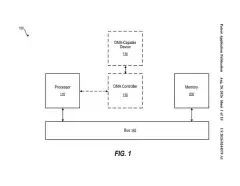
Apple's patent describes a management circuit built into the chip that tracks every task's status using a short ID tag. When the chip is running low on a type of memory compartment, the circuit scans those tags, identifies tasks that can safely give their compartments back, and reclaims them, all without you doing anything.
The result is that fewer tasks get stuck waiting, and the chip keeps moving. It's the kind of housekeeping that happens hundreds of millions of times per second inside a processor, and doing it well means your phone stays quick even when it's under pressure.
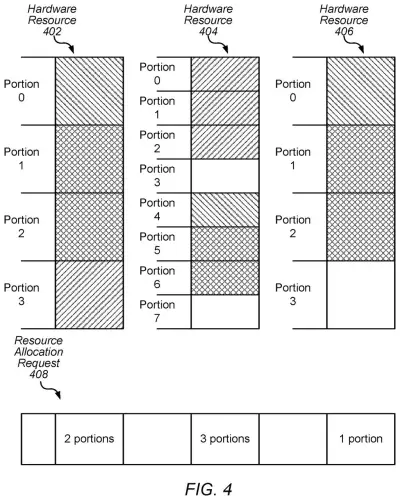
In response to determining that fewer than a respective requested number of one or more types of the hardware resources are available, the resource allocation management circuit may identify one or more threads for deallocation.
Translation: When the system runs low on memory, it automatically picks specific tasks to shut down to free up space.
How Apple's circuit tracks state IDs to free stuck memory
At the hardware level, a modern processor chip runs many threads simultaneously. A thread is just a unit of work: one frame of a video, one network request, one line of code being executed. Each thread needs its own small pockets of fast memory called registers to hold the numbers it's working with.
The problem is that registers are scarce. If a thread requests registers that aren't available, it stalls. Apple's patent introduces a resource allocation management circuit that sits above the individual allocation units and coordinates across them. It tracks which registers each thread holds using state identification values (short tags that reflect what stage of execution a thread is in, essentially a fingerprint of where the thread is in its lifecycle).
When a new thread requests registers and the chip is short:
- The management circuit checks the state ID tags of all active threads.
- It identifies threads that are in a state where their registers can be safely taken back (for example, threads that are waiting on something external and not actively computing).
- It deallocates registers from the fewest possible threads, freeing up exactly what's needed.
The key efficiency gain is that the circuit targets fewer threads for deallocation than a simpler system would, because it uses the state tags to pick the right candidates rather than evicting threads at random or in bulk.
What this means for iPhone chip performance under load
For you as a user, this kind of improvement shows up as the absence of something annoying: the brief freeze when you switch apps, the stutter mid-game, the moment a video call drops quality because the processor got backed up. A chip that manages its own internal memory more precisely stays ahead of those bottlenecks instead of reacting to them after the fact.
For Apple, it fits a clear pattern of pushing chip efficiency inward rather than simply adding more hardware. The Apple Silicon series already leads in performance per watt, and patents like this one suggest the company is refining the scheduling logic that keeps all those cores fed and moving. Coverage of new Big Tech patents in chip architecture shows Apple filing steadily in this area, which points to real engineering investment rather than a one-off idea.
Apple's fourth filing we've tracked in the AI chip wars since August builds on earlier work like juggling multiple tasks and a three-chip wake-up system.
Source: US 2026/0252387 A1 at the USPTO (PDF). Full patent text and figures are in the official publication.
Get our take in your Top Stories
Liked this breakdown? Add Patentlyze as a preferred source on Google, and our plain-English take shows up more often in your Top Stories the next time Apple patent news breaks.
Add Patentlyze on Google
One click.
There are more where this came from
We read the new patents from Big Tech, carmakers and more and send you the ones worth knowing. Plain English, free, every week.
The drawings · 7 sheets
7 drawing sheets from US 2026/0252387 A1 · click any drawing to enlarge


More from Apple
All 748 Apple patents →
More in Cell phone
All 496 Cell phone patents →
Google
Google Patents an AI System That Adjusts Chip Power Based on What You're Doing
Qualcomm
Qualcomm Patents a Lower-Power AI Video Filter for Mobile Chips
Qualcomm
Qualcomm Patents a Color-Tuning System That Focuses Only on What You're Looking At
Qualcomm