
Bambu Lab
Bambu Lab · Sensor · Filed Jul 14, 2026 · USPTO published Nov 19, 2026 · This week's release
Bambu Lab Files Patent for 3D Printers That Notice a Missing Print Plate
A 3D printer that can't tell its print plate is missing will melt plastic straight onto the heated bed. This patent application has the print head go and feel for the plate first.
- Publication number
- US 2026/0364885 A1(US20260364885A1)
- Applicant
- SHENZHEN TUOZHU TECHNOLOGY CO., LTD.
- Filed · Published
- Jul 14, 2026 · Nov 19, 2026
- Inventors
- Yuran WANG, Zihan CHEN
- Status when we published
- Waiting for an examiner
- Document
- 20 claims
- US classification
- 264/239
- Parent application
- Continuation of PCT/CN2025/081815 (filed Mar 11, 2025)(PCTCN2025081815)
What Bambu Lab's print plate check does
A 3D printer needs a removable plate sitting on its heated bed to catch the melted plastic. If that plate is missing, the plastic lands straight on the bed, and the finished print can be hard to pull off or even damage the printer.
Bambu Lab's patent application describes a quick check before printing. The print head moves to a chosen spot over the bed and lowers itself, and a sensor in the head reports what it runs into. If the plate is there, the sensor's signal changes. If it isn't, the head sails down and the signal stays flat.
So instead of trusting that you remembered to put the plate back, the printer can find out for itself. The goal is to keep plastic from ever hitting the bare bed.
controlling the toolhead to move to a target region and controlling the toolhead to descend; and during a process of controlling the toolhead to descend, detecting, based on a signal output by the detection device, whether the build plate is placed on a surface of the heatbed.
Translation: The printer moves its print head downward into position to check if the removable plate is resting on the heating bed.
How the nozzle and sensors find the plate
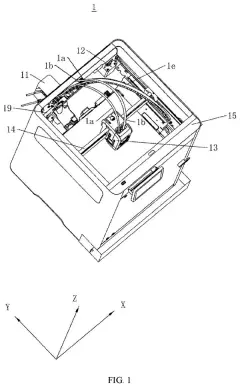
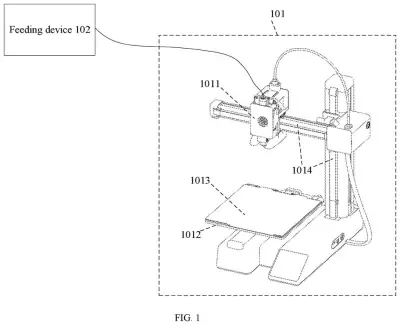
The claims cover a detection method run by the printer's controller. It moves the toolhead (the moving assembly that holds the nozzle) to a target region over the bed, lowers it, and reads a signal from a detection device built into the toolhead. That signal tells the printer whether a build plate is on the heatbed (the heated platform).
The filing describes two kinds of sensor:
- Force sensing: the head descends to a preset height, the lowest point of the printing space. If the plate is there, the nozzle presses against it and the signal changes. If the signal never changes, there is no plate. The target spot is where the plate overhangs the bed, and it must avoid any holes in the plate. One design uses a strain gauge (a tiny stretch sensor) on a flexing arm. Another uses a coil near a metal part of the hotend, which shifts when the nozzle is pushed up.
- Distance sensing: a coil in the toolhead senses nearby metal. If the plate is metal and the bed surface is not, a signal that keeps rising or falling as the head descends means the plate is present. The filing also covers the reverse setup, a non-metal plate on a metal bed, where a signal that never changes means the plate is in place.
The claims also cover a printer with this controller and a software version of the method.
By means of implementing the present disclosure, whether a printing panel is placed on the surface of a heatbed can be automatically detected, and the reliability is high.
Translation: This system reliably checks for the presence of the printing surface without requiring human intervention.
Why Bambu Lab's plate check saves your prints
If you print at home, this safeguard spares you a ruined first layer. Forget to put the plate back after pulling off a finished print, and the printer could lay plastic straight onto the bed. The filing says that can make the part hard to remove or even damage the printer. A built-in check lets the machine catch the mistake before any plastic comes out.
The sensors are also simple. The filing describes a strain gauge or a coil already near the toolhead, and says this keeps costs low. That suggests the check could be added without much extra hardware. As with any patent application, nothing here says it will ship in a particular printer.
Source: US 2026/0364885 A1 at the USPTO (PDF). Full patent text and figures are in the official publication.
Get our take in your Top Stories
Liked this breakdown? Add Patentlyze as a preferred source on Google, and our plain-English take shows up more often in your Top Stories the next time Bambu Lab patent news breaks.
Add Patentlyze on Google
One click.
There are more where this came from
We read the new patents from Big Tech, carmakers and more and send you the ones worth knowing. Plain English, free, every week.
The drawings · 5 sheets
5 drawing sheets from US 2026/0364885 A1 · click any drawing to enlarge


More from Bambu Lab
All 2 Bambu Lab patents →More in Hardware
All 2,375 Hardware patents →
Google
Google Patents a Home Device That Spots Falls Without Recognizing Faces
Samsung
Samsung Files Patent for a TV That Turns Off When You Fall Asleep
Figure AI
Figure AI Patents a Backpack Rig That Lets Workers Teach Humanoid Robots
Unitree
No comments yet