
Google
Google · Sensor · Filed Mar 2, 2026 · USPTO published Nov 19, 2026 · This week's release
Google Patents a Home Device That Spots Falls Without Recognizing Faces
Google has filed for a home gadget that can tell when you've fallen by tracking your body's balance point with invisible light, without ever capturing a photo of your face.
- Publication number
- US 2026/0368907 A1(US20260368907A1)
- Applicant
- Google LLC
- Filed · Published
- Mar 2, 2026 · Nov 19, 2026
- Inventors
- Aditya Shailesh Ghadiali
- Status when we published
- Waiting for an examiner
- Document
- 20 claims
- US classification
- 382/103
- Parent application
- National Stage Entry of PCT/US2023/031828 (filed Sep 1, 2023)(PCTUS2023031828)
What Google's face-blind home sensor actually does
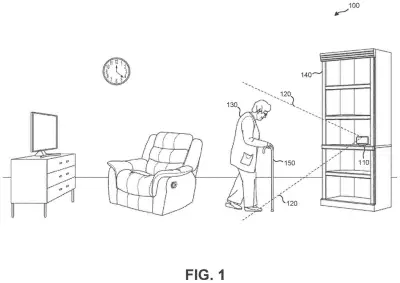
Imagine your grandmother lives alone, and the display on her bookshelf can tell when she has fallen and calls for help. It never records a photo of her face, and it never works out who she is.
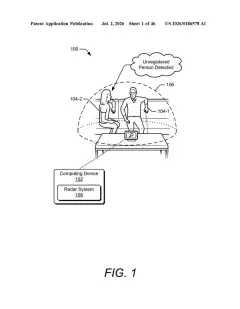
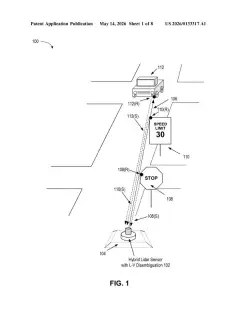
Google's patent application describes how. Instead of a regular camera, the device sends out invisible infrared light and measures the returning light to work out how far away each thing in the room is. That gives it a map of distances, a bit like a 3D outline of a person with no facial details. From that outline it can follow someone's movements, recognize a wave or a swipe, and track their center of gravity, the balance point of the body.
A sudden shift in that balance point can trigger a fall alert. The same idea could also coach your exercise form, flag slouching, or note restless sleep.
accessing depth information, wherein the depth information is derived from depth data generated by a sensor of the electronic device, the sensor comprising a plurality of photodiodes and having a field-of-view within a portion of an environment surrounding the electronic device …
Translation: The device looks at 3D sensor measurements of the surrounding room instead of using a standard camera.
How the sensor turns reflected light into a fall alert
The filing covers two related ideas. The first is controlling a device with gestures read from depth information (a map of how far away each part of a scene is) instead of ordinary photos. The second is tracking a person's center of gravity using infrared light and sending a notification based on what that balance point does.
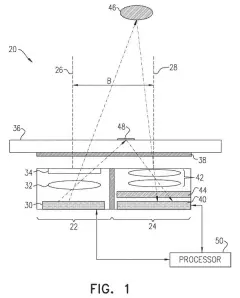
The hardware starts with an illuminator built from tiny lasers (vertical-cavity surface-emitting lasers, or VCSELs) that floods the room with infrared light. A time-of-flight sensor, a chip with many light-sensitive photodiodes, catches the reflection and measures the phase shift (a slight timing offset in the light wave) between what was sent and what came back. That yields distances, at roughly 30 to 60 frames per second in the examples.
The software then works in steps:
- A trained model finds people in the depth frames and draws a box around each one.
- A tracker based on a kernelized correlation filter (a method for following an object from frame to frame) follows each person's path.
- A gesture model finds hand landmarks and sorts movements into waves, swipes or points.
- A pose model builds a 3D skeleton, which is fleshed out into a volume so a center of gravity can be calculated.
In the examples, a center of gravity change above a set threshold produces a fall alert. Comparing a motion to a reference exercise produces form-correcting instructions. The description also mentions posture checks and sleep tracking.
A center of gravity of the object can be tracked captured light and a notification can be generated based on the tracked center of gravity.
Translation: It monitors how a person's weight shifts to trigger alerts without actually looking at them.
Why a sensor that can't ID you matters at home
If you have an older relative living alone, or you simply don't want a camera watching your living room, a face-blind sensor is an easier thing to say yes to. The filing says a depth map can't be used to identify a person's face, which is the privacy worry that follows most home sensors. The patent names Nest Hub-style assistant devices and Pixel phones as example hosts.
It also points to a display that wakes as you walk up, reacts to a wave from across the room, and could switch on lights or heating. Fall alerts could go to emergency contacts. The filing stays at the level of method and hardware, so how any of this would reach a product is unknown.
That makes this Google's 70th filing we've tracked since May in our on-device AI privacy watchlist, a thread that includes its work on a shared smart speaker and phone-based chatbot training.
Source: US 2026/0368907 A1 at the USPTO (PDF). Full patent text and figures are in the official publication.
Get our take in your Top Stories
Liked this breakdown? Add Patentlyze as a preferred source on Google, and our plain-English take shows up more often in your Top Stories the next time Google patent news breaks.
Add Patentlyze on Google
One click.
There are more where this came from
We read every patent application Big Tech publishes and send you the ones worth knowing. Plain English, free, every week.
The drawings · 8 sheets
8 drawing sheets from US 2026/0368907 A1 · click any drawing to enlarge


More from Google
All 1,127 Google patents →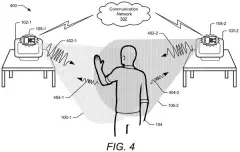
More in Hardware
All 2,355 Hardware patents →
Sony
Sony Patents a System That Checks Its Surroundings Before Sending Sensor Data
Samsung
Samsung Files Patent for a TV That Turns Off When You Fall Asleep
Samsung
Samsung Patents a Home Automation System That Reads What You're Doing
Apple
No comments yet