
Boeing
Boeing · Robotics · Filed May 15, 2025 · USPTO published Nov 19, 2026 · This week's release
Boeing Patents a Drone That Flies Ahead to Mark the Landing Spot
Boeing's filing describes an aircraft that carries a small drone in its cargo area and sends it ahead to the landing pad. The drone latches on and sends out a signal, and the aircraft follows that signal down.
- Publication number
- US 2026/0367645 A1(US20260367645A1)
- Applicant
- The Boeing Company
- Filed · Published
- May 15, 2025 · Nov 19, 2026
- Inventors
- Margaret REAGAN
- Status when we published
- Examiner raised objections; the company can respond
- Document
- 20 claims
- US classification
- 244/183
- Examiner
- GORDON, ANNA L (Art Unit 3642)
What Boeing's scout drone does for a landing
Ever tried to find your way somewhere when your phone's map suddenly loses its signal? Now imagine doing that in a self-flying electric aircraft that has to touch down on a small pad with nobody aboard to take the controls.
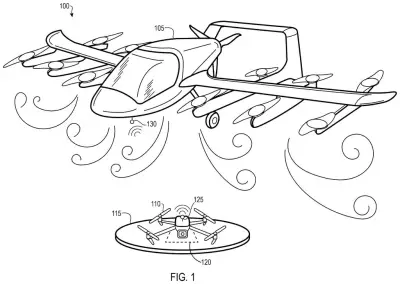
Boeing's filing describes a workaround. The aircraft carries a small drone in its cargo area. While it is still flying toward its destination, it picks a landing spot and sends the drone ahead. The drone lands on the pad, locks itself in place with magnets or clamps, and starts sending out an infrared signal. The aircraft then follows that signal down.
The lock matters because the aircraft's own propellers blast air downward as it lands, and that could shove a loose drone off the pad. The filing says the aircraft can land within about a meter of the drone, even if satellite positioning has dropped out.
… deploy the second vehicle to the landing zone location while the first vehicle is moving to the destination, wherein the second vehicle is configured to be anchored to the landing zone via a receiving element of the landing zone …
Translation: The main craft launches the scout drone on the fly to secure itself to the ground.
How the drone locks onto the landing pad
The filing covers two vehicles that work as a pair. The first is a vertical takeoff and landing aircraft (an eVTOL, meaning an electric aircraft that lifts off and lands straight up and down like a helicopter). It has a cargo area holding a small unmanned drone and a receiver for the drone's signal.
While the aircraft is still moving toward its destination, its computer picks a landing zone from a stored list. The claims say the pick is based at least in part on an energy expenditure metric, a score for how much battery the landing would cost. The description adds that the score can reflect distance, travel time and how hard the spot is to land on. Hard spots include ones surrounded by trees, water, power lines, roads or air traffic, compared with an empty field.
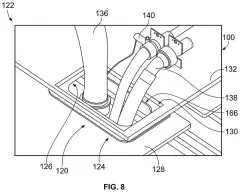
The aircraft then sends the chosen location to the drone and releases it from the cargo area. The drone flies to the pad and anchors itself to a receiving element on it. The filing describes two ways to do this:
- Magnets on the drone that line up with magnets on the pad
- Motorized feet that rotate to grip a lip on the pad
Once anchored, the drone transmits an infrared beacon (an invisible light signal, like a TV remote's). The aircraft steers toward that beacon and lands.
The first vehicle may navigate to the landing zone location in accordance with the location beacon.
Translation: The primary vehicle steers toward the deployed drone using its signal.
Why GPS-free landings matter for Boeing
If you ever ride in or live near autonomous electric aircraft, the question is what happens when the aircraft's navigation fails. Boeing's answer is a backup that does not depend on GPS. The filing argues that infrared guidance is more precise and less affected by atmospheric distortion than satellite positioning, which would let aircraft use tighter landing spots.
The filing is a work in progress. The examiner's first review rejected the claims as filed, which is routine at this stage and usually followed by amendments. Nothing in the document names a product, so treat it as a look at how Boeing is thinking about unpiloted landings, not a preview of a launch.
Source: US 2026/0367645 A1 at the USPTO (PDF). Full patent text and figures are in the official publication.
Get our take in your Top Stories
Liked this breakdown? Add Patentlyze as a preferred source on Google, and our plain-English take shows up more often in your Top Stories the next time Boeing patent news breaks.
Add Patentlyze on Google
One click.
There are more where this came from
We read the new patents from Big Tech, carmakers and more and send you the ones worth knowing. Plain English, free, every week.
The drawings · 8 sheets
8 drawing sheets from US 2026/0367645 A1 · click any drawing to enlarge


More from Boeing
All 3 Boeing patents →
More in Flight & Space
All 10 Flight & Space patents →
Wing (Google)
Wing Files Patent for a Drone Delivery Package With Its Own Lifting Handle
Skydio
Skydio Files Patent for a Drone Camera Mount That Adjusts Itself to Each Camera
Skydio
Skydio Patents a Charging Station That Repositions Landed Drones Automatically
Toyota
No comments yet