
Toyota
Toyota · Robotics · Filed Dec 31, 2025 · USPTO published Nov 19, 2026 · This week's release
Toyota Patents a Grocery Robot That Finds the Best Spot to Grip Items
Toyota's research arm has filed a patent for a robot that fetches groceries and decides, item by item, where to press a suction cup. If the first try slips, it works outward from that spot in a spiral until the grip holds.
- Publication number
- US 2026/0364807 A1(US20260364807A1)
- Applicant
- Toyota Research Institute, Inc.
- Filed · Published
- Dec 31, 2025 · Nov 19, 2026
- Inventors
- Carolyn C. Matl, Sangwoon Kim
- Status when we published
- Waiting for an examiner
- Document
- 20 claims
- US classification
- 700/259
- Examiner
- MOYER, DALE S (Art Unit 3656)
- Parent application
- Claims priority from a provisional application 63805403 (filed May 14, 2025)
What Toyota's suction-cup grocery robot does
Ever tried to pull one jar off a crowded shelf without knocking the others over? Now picture a robot doing that for an entire grocery list. Toyota's research arm has filed a patent for a shopping robot that looks at an item, decides how to grab it, and, when suction fits, grabs it with a suction cup.
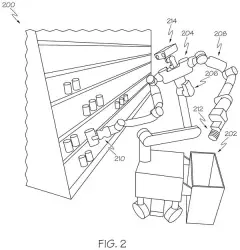
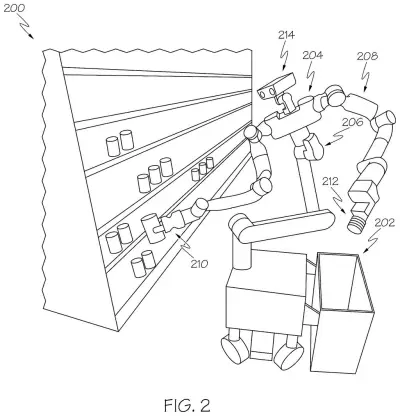
The robot checks what its cameras see against your shopping list, using the picture, the barcode or the printed text to confirm it has the right product. Then it works out the shape of the item and looks for the flattest, safest spot for the cup. It also notices whether the item hangs on a hook, sits on a shelf or rests in a grate, because each setup calls for a different choice.
If the cup doesn't seal on the first try, the robot backs off and tries a nearby spot. It keeps moving outward in a spiral until it gets a grip or a timer runs out.
… extract one or more geometric features of the target object from the image data; select a suction grasp strategy to acquire the target object from a set of one or more grasp strategies based on the one or more geometric features of the target object; and direct the mobile manipulator robot to execute the suction grasp strategy.
Translation: The robot analyzes the shape of the item to figure out the best way to pick it up with suction.
How the robot picks and retries a suction spot
Claim 1 is short and broad. A robot with several cameras spots the item it was sent to fetch, pulls out measurements of its shape (the geometric features), picks suction from a menu of grasp methods based on those measurements, and then carries it out. The filing's menu also includes pinching, side grasps, handle grasps and a two-finger gripper.
The narrower claims show how the shape reading works. The robot builds a point cloud (a swarm of 3D dots from camera depth readings that outlines the item), flattens it into a 2D outline, and scores each dot by how far it sits from the edge. A machine learning model then guesses whether the item hangs on a hook, sits in a grate, or rests on a shelf.
For hook items, the robot ranks the dots by distance from the edge, tests the top pick for flatness (a bumpy spot won't seal), and moves to the next dot if it fails. It also checks that the spot won't bump nearby items. For grate and shelf items, dots near the top of the item get extra weight.
Then the arm approaches along a straight line and presses on. A pressure sensor reports whether the cup sealed. If not, and a preset timer hasn't run out, the robot lifts off and tries a new spot along an expanding spiral from the first one. When the timer expires, it aborts.
… receive image data capturing one or more objects from a plurality of imaging devices coupled to a mobile manipulator robot.
Translation: Multiple cameras on the moving robot take pictures of the items to be gathered.
What this means for grocery-picking robots
If robots are ever going to fill a grocery order, they have to handle thousands of differently shaped items without dropping or crushing them. Picking a good grip spot is a big part of that. The filing's background argues that a single percentage point drop in success rate far outweighs even a big loss in path efficiency or computing speed, which is why the grasp details get so much attention.
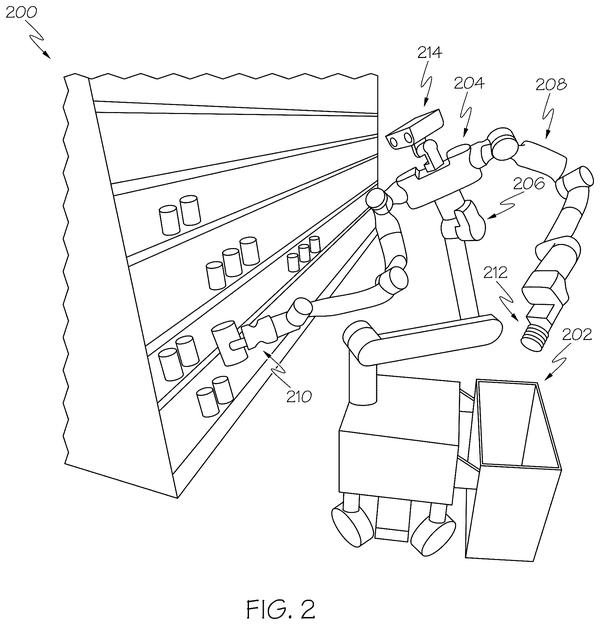
The setting is a store or warehouse where a robot receives a customer's order list, rolls to each item, and drops it into a basket on its body. So your online grocery order could, in theory, be assembled by a machine like this. The patent names no product and gives no timeline, so treat it as a look at how Toyota's researchers are tackling one stubborn problem: getting a suction cup to stick to everyday stuff.
Toyota's fourth filing in the robotics patents we cover since November builds on earlier applications for lifting jugs by their handles and picking from a pile.
Source: US 2026/0364807 A1 at the USPTO (PDF). Full patent text and figures are in the official publication.
Get our take in your Top Stories
Liked this breakdown? Add Patentlyze as a preferred source on Google, and our plain-English take shows up more often in your Top Stories the next time Toyota patent news breaks.
Add Patentlyze on Google
One click.
There are more where this came from
We read the new patents from Big Tech, carmakers and more and send you the ones worth knowing. Plain English, free, every week.
The drawings · 10 sheets
10 drawing sheets from US 2026/0364807 A1 · click any drawing to enlarge


Show the other 2 sheets


More from Toyota
All 16 Toyota patents →
More in Hardware
All 2,375 Hardware patents →
Samsung
Samsung Patents a Robot Hand That Adjusts Its Grip Based on What It's Holding
Sony
Sony Patents a Robot Hand That Corrects Its Own Grip by Sensing Pressure
Samsung
Samsung Patents a Robot That Chooses Its Own Best Vantage Point to Map a Room
Sony
No comments yet