
Airbus
Airbus · Flight & Space · Filed Jun 10, 2025 · USPTO published Nov 19, 2026 · This week's release
Airbus Files Patent for a Firefighting Plane Door That Opens With a Hand Lever
Most firefighting aircraft open their drop doors with electric or hydraulic gear. This Airbus filing replaces all of that with a lever, a rotating shaft and the weight of the water itself.
- Publication number
- US 2026/0366347 A1(US20260366347A1)
- Applicant
- AIRBUS DEFENCE AND SPACE, S.A.U.
- Filed · Published
- Jun 10, 2025 · Nov 19, 2026
- Inventors
- Antonio J. BELTRÁN CUESTA, Ekaitz LUCIO ARRIETA
- Status when we published
- Waiting for an examiner
- Document
- 15 claims
- US classification
- 244/129.5
- Examiner
- DANGOL, ASHESH (Art Unit 3642)
- Parent application
- National Stage Entry of PCT/EP2023/085412 (filed Dec 12, 2023)(PCTEP2023085412)
What Airbus's hand-operated water door does
A firefighting plane banks over a burning ridge with a tank full of water or fire retardant in its belly. To drop it, the crew has to open a big door in the bottom of that tank, and it has to open fast and without fail.
Today that door is usually opened by electric or hydraulic equipment. That gear adds weight, which means less water on board. It also adds parts that can break and chores for maintenance crews. Sometimes the aircraft has to be modified just to power it.
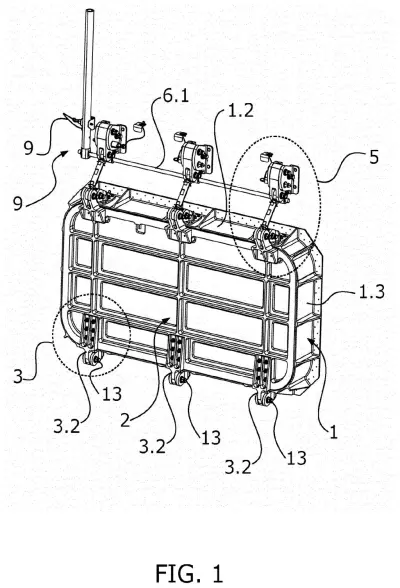
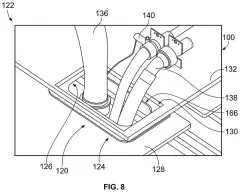
Airbus's patent application describes a door that is purely mechanical. Three latches hold it shut, and a crew member pulls one handle inside the aircraft to free all three. Once the latches let go, the weight of the water pushes the door open on its own. No extra power source is needed.
… an actuator in mechanical connection with the plurality of latch units and configured to actuate the latch units to release the door to allow fluid from the tank to be discharged through the frame.
Translation: A mechanical linkage controls the latches that fling the door open to drop the firefighting fluid.
How the latch lets water pressure open the door
The filing covers a discharge door system built into an airborne tank that sits inside an aircraft's cargo hold. It has a frame fixed to the tank as the opening, and a door hinged along the lower side of the frame. The main example uses three evenly spaced hinges. A seal runs around the door's edge to keep the tank watertight. One version uses an inflatable silicone rubber seal with a valve, so it can adjust its shape when maneuvering forces flex the door.
The locking side is the clever part. Three identical latch units sit along the upper side of the frame. Each one links a latch, a lever and a connecting rod through hinged joints. When the door is closed, the rod and lever sit in a position where the pressure of the water pushes the latch tighter shut. The more water pressing on the door, the more firmly it stays locked.
To drop the load, an operator moves a handle from inside the aircraft:
- The handle turns a cam shaft (a rotating rod) that runs through all three latch units.
- A second lever on the shaft pushes each first lever until the rod and lever line up, which frees the latch.
- The water then pushes the door open and flows out through the frame.
Safety pins guard against accidents. One sits on the handle, and one sits on each latch unit, so a bump in flight cannot open the door early.
Why a purely mechanical door suits fire planes
The practical payoff is more water per flight. Every pound of door equipment is a pound the plane cannot spend on fire retardant, and the filing says electric and hydraulic systems add weight, extra failure points and special maintenance. A mechanical door removes those, and it also means no changes to the aircraft's own electrical or hydraulic systems.
For firefighting operators, that could make a tank easier to install in an existing cargo aircraft and easier to trust. A handle and a set of latches are simple to inspect, and there is less that can go wrong at the moment the drop matters most. The filing describes the door only as part of a tank system. It names no specific Airbus aircraft or product.
Airbus makes its third filing we've tracked since November in our Airbus coverage, adding to earlier applications on tilting wingtips and ground taxi scheduling.
Source: US 2026/0366347 A1 at the USPTO (PDF). Full patent text and figures are in the official publication.
Get our take in your Top Stories
Liked this breakdown? Add Patentlyze as a preferred source on Google, and our plain-English take shows up more often in your Top Stories the next time Airbus patent news breaks.
Add Patentlyze on Google
One click.
There are more where this came from
We read the new patents from Big Tech, carmakers and more and send you the ones worth knowing. Plain English, free, every week.
The drawings · 8 sheets
8 drawing sheets from US 2026/0366347 A1 · click any drawing to enlarge


More from Airbus
All 5 Airbus patents →
More in Flight & Space
All 10 Flight & Space patents →
Archer
Archer Files Patent for a Cockpit Display That Counts Down to Battery and Engine Limits
SpaceX
SpaceX Files Patent for Internet Dishes That Hop Satellites Before a Tree Blocks Them
Boeing
Boeing Files Patent for a Fold-Down Cabin Shelf That Also Parks the Trash Cart
Boeing
No comments yet