
Chervon
Chervon · Gear · Filed Jul 24, 2026 · USPTO published Nov 19, 2026 · This week's release
Chervon Patents a Nail Gun Depth Dial You Can Set With One Quick Turn
Adjusting how deep a nail gun drives a nail usually means spinning a knob several full rotations. Chervon's new patent cuts that down to a single partial turn, and adds a mechanism that physically locks the gun so it can't fire when the nail magazine runs empty.
- Publication number
- US 2026/0364761 A1(US20260364761A1)
- Applicant
- Nanjing Chervon Industry Co., Ltd.
- Filed · Published
- Jul 24, 2026 · Nov 19, 2026
- Inventors
- Junjie Ye, Jie Jiang, Ran Lan
- Status when we published
- Waiting for an examiner
- Document
- 20 claims
- US classification
- 227/140
- Parent application
- Continuation of 18/452,629 (filed Aug 21, 2023)(18452629)
What Chervon's rotary depth knob actually does
Every time you reload a nail gun and start a new run of trim or framing, you check the depth setting. Too shallow and nails pop out; too deep and you crater the wood. On most guns, dialing that setting in means spinning a small knob around and around until you feel it stop.
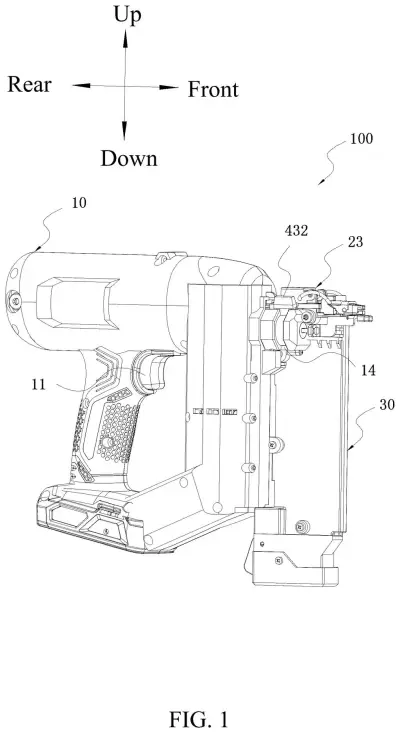
Chervon's patent describes a rotary dial that sits on the outside of the gun and rotates along the same axis the nail travels. To go from maximum depth to minimum depth, you turn it at most one full revolution, and in many designs just a quarter-turn. Physical stops built into the housing tell your fingers exactly when you've hit the limits.
The gun also gets a second feature: a small brake piece that rides on top of the nail stack. While nails remain in the magazine, the brake sits clear and the gun fires normally. The moment the last nail is gone, the brake drops into a slot and physically blocks the trigger mechanism. No more dry-firing into your workpiece and wondering whether the nail went in.
… when the operating member is triggered to switch from the first position to the second position, an angle by which the operating member rotates about a first straight line is less than or equal to 360° …
Translation: You can adjust the depth dial with a single turn of less than a full circle.
How the gear piece and stopper rod lock each depth setting
The patent covers three closely related independent claims, all centered on making the depth-adjustment dial faster and more intuitive.
Depth adjustment by partial rotation: A rotating dial (the "operating member") mounts coaxially with the nail's firing direction. Turning it moves a drive rod inside the housing, which shifts a stopper rod so it rests against a different tooth on a gear piece. Each tooth corresponds to a different depth setting. Because the teeth are arranged around a short arc rather than spread across multiple full rotations, the dial only needs to sweep up to 360 degrees, and in practice often 150 degrees or less, to cover the full range from deepest to shallowest.
Ergonomic sizing: A second independent claim specifies that the exposed portion of the dial must extend at least 5 mm outside the housing, ensuring a gloved hand can grip and turn it without tools.
Idle-strike prevention: A brake piece sits above the nail stack inside the magazine. While nails are present, the piece rests on top of them and stays clear of the trigger mechanism. When the last nail is gone, a spring rotates the brake piece downward into a slot in the nail-pusher, and a first brake portion physically blocks the gear piece from moving far enough to trigger the firing switch. The gun cannot fire until it is reloaded.
Physical stops on the housing body define the first (maximum depth) and second (minimum depth) positions, so the dial cannot be over-rotated and cannot be misread.
… the nail gun has a maximum desired penetration depth when the operating member is operated to the first position, and the nail gun has a minimum desired penetration depth when the operating member is operated to the second position …
Translation: Switching between the two end positions instantly changes the nail depth from deepest to shallowest.
What this means for contractors and DIYers on the job
For a finish carpenter or framing crew, stopping mid-task to fiddle with a depth dial costs time and concentration. A setting that snaps between extremes in one short turn is a real workflow improvement, especially when you are switching between materials, say, hardwood flooring and pine trim, on the same job.
The idle-strike prevention feature carries a safety angle. When a gun fires on an empty magazine, the driver blade hits bare metal and can bounce, and the user may assume a nail went in when it didn't. A mechanical lock that stops the gun the instant nails run out removes both risks. Because both features are purely mechanical, with no sensors or software, they add almost no cost and work the same way whether the gun is battery-powered or pneumatic.
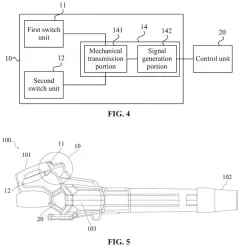
Chervon's second filing in our power tools and outdoor coverage since November follows a cruise control button for blowers, adding to the two applications we've tracked from the company.
Source: US 2026/0364761 A1 at the USPTO (PDF). Full patent text and figures are in the official publication.
Get our take in your Top Stories
Liked this breakdown? Add Patentlyze as a preferred source on Google, and our plain-English take shows up more often in your Top Stories the next time Chervon patent news breaks.
Add Patentlyze on Google
One click.
There are more where this came from
We read the new patents from Big Tech, carmakers and more and send you the ones worth knowing. Plain English, free, every week.
The drawings · 15 sheets
15 drawing sheets from US 2026/0364761 A1 · click any drawing to enlarge


Show the other 7 sheets


More from Chervon
All 2 Chervon patents →More in Gear
All 26 Gear patents →
Hilti
Hilti Patents a Nail Gun That Scans Its Fasteners Before Firing
Milwaukee
Milwaukee Tool Files Patent for Pipe Cameras That Label Rust, Cracks and Clogs
Stihl
Stihl Patents a Trimmer That Can Tell When Its Line Has Worn Too Short
Stihl
No comments yet