
Milwaukee
Milwaukee · Gear · Filed Jun 27, 2025 · USPTO published Nov 19, 2026 · This week's release
Milwaukee Tool Files Patent for Pipe Cameras That Label Rust, Cracks and Clogs
Milwaukee Tool wants its pipe cameras to do more than show you a murky tunnel: this patent has an AI model circle the rust, the crack or the clog and tell you what it thinks it is.
- Publication number
- US 2026/0370928 A1(US20260370928A1)
- Applicant
- Milwaukee Electric Tool Corporation
- Filed · Published
- Jun 27, 2025 · Nov 19, 2026
- Inventors
- Nikita Bhatt, Douglas R. Fieldbinder
- Status when we published
- Examiner raised objections; the company can respond
- Document
- 20 claims
- US classification
- 348/84
- Examiner
- SATTI, HUMAM M (Art Unit 2422)
- Parent application
- National Stage Entry of PCT/US2023/086279 (filed Dec 28, 2023)(PCTUS2023086279)
What Milwaukee's AI pipe camera actually does
Every time a plumber feeds a camera down a drain, the same moment repeats: a grainy, badly lit picture appears on a screen, and someone has to decide whether that dark blob is tree roots, a crack, or just a shadow.
Milwaukee Tool's patent application adds a second set of eyes. The camera sits on the end of a long cable, and software trained on labeled example photos looks at each image the camera sends back. It then draws a box around anything it recognizes and attaches a label, such as rust.
You still see the regular picture. The labels simply sit on top of it, along with a score showing how sure the software is. The filing says the point is to help when lighting is poor or when the person watching isn't confident about what they're seeing.
… access a machine learning model that has been trained on training data to generate classified feature data from an input image; apply the image to the machine learning model to generate classified feature data that indicate a classification of a region in the image …
Translation: The system uses trained artificial intelligence to analyze pipe photos and categorize what it sees.
How the camera tags damage and blockages on screen
The system has three basic parts: a cable pushed into a pipe, conduit or other hard-to-reach space, a camera on the far end of that cable, and a processor that runs a trained machine learning model (software that learned to recognize things by studying many labeled examples). The processor takes each camera image, runs it through the model, and produces classified feature data, which is the patent's term for labels attached to regions of the image.
The claims get specific about what those labels could say. They can flag an obstruction in a pipe and say what it's made of, such as dirt, sediment, plant debris or calcification. They can mark damage like a crack, fracture, rust or corrosion. They can also identify the material of the pipe itself.
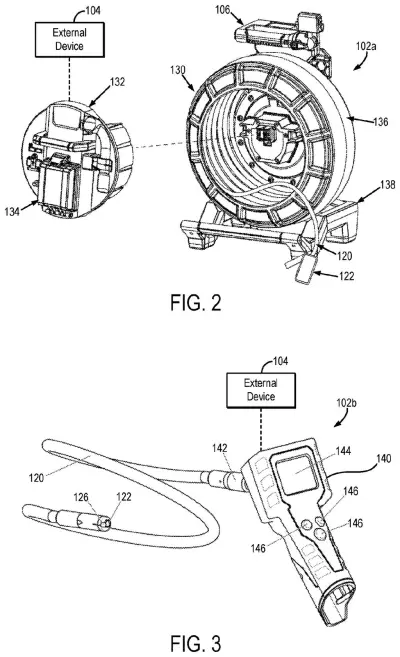
The labels can appear as bounding boxes, color-coded pixels or highlighted regions laid over the picture, along with a confidence score. The filing covers several hardware setups:
- A pipeline reel with a rotating drum and a detachable control hub
- A handheld borescope with its own built-in screen
- A separate monitor, phone or tablet that shows the results
The model can run on the tool itself or on an outside device or server. The description also covers letting users mark a label as wrong, so the model can be retrained, and tracking one object from frame to frame in video.
… an inspection camera tool (e.g., a pipeline inspection tool, a handheld inspection camera tool) having a cable configured to be directed into an interior space (e.g., a pipe, a conduit), where a camera disposed on a distal end of the cable is operable to capture an image …
Translation: A wired camera is pushed inside dark spaces like pipes and conduits to take pictures.
Why a second opinion matters inside a sewer line
If you hire a plumber or work in the trades, this could mean fewer arguments over what the camera is actually showing. A labeled image gives you something to point at when a crew explains why a section of pipe needs repair, and it may help newer techs who aren't yet sure what corrosion or a blockage looks like on a grainy screen.
This is a patent application, not a product, and it was initially rejected by the examiner, which is routine at this stage and usually followed by changes to the claims. The filing says nothing about how accurate the labels would be, and the idea of pairing a camera with image-recognition software is not exotic. What Milwaukee Tool is claiming is that combination built into its inspection gear.
Source: US 2026/0370928 A1 at the USPTO (PDF). Full patent text and figures are in the official publication.
Get our take in your Top Stories
Liked this breakdown? Add Patentlyze as a preferred source on Google, and our plain-English take shows up more often in your Top Stories the next time Milwaukee patent news breaks.
Add Patentlyze on Google
One click.
There are more where this came from
We read the new patents from Big Tech, carmakers and more and send you the ones worth knowing. Plain English, free, every week.
The drawings · 6 sheets
6 drawing sheets from US 2026/0370928 A1 · click any drawing to enlarge


More from Milwaukee
All 2 Milwaukee patents →More in Gear
All 26 Gear patents →
Hilti
Hilti Files Patent for a Lighter Piston Inside Its Hammer Drills
Greenworks
Greenworks Patents a Riding Mower With Motors Built Into Each Wheel and a Battery Mounted Below the Seat
Hilti
Hilti Files Patent for a Laser Surveyor That Works Out Where It's Standing
Makita
No comments yet