
Chervon
Chervon · Gear · Filed Sep 19, 2025 · USPTO published Nov 19, 2026 · This week's release
Chervon Patents a Cruise Control Button for Blowers and Other Power Tools
If you've ever kept a finger clamped on a trigger just to hold one steady speed, Chervon has a fix in mind: a button that freezes whatever speed you're running and lets you let go.
- Publication number
- US 2026/0370162 A1(US20260370162A1)
- Applicant
- Nanjing Chervon Industry Co., Ltd.
- Filed · Published
- Sep 19, 2025 · Nov 19, 2026
- Inventors
- Xiujian Wu, Wenfei Zhang, Jifeng Feng
- Status when we published
- Examiner raised objections; the company can respond
- Document
- 20 claims
- US classification
- 173/216
- Examiner
- AHMED, MOBEEN (Art Unit 3731)
What Chervon's trigger-lock button actually does
Most power tools today have two controls that don't talk to each other: a main trigger that sets the speed, and a separate button that holds a constant speed. According to the filing, once you've found the speed you like with the trigger, you have to keep squeezing it, so your hand is never free. And if you press the hold button, the speed changes on you anyway.
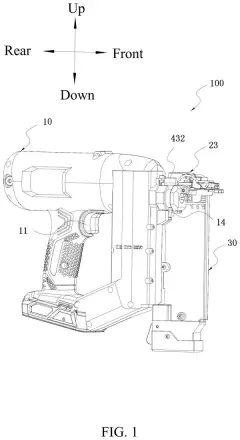
Chervon's patent application links the two controls. Get the tool running at the speed you want, tap the constant-speed button, and the motor holds that exact speed while you let go of the trigger. Tap again and it steps to the next preset speed, higher or lower depending on the setting. If the tool is stopped, the button starts it at a preset speed.
The filing also worries about accidents. Right after you press the button, the tool ignores the trigger for a short window, and it shrugs off tiny trigger bumps from vibration or your finger slowly easing off.
… control the electric motor to switch from a first rotational speed to a second rotational speed when the electric motor is in the constant speed operation mode …
Translation: It adjusts the motor speed when the tool is already running at a locked speed.
How the button reads your trigger and picks a speed
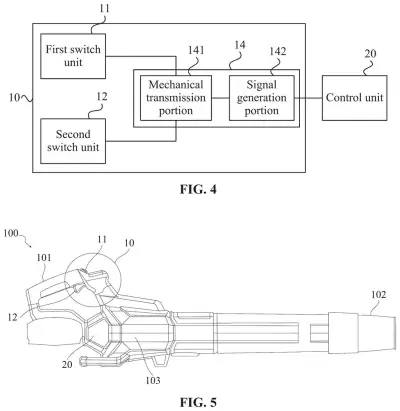
The tool has two modes. In variable speed mode, the motor follows your trigger: press harder, spin faster. In constant speed mode, the motor holds a set speed no matter what the trigger does. The patent covers the button (called the "first switch unit") that moves you between them and changes speed inside constant mode.
What the button does depends on what the tool is doing:
- Running on the trigger: it freezes the motor at its current speed and switches to constant mode.
- Already in constant mode: it steps to the nearest preset speed above or below, depending on whether it's set to upshift or downshift. Press past the top or bottom preset and the motor stops or drops to a crawl (the example threshold is 1 radian per second, a very slow spin).
- Stopped: it starts the motor at a preset speed.
The trigger has two zones. The first 70% of its travel adjusts speed smoothly (the example range is 13,000 to 17,000 rpm), and the last 30% is a "boost" zone at the motor's maximum.
To avoid accidental exits from constant mode, the controller ignores trigger signals for a preset period after the button press. It also ignores small trigger changes and readings below a threshold of 1 to 1.1 times the motor's speed when the trigger was operated. Pressing the button a preset number of times can add, delete or change a stored speed.
… if the electric motor is in the variable speed operation mode, control the electric motor to operate at a constant speed in the constant speed operation mode based on the first rotational speed …
Translation: It locks in whatever variable speed you currently have when you press the button.
Why a hands-free blower trigger matters to you
If you use a blower or another handheld tool for long stretches, this could save you a clamped finger. Set the speed once with the trigger, tap the button, and the tool keeps going while your hand relaxes. Because the button also steps through preset speeds, you could change speed without going back to the trigger.
The patent application also guards against the risk this creates: a tool that drops out of constant mode by accident because of vibration or a slip of the finger. As for status, the examiner's first review rejected the claims as filed, which is routine and usually followed by amendments, so the final wording may shrink. The filing doesn't announce a product.
Source: US 2026/0370162 A1 at the USPTO (PDF). Full patent text and figures are in the official publication.
Get our take in your Top Stories
Liked this breakdown? Add Patentlyze as a preferred source on Google, and our plain-English take shows up more often in your Top Stories the next time Chervon patent news breaks.
Add Patentlyze on Google
One click.
There are more where this came from
We read the new patents from Big Tech, carmakers and more and send you the ones worth knowing. Plain English, free, every week.
The drawings · 3 sheets
3 drawing sheets from US 2026/0370162 A1 · click any drawing to enlarge


More from Chervon
All 2 Chervon patents →More in Gear
All 26 Gear patents →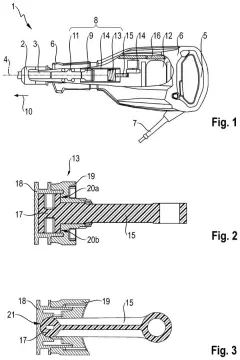
Hilti
Hilti Files Patent for a Lighter Piston Inside Its Hammer Drills
Greenworks
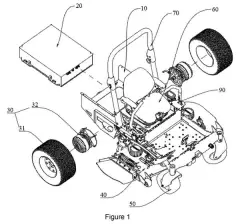
Greenworks Patents a Riding Mower With Motors Built Into Each Wheel and a Battery Mounted Below the Seat
Milwaukee
Milwaukee Tool Files Patent for Pipe Cameras That Label Rust, Cracks and Clogs
Hilti
No comments yet