
Stihl
Stihl · Gear · Filed Mar 20, 2026 · USPTO published Nov 19, 2026 · This week's release
Stihl Patents a Trimmer That Can Tell When Its Line Has Worn Too Short
Your string trimmer's line wears down while you work, and you usually find out only when the cutting gets sloppy. Stihl's filing has the tool work it out from its own motor.
- Publication number
- US 2026/0363164 A1(US20260363164A1)
- Applicant
- Andreas Stihl AG & Co. KG
- Filed · Published
- Mar 20, 2026 · Nov 19, 2026
- Inventors
- Lisa Katharina Hill, Klaus Kaupp
- Status when we published
- Waiting for an examiner
- Document
- 20 claims
- US classification
- 56/10.2R
What Stihl's worn-line detection does
Ever pulled the trigger on a string trimmer and wondered why it suddenly cuts like it's tired? Often the culprit is the little plastic line, which wears down to a stub and sweeps a much smaller circle than it should.
Stihl's patent application has the trimmer notice this by itself. Spinning a long line takes more effort from the motor than spinning a short one, so the tool compares how fast the line is turning with how much power the motor is using. No extra sensors are needed, because it relies on measurements the tool already makes.
The catch is that a trimmer's workload jumps around as you sweep through grass, lift off, and turn. So instead of trusting a single reading, it collects hundreds of them and only decides the line is too short when enough readings agree. Then it can light an LED on the shaft or, on models with automatic line feeding, let out more line.
… controlling a power of a motor of the line mower to set the mowing line into rotation for mowing and to tighten it by the rotation; capturing an actual rotational speed; and determining, using the actual rotational speed and the power of the motor whether the mowing line is too short; …
Translation: The system monitors motor speed and power to figure out when the string has worn down.
How the trimmer reads its own motor strain
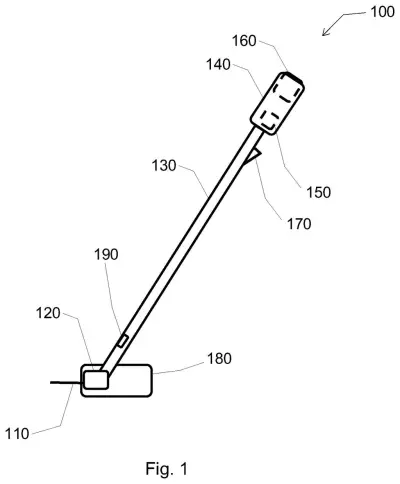
A string trimmer's control unit already steers the motor toward a target speed, which you set with a throttle lever, and it already measures the actual speed (the filing mentions Hall sensors or optical sensors). Stihl's method adds a check that compares the motor's power draw with a reference power for that speed. The reference can come from stored curves or from a simple formula.
Readings go haywire during start-up and when you lift the trimmer out of the grass, so the patent adds guardrails:
- Only count readings when speed and power are above minimums (the example uses 4000 rpm and 15 W) and the speed isn't changing fast.
- Skip readings when the actual speed overshoots the target, which happens right when the load drops off.
- Smooth values with a moving average (the average of the last few readings, to iron out blips).
The voting step is what the first claim covers. In the example, over 500 readings the unit sorts each estimated line length into buckets and flags the line when a bucket below 300 mm collects at least 80 hits. It keeps a rolling window, dropping the oldest reading as a new one arrives.
After you change the line, a calibration mode runs the motor at 600 W for about 5 seconds and records the speed, tuning the check to your line type. The filing calls all these figures examples. The other independent claims cover using the target speed and using a calibrated reference value.
The proposed method allows for a more reliable detection of whether the mowing line of a line mower is too short.
Translation: This new technique makes it much more dependable to spot when the trimmer string gets too short.
What this means for your next trimmer
A worn line is easy to miss. The trimmer still spins, but it cuts a smaller circle, so you make more passes and the job drags. A tool that warns you, or feeds out more line on its own, takes that guessing off your plate. The filing says the check works both in open air and while cutting, so you don't have to stop and test it.
Because the method uses speed and power the controller already tracks, it could work on both battery and gas models, and the filing covers both, with the warning delivered by a simple LED. A patent application is only a statement of an idea, and nothing in it says Stihl will sell this. It does show how the company thinks about keeping a trimmer cutting well without adding parts.
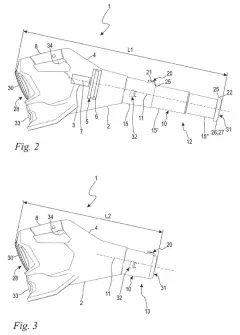
Stihl's second filing in our power tools & outdoor coverage since November follows a locking leaf blower tube and applies the same focus on simpler one-handed controls.
Source: US 2026/0363164 A1 at the USPTO (PDF). Full patent text and figures are in the official publication.
Get our take in your Top Stories
Liked this breakdown? Add Patentlyze as a preferred source on Google, and our plain-English take shows up more often in your Top Stories the next time Stihl patent news breaks.
Add Patentlyze on Google
One click.
There are more where this came from
We read the new patents from Big Tech, carmakers and more and send you the ones worth knowing. Plain English, free, every week.
The drawings · 2 sheets
2 drawing sheets from US 2026/0363164 A1 · click any drawing to enlarge


More from Stihl
All 2 Stihl patents →More in Gear
All 26 Gear patents →
Chervon
Chervon Patents a Nail Gun Depth Dial You Can Set With One Quick Turn
Hilti
Hilti Files Patent for a Surveying Laser That Rechecks Where It's Standing
Chervon
Chervon Patents a Cruise Control Button for Blowers and Other Power Tools
Hilti
No comments yet