
Ferrari
Ferrari · Automotive · Filed Mar 26, 2026 · USPTO published Nov 19, 2026 · This week's release
Ferrari Files Patent for Side Wings That Also Help Cool the Radiators
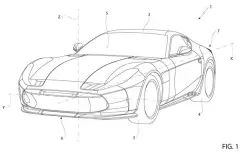
Ferrari has patented a small wing behind each rear wheel that does two jobs at once: it presses the car into the road and helps drag cooling air through a radiator. The trick is all in where the wing sits relative to the air duct.
- Publication number
- US 2026/0365261 A1(US20260365261A1)
- Applicant
- FERRARI S.P.A.
- Filed · Published
- Mar 26, 2026 · Nov 19, 2026
- Inventors
- Salvatore Sedda, Giuseppe Bagnardi, Matteo Biancalana, Stefano de Fabiis, Flavio Manzoni, Carlo Palazzani
- Status when we published
- Waiting for an examiner
- Document
- 18 claims
- US classification
- 296/1.01
How Ferrari's rear wing doubles as a cooling aid
Ever wondered why a fast car needs both big wings to stay glued to the road and big vents to keep its parts from overheating? Those are usually two separate jobs, and each one costs something, because both wings and vents add drag, the air resistance that slows a car down.
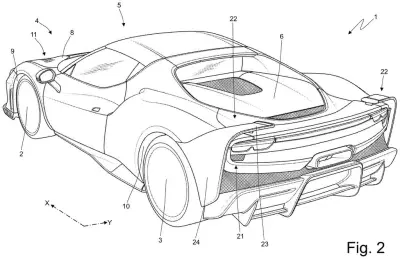
Ferrari's patent tries to make one piece of bodywork handle both. Behind each rear wheel, the car carries a small, flat wing. Right beneath it sits an air duct holding a radiator, the same kind of heat exchanger that keeps a regular car's engine from overheating. The duct's entrance sits just ahead of the wing, and its exit sits just behind.
As air rushes past, it piles up in front of the wing, which helps shove it into the duct. Behind the wing, the air thins out, which helps pull it back out. The result is more downforce (the downward push that keeps the tires gripping) and better cooling, without a bigger scoop.
… at least one lateral aerodynamic appendage provided with an airfoil, which is located higher than the inlet opening of the cooling duct, is shaped so as to generate a downforce, is oriented horizontally and is arranged at a given distance from the rest of the body so that the air can also flow under the airfoil.
Translation: A wing sits above the air intake to push the car down while letting air pass underneath.
How the wing, duct and panel line up
The claims describe a car with two lateral aerodynamic appendages, meaning small wings mounted on each side of the body. Each has a horizontal airfoil (a wing-shaped blade that generates downforce) held a short distance away from the body so air can flow underneath it.
Below each airfoil sits a cooling duct containing a radiator. The filing spells out the layout in some detail:
- The airfoil sits higher than the duct's inlet and farther back than it.
- A demarcation panel (a section of body panel) runs from the rear edge of the inlet to a spot under the airfoil, forming a channel for air to flow through.
- A formula ties together the wing's chord length (the straight-line distance from its front edge to its back edge), its distance from the inlet and the panel length, keeping the result between zero and one chord length.
Dependent claims add limits: the wing's front edge sits within 25 centimeters of the inlet's center, its back edge within 15 centimeters of the outlet's center, and its width stays under 40% of the car's width.
A separate independent claim covers a different idea: an upside-down L-shaped piece, with a vertical fin joined smoothly to the wing, mounted behind each rear wheel. The description says the cooling circuits could serve the electrical parts, such as the battery and motors.
Why cooling air matters to a fast Ferrari
Cooling is a quiet tax on any fast car. Radiators need air, and every vent that lets air in adds drag. If a wing that already has to be there can also help move air through the radiator, the car can get the cooling it needs with a smaller penalty, so it can keep more of its grip without giving up as much speed.
The filing describes a car with rear driven wheels, a central engine and cooling circuits that could serve electrical parts, which fits a high-performance road car. It also notes that some race-style tricks do not always pass road-legal safety rules. A design built around fixed, small side wings is meant to avoid that problem, though the filing does not say it has been tested against those rules.
Source: US 2026/0365261 A1 at the USPTO (PDF). Full patent text and figures are in the official publication.
Get our take in your Top Stories
Liked this breakdown? Add Patentlyze as a preferred source on Google, and our plain-English take shows up more often in your Top Stories the next time Ferrari patent news breaks.
Add Patentlyze on Google
One click.
There are more where this came from
We read the new patents from Big Tech, carmakers and more and send you the ones worth knowing. Plain English, free, every week.
The drawings · 9 sheets
9 drawing sheets from US 2026/0365261 A1 · click any drawing to enlarge


Show sheet 9

More from Ferrari
All 2 Ferrari patents →More in Automotive
All 432 Automotive patents →
Ford
Ford Patents a Way to Keep an EV Battery Cool After Part of It Fails
Tesla
Tesla Patents a Rear Wing That Hides Until the Car Needs It
Toyota
Toyota Patents a Dashboard Display That Shows Your Side Mirror Camera When You Signal
GM
No comments yet