
GM
GM · Automotive · Filed May 19, 2025 · USPTO published Nov 19, 2026 · This week's release
GM Files Patent for Warming a Cold EV Battery With the Car's Own Electronics
GM describes a way to warm a cold EV battery using electronics the car already has, by hunting for the one electrical rhythm that pushes the most current through it.
- Publication number
- US 2026/0370173 A1(US20260370173A1)
- Applicant
- GM Global Technology Operations LLC
- Filed · Published
- May 19, 2025 · Nov 19, 2026
- Inventors
- Neeraj S. Shidore, Abir Chatterjee, Mohammad N. Anwar, Suresh Gopalakrishnan, Chandra S. Namuduri, Renato Amorim Torres
- Status when we published
- Waiting for an examiner
- Document
- 20 claims
- US classification
- 318/473
What GM's battery-warming patent actually does
Ever notice your phone battery tank on a freezing day? Electric cars have the same weakness. A cold battery doesn't work as well, so the car would like to warm it up before you ask much of it.
GM's patent describes a way to do that with parts the car already carries. The motor controller (called the inverter) can send a rapid back-and-forth wobble of current toward the battery, and that wobble creates heat. The trick is the rhythm. Like pushing a kid on a swing, there is a timing where each push adds the most. The car tries a range of rhythms, measures how much current reaches the battery at each one, and locks onto the strongest.
Because the best rhythm can shift as the battery gets warmer, the car can run the test again and adjust.
sweeping a ripple current at an inverter of the vehicle through a plurality of frequencies, wherein the inverter is associated with the battery …
Translation: The system cycles electrical currents through different speeds to find the right frequency.
How the car finds its battery's sweet spot
The setup has three parts: a battery, an inverter (the box that turns the battery's one-way DC power into the alternating current a motor uses), and a processor. The processor tells the inverter to create a ripple current, a small repeating swing in current that travels back along the high-voltage wires to the battery. Current moving through the battery produces heat.
The key step is finding the best frequency:
- Sweep: the inverter steps through many frequencies while keeping the ripple the same size. The filing's example steps up by about 50 Hz every tenth of a second.
- Measure: a sensor on the battery records the current at each frequency.
- Pick: the frequency with the biggest battery current is the resonance frequency (the rhythm where the circuit naturally boosts the swing). In the example, the peak is about 275 amps at roughly 600 Hz. A separate graph shows a resonant peak near 1.2 kHz with a gain of about 2.5.
- Run: the inverter then operates at that frequency to heat the battery.
The ripple comes from running the inverter's switches out of step with each other, which makes an unbalanced current at the motor. It is injected along a particular electrical direction in the motor (the d-axis). Setting its main frequency equal to, or half of, the resonance frequency gives the most gain at the battery while imparting no motion at the motor, per the filing.
For cars with two motors, the system runs the sweep on each inverter and picks the one with the highest peak. It can also set the frequency and the timing offset between the two motors, and it can repeat the sweep as the battery warms.
… determines a resonance frequency of the ripple current for which the magnitude of the battery current is a maximum …
Translation: It identifies the exact electrical frequency that creates the most heat.
What this means for cold-weather EV driving
If you drive an electric car somewhere cold, battery temperature affects how the car behaves on a freezing morning. GM's filing says cold conditions affect battery operation and that the goal is to bring the battery to its best operating temperature. The approach reuses the inverter, the motors and a battery current sensor, so the heating is a software-driven job for hardware already in the car.
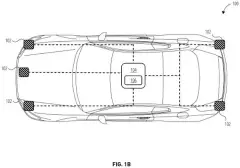
The description covers multi-motor cars, with a front motor and two rear motors as its example. It gives no heat-up times, energy figures or comparisons, so there is no way to say how much faster it would warm a battery than other methods. It is also a patent application, which doesn't mean it will end up in a car.
Source: US 2026/0370173 A1 at the USPTO (PDF). Full patent text and figures are in the official publication.
Get our take in your Top Stories
Liked this breakdown? Add Patentlyze as a preferred source on Google, and our plain-English take shows up more often in your Top Stories the next time GM patent news breaks.
Add Patentlyze on Google
One click.
There are more where this came from
We read the new patents from Big Tech, carmakers and more and send you the ones worth knowing. Plain English, free, every week.
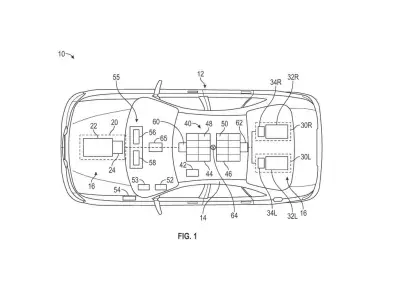
The drawings · 7 sheets
7 drawing sheets from US 2026/0370173 A1 · click any drawing to enlarge


More from GM
All 10 GM patents →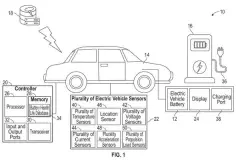
More in Automotive
All 432 Automotive patents →
Hyundai & Kia
Kia Patents a Battery Check That Waits Before Crying Wolf on Your EV
Tesla
Tesla Patents a Fallback for When Part of Its Car Screen Fails
Honda
Honda Patents a Car That Turns Its Windows and the Ground Into a Drawing Board
Nvidia
No comments yet