
Ferrari
Ferrari · Automotive · Filed May 12, 2026 · USPTO published Nov 19, 2026 · This week's release
Ferrari Patents a Suspension That Tilts the Front Wheels Without a Bulky Extra Arm
Ferrari wants to change how a car's front wheels lean without bolting an extra motorized arm to each one. Its answer is to let two mounting points on the existing suspension slide.
- Publication number
- US 2026/0364988 A1(US20260364988A1)
- Applicant
- FERRARI S.P.A.
- Filed · Published
- May 12, 2026 · Nov 19, 2026
- Inventors
- Alberto BODINI, Isabel RAMIREZ RUIZ
- Status when we published
- Waiting for an examiner
- Document
- 9 claims
- US classification
- 280/124.138
What Ferrari's wheel-tilting suspension does
You're coming into a tight corner in a Ferrari, and the front tires need to lean just the right amount to grip the road. Carmakers can adjust that lean with motors, but the usual way adds a separate arm between each wheel and the body of the car.
Ferrari's filing drops that extra arm. Each front wheel is already held by two A-shaped frames, one above and one below, and each frame is built from two rods. Ferrari lets the two ends of the upper frame's rods, where they attach to the car's body, slide forward or back. Move them, and the wheel's mounting point shifts, which tilts the wheel.
Ferrari's stated goal is a narrower setup with less weight hanging off the wheel, so the car can reshape how its tires meet the road using parts that are already there.
… at least each suspension of the front wheels comprises an upper triangle and a lower triangle with corresponding vertices connected to the corresponding wheel on opposite sides along the direction Z with respect to the centre of the wheel and opposite base ends connected to the chassis in a rotating manner along the direction X.
Translation: The front suspension uses upper and lower triangular arms that attach above and below the wheel.
How two sliding rod mounts tilt the wheel
The patent covers a road vehicle whose front suspension uses a double-triangle layout. Each wheel hangs from an upper and a lower triangle (two rods each, meeting at a point that attaches to the hub carrier, the part that holds the wheel). The base ends hinge on the chassis so the wheel can move up and down over bumps.
The change sits in the upper triangle. At least one of its two rod ends on the chassis can slide along the car's length, nose to tail. Starting from a neutral position, sliding changes where the triangle's point sits, and that changes the wheel's camber (how far the top of the wheel leans in or out) and its caster (how far the steering axis leans forward or back).
The filing describes three cases:
- Both ends slide apart together, which moves the point sideways only and changes camber alone.
- Both ends slide the same distance in the same direction, which moves the point fore and aft only and changes caster alone.
- The ends move independently by different amounts, which changes both angles.
One actuator (a motor or similar driver) on the chassis can move both ends together, or each end can get its own. The description says the same idea can apply to the lower triangle, and that it also gives control over the kingpin angle, scrub radius and caster trail, which are other steering geometry settings.
What this means for Ferrari's road cars
For you, the benefit would show up in how a car carries itself on the road, if a car were ever built this way. Ferrari says the design saves space across the width of the car and cuts unsprung mass, the weight the springs don't support. Engineers try to keep that number low because a lighter wheel assembly can follow the road surface more closely.
The filing is aimed at sports road vehicles. It names no model, gives no performance figures, and says nothing about timing. It is a patent application, so it shows an engineering direction and says nothing about a product plan.
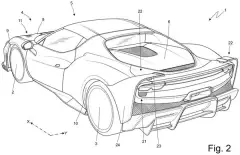
Ferrari's second patent application in our Ferrari coverage since November follows the side wings cooling filing in the two we've tracked.
Source: US 2026/0364988 A1 at the USPTO (PDF). Full patent text and figures are in the official publication.
Get our take in your Top Stories
Liked this breakdown? Add Patentlyze as a preferred source on Google, and our plain-English take shows up more often in your Top Stories the next time Ferrari patent news breaks.
Add Patentlyze on Google
One click.
There are more where this came from
We read the new patents from Big Tech, carmakers and more and send you the ones worth knowing. Plain English, free, every week.
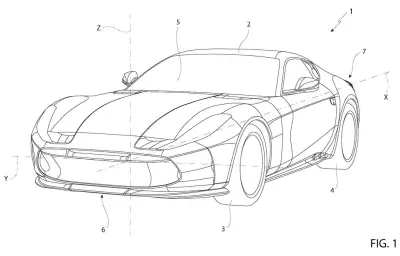
The drawings · 6 sheets
6 drawing sheets from US 2026/0364988 A1 · click any drawing to enlarge


More from Ferrari
All 2 Ferrari patents →More in Automotive
All 432 Automotive patents →
Hyundai & Kia
Kia Files Patent for EVs That Coast Down to the Right Speed Before Curves
Mobileye (Intel)
A New Intel Self-Driving Tech Patent Uses Other Drivers' Paths to Find Where Lanes Split and Merge
Amazon
Amazon Unit Zoox Files Patent for Maps That Draw Their Own Lane Lines
Qualcomm
No comments yet