
Hyundai & Kia
Hyundai & Kia · Automotive · Filed Nov 13, 2025 · USPTO published Nov 19, 2026 · This week's release
Kia Patents a Battery Check That Waits Before Crying Wolf on Your EV
Most cars flag a battery fault the moment one reading crosses a line. Kia's patent application adds a gray zone, so a single blip no longer sets off an alarm.
- Publication number
- US 2026/0365074 A1(US20260365074A1)
- Applicant
- KIA CORPORATION
- Filed · Published
- Nov 13, 2025 · Nov 19, 2026
- Inventors
- Ki Young Lee, Yoon Sung Choi, Jae Won Kim
- Status when we published
- Examiner raised objections; the company can respond
- Document
- 20 claims
- US classification
- 701/1
- Examiner
- STRYKER, NICHOLAS F (Art Unit 3665)
How Kia's battery gray zone cuts false alarms
Every time you drive an electric or hybrid car, a battery computer keeps checking the pack's temperature, voltage and electrical resistance. The usual rule is blunt: if a reading crosses a set line, the car flags a fault. A flaky sensor or a brief spike can trigger a warning even when nothing is wrong, and false alarms cost owners and carmakers real money.
Kia's patent application adds a gray zone between "normal" and "fault." A reading that lands in that zone does not raise an alarm right away. Instead, the system keeps a tally of how many times it happens and how long the battery stays there. Only when the count or the time passes a limit does the car send out an alert.
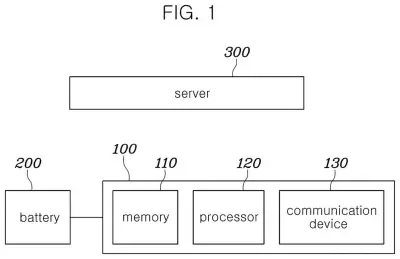
A server can also move the fault line, using data from many cars plus your car's type, mileage and age.
… a processor configured to determine whether the battery is abnormal based on a number of times and a duration that the state information values of the battery are included in a preset abnormality interval; …
Translation: The car waits to see if a battery issue happens repeatedly before flagging a real problem.
How the car counts and times borderline readings
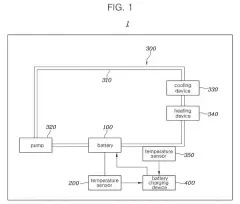
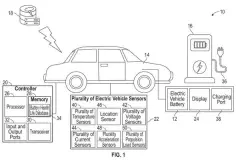
The filing describes a battery monitor with three parts: a memory that logs the battery's temperature, voltage and resistance over time, a processor that judges whether something is wrong, and a communication device that sends the result to an outside device, such as another controller in the car or a server.
The key idea is the abnormality interval, a band set between the battery's normal operating limit and the diagnostic trouble code (DTC) trigger threshold (the point where a car normally stores a fault code and lights a warning). Readings that fall in the band get counted, and the time spent there gets added up. The battery is judged abnormal when either the count or the total time passes a preset limit.
The filing applies this to several checks:
- Over-temperature, using the maximum operating temperature and an upper limit
- Over-voltage and under-voltage, using the upper and lower voltage limits
- Low resistance, such as weak insulation around the main relay (the switch that connects the battery to the car), which can cause leakage current
Two extras are described. First, the processor can skip a stored reading that jumps sharply from the readings right before or after it, treating it as likely sensor noise. Second, a server can adjust the DTC threshold using data from many vehicles and each car's type, mileage and age, narrowing the gray zone for older or high-mileage cars.
An apparatus for managing a battery in an electrified vehicle includes a memory configured to store state information values including temperature, voltage, and resistance of the battery of the electrified vehicle over time.
Translation: The system keeps a historical log of the battery pack's vital signs like heat and voltage.
What this means for EV owners and repair bills
For you, the practical gain is fewer pointless warnings. A battery warning can mean a dealer visit, a tow or a pack inspection, so a car that waits for a pattern before sounding the alarm could save owners and carmakers from unnecessary repairs. The filing says it wants to reduce over-diagnosis caused by sensor errors and brief disturbances.
The server piece also lets the rules adapt as fleets age and as more data comes in. The examiner's first review rejected the claims as filed, which is routine at this stage and usually followed by amendments. The filing gives no real threshold numbers and names no specific Kia or Hyundai model.
Hyundai's sixth filing since November in our Hyundai coverage adds to a run that includes a hydrogen camping power patent and a charge-to-100% dashboard warning.
Source: US 2026/0365074 A1 at the USPTO (PDF). Full patent text and figures are in the official publication.
Get our take in your Top Stories
Liked this breakdown? Add Patentlyze as a preferred source on Google, and our plain-English take shows up more often in your Top Stories the next time Hyundai & Kia patent news breaks.
Add Patentlyze on Google
One click.
There are more where this came from
We read the new patents from Big Tech, carmakers and more and send you the ones worth knowing. Plain English, free, every week.
The drawings · 5 sheets
5 drawing sheets from US 2026/0365074 A1 · click any drawing to enlarge


More from Hyundai & Kia
All 15 Hyundai & Kia patents →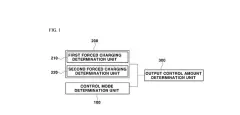
More in Automotive
All 432 Automotive patents →
Waymo (Google)
Waymo Files Patent to Turn a Car's Sensor Washing Into a Health Check
Nvidia
Nvidia Files Patent for a Self-Check in Cars That Aren't Sure Where They Are
Ford
Ford Patents a Way to Keep an EV Battery Cool After Part of It Fails
GM
No comments yet