
Tesla
Tesla · Automotive · Filed May 15, 2025 · USPTO published Nov 19, 2026 · This week's release
Tesla Patents a Fallback for When Part of Its Car Screen Fails
If one chip behind a car screen dies, the whole display can go with it. Tesla's patent application has the screen give up a section and keep your speed and warnings alive.
- Publication number
- US 2026/0369193 A1(US20260369193A1)
- Applicant
- Tesla, Inc.
- Filed · Published
- May 15, 2025 · Nov 19, 2026
- Inventors
- Edoardo Rundeddu, Yiting Huang
- Status when we published
- Approved; patent expected soon
- Document
- 19 claims
- US classification
- 345/204
- Examiner
- ALMEIDA, CORY A (Art Unit 2628)
What Tesla's failing-screen backup plan actually does
Every time you glance at a car screen to check your speed, you're trusting a chain of small chips to all be working at once. On big screens, several driver chips are often linked in a row, each handling one slice of the picture and the touch sensing for that slice. If one slice fails, the problem can spread down the row and take the whole display with it.
Tesla's patent application describes a controller that watches for error reports from those chips. When it spots a failure, it unlinks the row, switches off the broken chip and its slice of the screen, and sends the most important content to a slice that still works. That means things like your speed, warning lights, turn signals and navigation. Entertainment and games lose out.
The filing also covers touch buttons, so you could still tap a control on the backup slice, plus a message telling you something is wrong.
… reconfigure the plurality of DDICs from a cascaded configuration to a non-cascaded configuration, wherein in the non-cascaded configuration at least the first DDIC is disabled; and cause higher priority content to be displayed by the second display portion …
Translation: It shuts down the broken screen section and shifts important information over to the working part of the display.
How Tesla's controller reroutes the screen chips
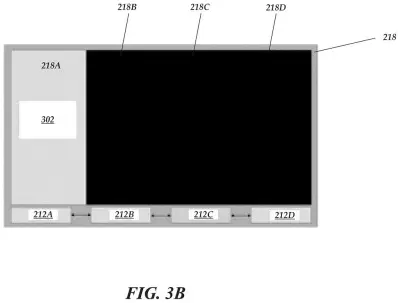
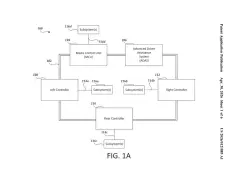
The setup starts with a display driver chip (called a DDIC), a small chip that draws the picture on one section of a screen and reads touches there. On big screens, several of these are cascaded, meaning wired in a chain where each one depends on its neighbors. That is why one failure can spread.
A controller (the car's main small processor) reads error reports that the chips write into status registers (small memory slots). Some reports come from forward error correction checks, a method that catches bad output. The controller can also test chips by turning them on one at a time and checking their video and touch responses.
When it finds a fault, the claims call for these steps:
- Switch the chips from a cascaded setup to a non-cascaded one, with the faulty chip disabled.
- Show higher priority content (safety information, controls, emergency notices, navigation) on a section that still works.
- Optionally, confirm the healthy section works first, reset the chips before disabling others, and tell the remaining chips to ignore the dead ones so they don't raise false alarms.
The description says the chips can be switched off by setting GPIO pins (simple electrical on/off wires) or by programming registers. The moved content can include touchable controls and a warning about the fault itself.
… accesses error status information associated with the one or more display panels, the first DDIC, and the second DDIC; and determines a fault associated with the first display portion. In response to the determination, the controller causes higher priority content to be displayed by the second display portion.
Translation: The system constantly monitors the hardware for damage and automatically reroutes critical dashboard data when something breaks.
Why a half-working screen beats a dead one in a Tesla
In a car, the screen is more than entertainment. It shows your speed, turn signals and warnings you are expected to see. A design that fails gracefully, losing a section but keeping the essentials, matters most on large screens. The filing uses an electric vehicle with a center display and an instrument cluster as its example, and it says the idea could also apply to home entertainment systems or building displays.
The patent office has approved this application, and once Tesla pays the final fee it should be issued as a granted patent. Until then it is still a filing, and the document describes no product, price or launch date.
This is the 58th Tesla filing we've tracked since May in our Tesla coverage, which has included applications like the air suspension valves and the sprayed seat surfaces.
Source: US 2026/0369193 A1 at the USPTO (PDF). Full patent text and figures are in the official publication.
Get our take in your Top Stories
Liked this breakdown? Add Patentlyze as a preferred source on Google, and our plain-English take shows up more often in your Top Stories the next time Tesla patent news breaks.
Add Patentlyze on Google
One click.
There are more where this came from
We read every patent application Big Tech publishes and send you the ones worth knowing. Plain English, free, every week.
The drawings · 6 sheets
6 drawing sheets from US 2026/0369193 A1 · click any drawing to enlarge


More from Tesla
All 59 Tesla patents →
More in Automotive
All 377 Automotive patents →
Intel
Intel Patents a Car Infotainment System That Keeps Your Screen on When the GPU Fails
Apple
Apple Files Patent for Setting Up a Digital Car Key With a Card Tap
Intel
Intel Patents a Way to Stream Every Car Screen to Remote Engineers at Once
Sony
No comments yet