
Google
Google · AI / ML · Filed May 14, 2025 · USPTO published Nov 19, 2026 · This week's release
Google Files Patent for Ads That Blend Into AI Search Answers
Google has filed a patent application for an AI search assistant that writes ads into its own answers, so a sponsored link can read like part of the reply instead of sitting in a box beside it.
- Publication number
- US 2026/0368496 A1(US20260368496A1)
- Applicant
- Google LLC
- Filed · Published
- May 14, 2025 · Nov 19, 2026
- Inventors
- Matthias Heiler, Shashidhar Anil Thakur, Dorothea Wiesmann Rothuizen, Vivek Rao
- Status when we published
- Waiting for an examiner
- Document
- 20 claims
- US classification
- 706/11
What Google's ad-in-the-answer patent does
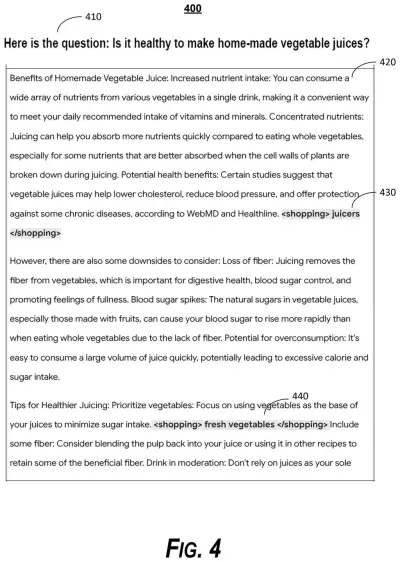
Someone types a question into an AI search box: is it healthy to make vegetable juice at home? The assistant writes back a few paragraphs. Inside them, the name of an ingredient is a link where you can buy it.
That is the idea in this Google patent application. Instead of putting a banner or a boxed ad beside the answer, Google describes rewriting the advertiser's content so it reads like part of the answer. The filing says people learn to ignore anything that looks like a typical ad, so the goal is to make sponsored content look organic and less intrusive.
For you, that could mean an AI answer carrying a sponsored link, image or short video that matches the tone of the text around it. The filing's own example is a juice recipe with a shopping link for every ingredient.
… generate a preliminary response and a full answer to a first query; a first machine-learned model, wherein the first machine-learned model is configured to generate a proxy phrase based on a long-form content; and a second machine-learned model …
Translation: The system uses two separate AI models to pick keywords and shape external content before blending it in.
How a short keyword phrase finds the ad
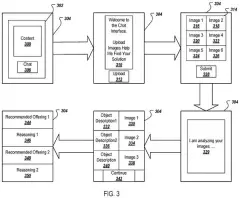
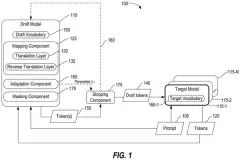
Google's filing describes a pipeline that runs behind an AI search assistant (a chatbot-style search tool that writes full answers instead of listing links). The assistant first produces a preliminary response. That can be a cached answer to a similar earlier question, a best guess, a summary of key points, or the first paragraph of the answer.
From there, the steps look like this:
- A first model boils the preliminary response down to a proxy phrase, a handful of keywords (the filing says fewer than six) that capture what you want. Its example turns "leather pants men fashion nova" into "men's leather pants fashion nova."
- That phrase goes to a content server (an ad backend), which returns a content item such as a text ad, image or video. The filing says these servers handle short phrases well but can pick irrelevant items when fed long text.
- A second model rewrites the content item to fit the answer, taking its tone into account, and decides where to place it. The result can be text with a link, an image or a video.
The ad lookup runs in parallel with writing the full answer, so you are not kept waiting. The first model can also judge whether the answer involves a product or service at all. If it does not, no link is added. The assistant then combines the rewritten media with the full answer into the final reply. The filing also mentions filters for brand safety and inappropriate content.
… process, using the second machine-learned model, the first content item and the full answer to generate a final answer to the first query.
Translation: The final step combines the ad content with the AI answer so everything flows together smoothly.
Why ads inside AI answers matter for search
If you use AI search, this filing shows one way those answers could carry ads. Search has long run on ads, and a chatbot-style answer has no obvious slot for one. The filing's fix is to put the ad inside the answer: a link on an ingredient, a product image, or a short video, written to match the tone of the text.
For Google's ad business, the useful part is the plumbing. The filing says existing ad servers are built for short phrases, so the first model translates a long answer into a few keywords. That lets the current ad machinery plug into AI answers. The filing also describes a check that leaves links out when the answer has nothing to do with a product or service.
This is the 99th filing from Google in AI assistant and agent coverage we've tracked since May, joining one on speeding up chatbots and one on shrinking example lists.
Source: US 2026/0368496 A1 at the USPTO (PDF). Full patent text and figures are in the official publication.
Get our take in your Top Stories
Liked this breakdown? Add Patentlyze as a preferred source on Google, and our plain-English take shows up more often in your Top Stories the next time Google patent news breaks.
Add Patentlyze on Google
One click.
There are more where this came from
We read every patent application Big Tech publishes and send you the ones worth knowing. Plain English, free, every week.
The drawings · 14 sheets
14 drawing sheets from US 2026/0368496 A1 · click any drawing to enlarge


Show the other 6 sheets


More from Google
All 1,127 Google patents →
More in AI assistant & agent
All 436 AI assistant & agent patents →
Microsoft
Microsoft Patents a System That Tests AI Setups Before Committing to Them
Samsung
Samsung Files Patent for a Wearable That Remembers Where You Left Your Wallet
Samsung
Samsung Files Patent for a Phone That Builds Its Own Shortcuts From Your Chats
Qualcomm
No comments yet