
Microsoft
Microsoft · AI / ML · Filed May 7, 2025 · USPTO published Nov 12, 2026 · This week's release
Microsoft Patents a System That Tests AI Setups Before Committing to Them
Before an AI assistant ever talks to a customer, Microsoft's patent application has a program rehearse many ways of answering, then builds a router that picks the best one for each question.
- Publication number
- US 2026/0359087 A1(US20260359087A1)
- Applicant
- Microsoft Technology Licensing, LLC
- Filed · Published
- May 7, 2025 · Nov 12, 2026
- Inventors
- Prasoon PATIDAR, Alexander Steven Crown, Tsu-wang Hsieh, Yifei Xu, Tusher Chakraborty, Leonardo De Oliveira Nunes, Ranveer Chandra
- Status when we published
- Waiting for an examiner
- Document
- 20 claims
- US classification
- 703/23
What Microsoft's AI practice arena actually does
A shopper at a store kiosk asks whether wireless noise-canceling headphones under $200 are in stock. Behind the screen, an AI assistant has to make a call: answer on the kiosk's own small chip, or send the question to a much bigger AI in the cloud? Choose wrong and the answer is slow, off-target, or expensive to produce.
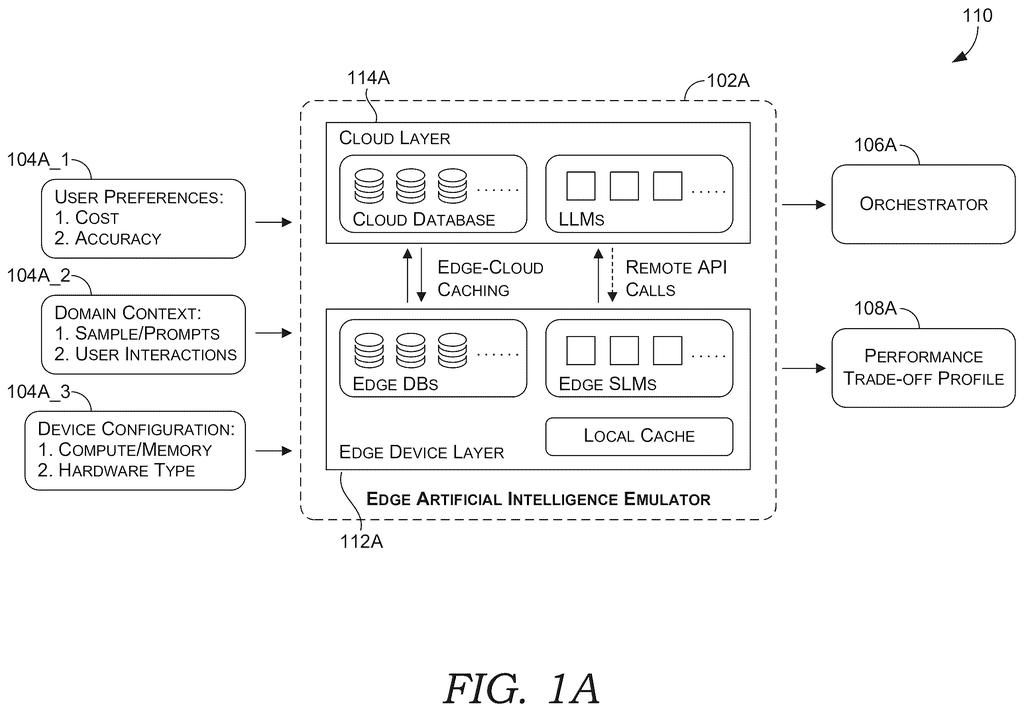
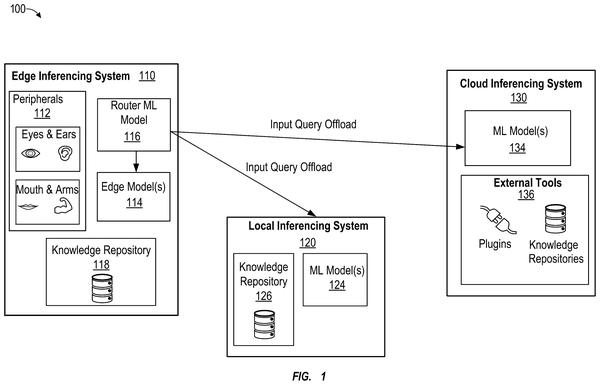
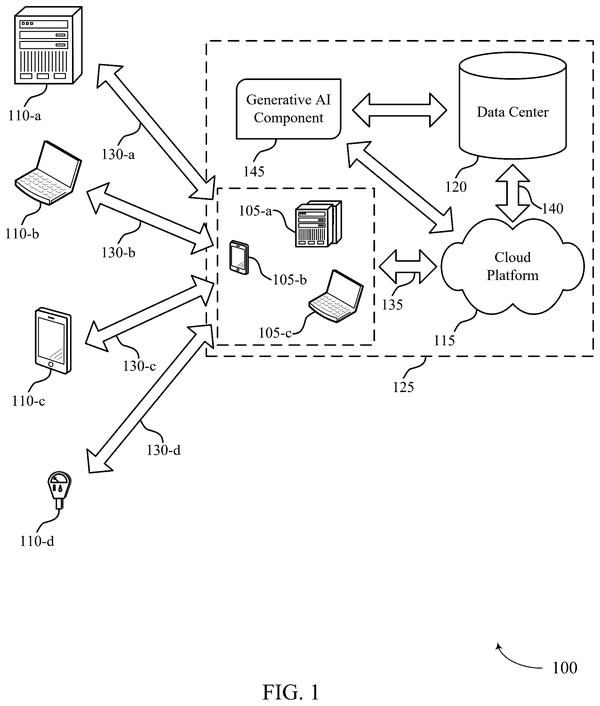
Microsoft's patent application describes a practice arena for making that choice. Before a company launches its assistant, the system simulates the kiosk, the cloud, and the connection between them. It then tries many combinations of tools and measures how accurate, fast, and costly each one is.
Once the assistant goes live, a small traffic director built from those tests sends each question down the route that fits what you asked, the device you're using, and your connection. Engineers no longer have to test every combination by hand.
… simulating interactions of a hybrid edge-cloud computing environment, wherein the interactions are associated with functionality of the artificial intelligence system …
Translation: It tests how the AI setup will behave in mixed local and cloud settings before actual deployment.
How the emulator scores each answer route
The system starts with a configuration profile (a settings file) that describes one specific AI assistant. It captures what the owner cares about, such as accuracy, cost, and speed, plus the subject area the assistant covers and the hardware it runs on.
Using that profile, an emulator (a testing program that imitates the real setup) simulates how a small AI model on the local device and a large model in the cloud would work together. The simulation includes saving repeat answers and making remote calls. It tries different combinations of the steps that make up an answer:
- User input, then query clean-up such as adding synonyms
- Context retrieval (looking up relevant documents in a database, often called RAG, or retrieval-augmented generation)
- Post-retrieval filtering and re-ranking of what was found
- A model query, sent to either the local model or the cloud model
- The final response
From those tests the emulator produces two things. One is an orchestrator, a lightweight router that picks the best path for each live question. The other is a performance trade-off profile, a report scoring the paths on accuracy, cost, and latency (delay). The filing says the router uses unsupervised methods (techniques that find patterns without labeled examples), such as clustering and similarity matching. If a path misses its speed or accuracy goal, the system can reroute the question.
… automates performance trade-off profiles evaluation of various component combinations to optimize edge AI systems …
Translation: The software automatically compares different parts to find the best balance of speed and cost.
Why cheaper AI answers matter for stores and banks
If you've ever waited on a slow chatbot, or seen a company cut an AI feature because the bills got too high, this is the problem the filing targets. Its examples have simple questions answered on the device itself, such as a cached account balance, while harder ones go to a bigger AI in the cloud.
For businesses, the pitch is skipping manual testing and paying for cloud AI only when a question needs it. The description also says the system can reroute a question if a path misses its speed or accuracy target, and that it can be updated as models change. For you, the best case is quicker answers from kiosks and apps, even on a weak connection.
Microsoft's 47th filing we've tracked since May on AIs working in teams builds on earlier ideas like one model gaining specialties and two small AIs sharing tasks.
Source: US 2026/0359087 A1 at the USPTO (PDF). Full patent text and figures are in the official publication.
Get our take in your Top Stories
Liked this breakdown? Add Patentlyze as a preferred source on Google, and our plain-English take shows up more often in your Top Stories the next time Microsoft patent news breaks.
Add Patentlyze on Google
One click.
There are more where this came from
We read every patent application Big Tech publishes and send you the ones worth knowing. Plain English, free, every week.
The drawings · 13 sheets
13 drawing sheets from US 2026/0359087 A1 · click any drawing to enlarge


Show the other 5 sheets


More from Microsoft
All 646 Microsoft patents →
More in AI assistant & agent
All 413 AI assistant & agent patents →
Google
Google Patents an AI Chatbot That Creates Images Between Lines of Its Answer
Apple
Apple Files Patent for a Switchboard That Routes App Questions to the Right AI Model
Qualcomm
A New Qualcomm Patent Has Your Phone Decide Which AI Questions Need the Cloud
Salesforce
No comments yet