
Samsung
Samsung · AI / ML · Filed May 5, 2026 · USPTO published Nov 12, 2026 · This week's release
Samsung Files Patent for a Wearable That Remembers Where You Left Your Wallet
Samsung's filing describes a wearable that writes down what you see and hear as you go about your day. Later, you could ask it where you left your wallet or whether you took your pills.
- Publication number
- US 2026/0359303 A1(US20260359303A1)
- Applicant
- Samsung Electronics Co., Ltd.
- Filed · Published
- May 5, 2026 · Nov 12, 2026
- Inventors
- Zhongyang Zhang, Yu Zhang, Hao Chen, Han Wang, Priyabrata Parida
- Status when we published
- Waiting for an examiner
- Document
- 20 claims
- US classification
- 715/256
- Parent application
- Claims priority from a provisional application 63801667 (filed May 7, 2025)
What Samsung's memory glasses would do for you
A pair of smart glasses watches you set your wallet on the kitchen counter. An hour later you are searching the house, and the glasses have no idea where it went. Samsung's patent describes a way to give wearables a real memory.
The idea is that your wearable would turn what it sees and hears into short written notes, then file them in an organized map of people, objects and moments. Later you could ask a plain question like "Where did I leave my glasses?" and get an answer such as "On the living room couch at 3:45 PM yesterday."
The filing also lists uses like tracking medication, recalling what was agreed in a meeting, or counting how many times you worked out last month. Because it stores written notes instead of raw video, it is meant to fit on a small, battery-limited device.
… transforming, by the first electronic device, the unstructured sensor data into structured text-based data using a vision language model (VLM) and a large language model (LLM); …
Translation: The wearable uses advanced AI to turn raw camera footage and sensor readings into clear notes about what you are doing.
How the AI turns video and sound into notes
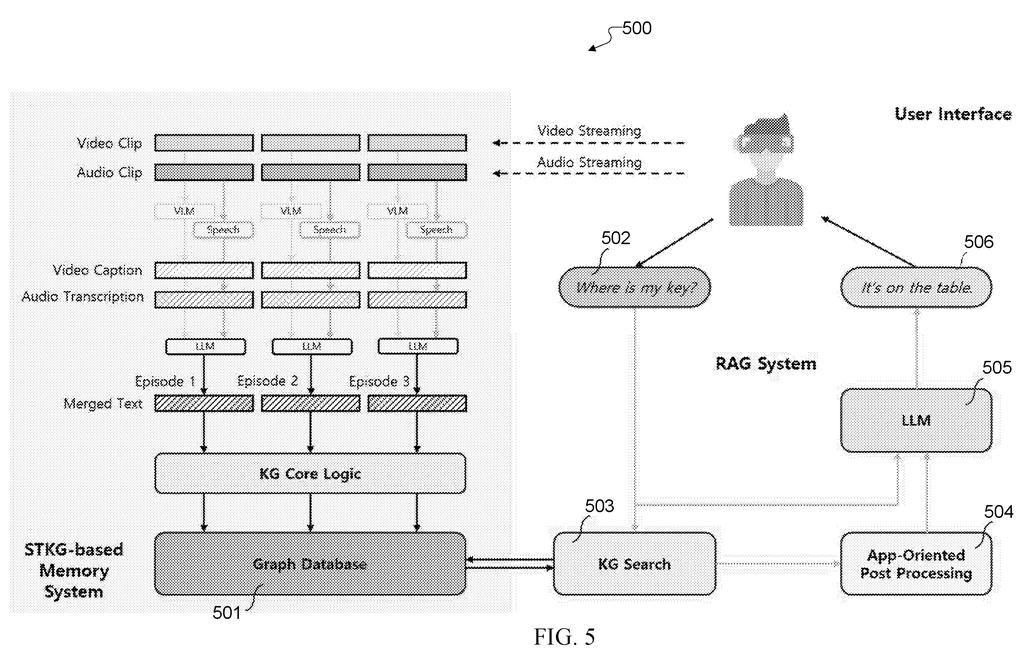
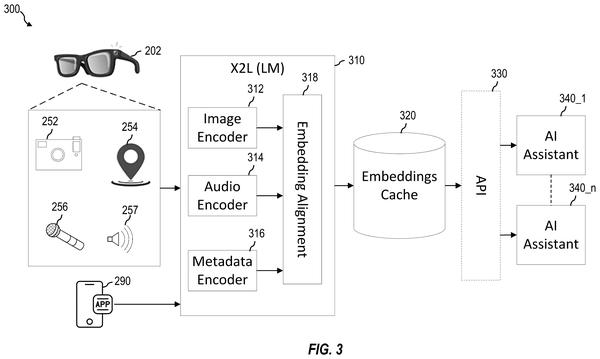
The patent covers a three-stage pipeline. First, a wearable's camera and microphone collect raw video and audio. To save battery, the camera can switch on only when something significant happens (a motion sensor noticing movement, for example), and the device can send fewer video frames off for processing.
Second, a vision language model (an AI that describes images in words) captions the video clips, and a speech model transcribes the audio. A large language model (the type of AI behind chatbots) then cleans up the two and lines them together into one written "episode." If nobody else is on screen, it assumes the voice belongs to the wearer.
Third, the episodes go into a spatial-temporal knowledge graph, a web of linked notes:
- Episode nodes hold the written description of each moment.
- Entity nodes stand for objects and people pulled from those descriptions, with details like "green cup."
- Edges link episodes to the things in them, and things to each other.
- History times record each appearance, so the system can count events.
When new episodes arrive, the AI checks whether an object is new or already known, and merges duplicates to keep the web small. To answer a question, the system converts it into numbers (so it can be compared with the stored notes), finds the closest matches, and has the language model write a reply.
… storing, by the first electronic device, the structured text-based data using a spatial-temporal knowledge graph (STKG).
Translation: It organizes those notes into a smart memory map that tracks where and when you interacted with your belongings.
Why a wearable that remembers cuts both ways
If this ever shipped on glasses or a headset, you could ask your wearable where you left your wallet, whether you took your morning pills, or what a client agreed to in last week's meeting. The filing's examples lean on older users, professionals and students, which tells you the pitch is a memory aid for ordinary life.
The uncomfortable side is obvious: a device that records your surroundings also records everyone near you. The filing text does not address consent or privacy. It does describe keeping short text instead of raw footage, which lightens storage on a small device, and recording only when sensors detect an event. Whether any of this becomes a product is unknown. This is a patent application describing a design, not a release.
Samsung's 32nd filing we've tracked since June in our AI assistants that learn about you watchlist builds on rewriting vague questions with phone data and suggesting what to search for.
Source: US 2026/0359303 A1 at the USPTO (PDF). Full patent text and figures are in the official publication.
Get our take in your Top Stories
Liked this breakdown? Add Patentlyze as a preferred source on Google, and our plain-English take shows up more often in your Top Stories the next time Samsung patent news breaks.
Add Patentlyze on Google
One click.
There are more where this came from
We read every patent application Big Tech publishes and send you the ones worth knowing. Plain English, free, every week.
The drawings · 7 sheets
7 drawing sheets from US 2026/0359303 A1 · click any drawing to enlarge


More from Samsung
All 1,629 Samsung patents →
More in AI assistant & agent
All 413 AI assistant & agent patents →
Nvidia
Nvidia Patents an AI Assistant That Remembers Your Preferences Across Conversations
Microsoft
Microsoft's New Patent Lets You Choose What the AI Remembers About You
Amazon
Amazon Patents a Coding Assistant That Remembers How You Like to Write Code
Qualcomm
No comments yet