
Google Patents a Smart System for Hiding Broken Display Subpixels
Every display has a few bad pixels hiding in it — Google's patent describes a controller that can automatically route around broken subpixels, blending in repairs using both same-color neighbors and pixels of entirely different colors.
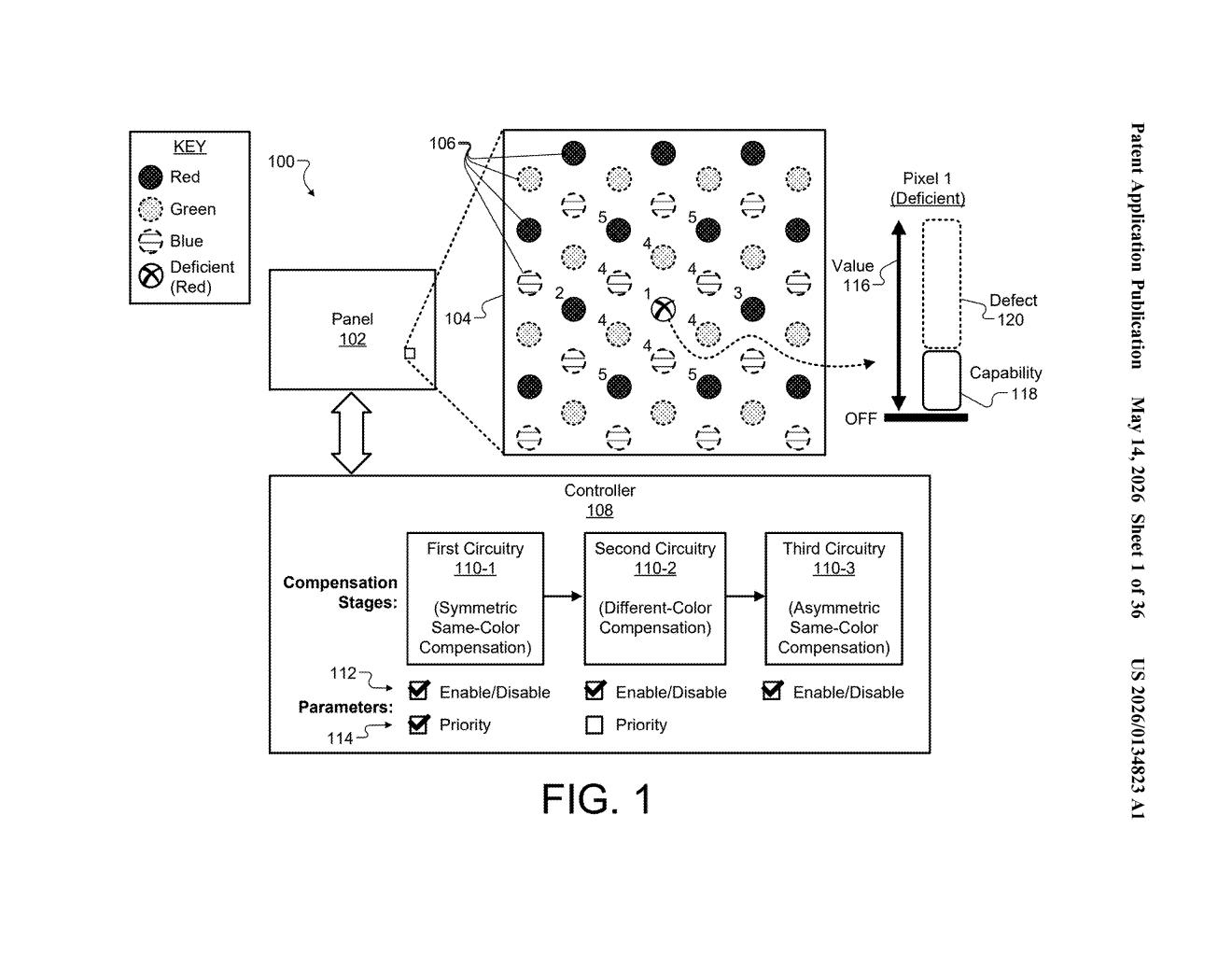
What Google's subpixel defect compensation actually does
Imagine your TV has a single tiny dot that's stuck on or off. Most of the time you'd never notice, but on a crisp white screen it sticks out like a smudge. Display makers have always had to decide: throw the panel away, or ship it anyway and hope nobody notices.
Google's patent describes a smarter middle path. A display controller detects when a subpixel — the individual red, green, or blue dot that makes up a single pixel — isn't working correctly. It can then automatically borrow light from nearby subpixels of the same color, or even nudge a neighboring pixel of a different color to partially fill the gap.
The clever part is that both strategies can be switched on or off independently depending on context — like what type of content is on screen, or how severe the defect is. That means your device can pick the least-noticeable fix for any given situation, rather than applying one blunt correction to everything.
How the controller switches between same-color and cross-color fixes
The system centers on a display controller with three distinct modules working together.
First, an identification module spots a defective subpixel by looking at the image value being sent to it — if the subpixel should be bright but can't respond, the module flags it. This is a per-frame, per-pixel check rather than a one-time factory calibration.
Once a defect is flagged, two separate compensation circuits take over:
- First circuitry (same-color compensation): redistributes the missing light across two or more neighboring subpixels of the same color — for example, splitting the load between two adjacent red subpixels when a red one fails. The patent also describes an asymmetric variant, where the correction isn't split evenly.
- Second circuitry (cross-color compensation): uses a subpixel of a different color to partially cover the deficit — trading some color accuracy for perceived brightness.
Critically, either or both circuits can be selectively enabled based on a configurable criterion — content type, ambient light, display mode, or defect severity. This makes the whole approach tunable rather than one-size-fits-all, which is especially useful in micro-display or AR contexts where panel real estate is extremely tight.
What this means for AR headsets and high-res displays
This kind of compensation is most valuable in micro-OLED or high-PPI displays — exactly the panels used in AR and VR headsets, where individual subpixels are tiny, densely packed, and expensive to replace. A single bad subpixel on a headset display sits millimeters from your eye, making it far more visible than the same defect on a 65-inch TV across the room. Smarter software compensation could let manufacturers use panels with slightly higher defect rates without hurting perceived quality — which in turn improves yield and lowers cost.
For you as an end user, the practical upside is a display that self-heals quietly in the background, keeping images looking clean even as individual subpixels age or fail over time.
This is genuinely solid display engineering, not a flashy AI pitch. The dual-mode compensation approach — same-color vs. cross-color, selectively enabled — is a meaningful refinement over the blunt 'neighbor averaging' tricks most panels use today. Given the inventor list and Google's known work on AR hardware, it reads like real productization work aimed at high-density headset panels.
There are more where this came from
We read every patent application Big Tech publishes and send you the ones worth knowing. Plain English, free, every week.
Want this weekly breakdown for a company we don't cover? Patentlyze Pro →