
Intel Patents a Way to Measure Wind Resistance Using Only a Vehicle's Energy Readings
Intel has filed a patent for a system that estimates the air pressure building up at the front of a moving vehicle, without needing a dedicated pressure sensor, by watching how hard the motor is working.
How Intel turns energy data into air pressure readings
A truck sits at a stoplight on a breezy highway on-ramp. The driver doesn't know it, but the wall of air pressing against the front of that truck is making the engine work harder and burning extra fuel every single mile.
Intel's patent describes a device that figures out how much air pressure is pushing against the front of a vehicle by measuring how much energy the vehicle is spending just to keep moving. The idea is that if you know exactly how much power is going into propulsion, you can back-calculate how hard the air is pushing back, without bolting on any extra pressure sensors.
That number, once you have it, could help a self-driving system or cruise control decide when to tuck in behind another vehicle to reduce drag, or warn a fleet manager that a particular route is unusually windy today.
determine, using the first data, energy used by the first vehicle for propulsion; and estimate, from the energy used by the first vehicle for propulsion, a first air pressure …
Translation: The system figures out how much energy goes toward moving the car and uses that to calculate wind pressure.
How the processor estimates front-of-vehicle air pressure
The system has two main parts: a sensor that continuously reads the vehicle's energy consumption, and a processor that does math on those readings.
The processor first strips out energy that is going to things other than forward motion (think: air conditioning, lighting, onboard electronics). What is left is the energy attributable purely to propulsion, meaning the work needed to overcome gravity, rolling resistance, and aerodynamic drag.
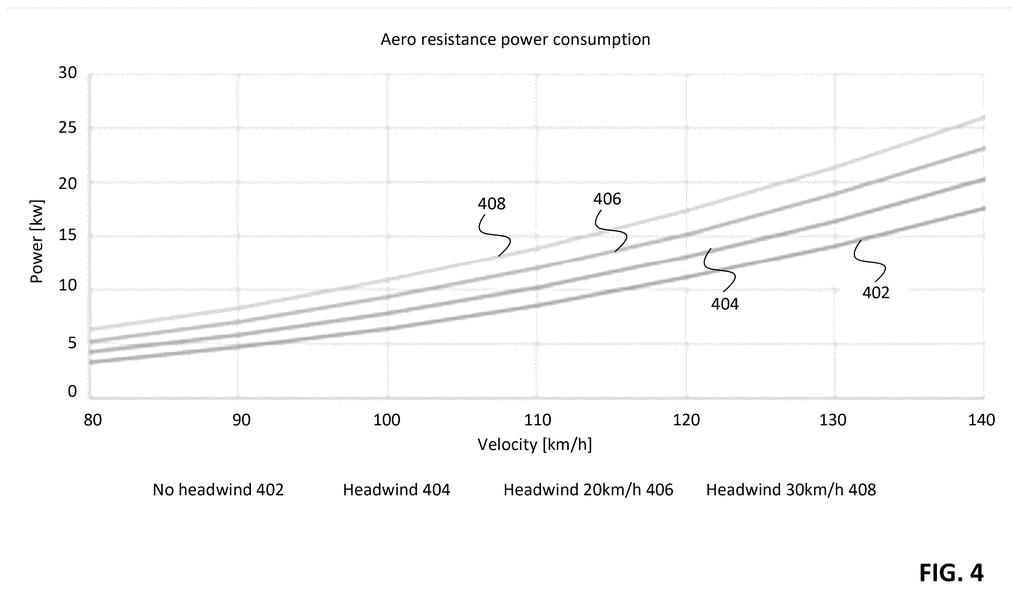
From that propulsion-only figure, the processor estimates the air pressure at the front of the vehicle. In physics terms, aerodynamic drag is a known function of air density and speed, so if you know speed and power, you can isolate the pressure component. The patent treats the front of the vehicle as a specific measurement zone.
The claim is written broadly: it requires only one sensor for energy usage and a processor that runs this two-step calculation. It does not specify the type of vehicle, the type of motor, or any particular algorithm, which makes the coverage wider than it might first appear.
What this could mean for electric vehicles and fuel savings
For electric vehicles, this kind of system could improve range estimates in real time. Knowing the actual aerodynamic load right now, rather than relying on a static model built in a wind tunnel years ago, lets the software give you a more honest picture of how far you will get before the next charge stop.
For autonomous and semi-autonomous vehicles, a live air-pressure estimate opens the door to active drag management: the vehicle could choose to follow another vehicle more closely when air resistance is high, or flag a headwind condition to a routing system. The practical payoff is modest fuel or battery savings accumulated over many miles, which matters a lot in commercial trucking and ride-share fleets.
Intel's 167th filing in our Intel coverage since May adds to a run that includes memory value prediction and live security chip reconfiguration.
Claim 1 covers any device that reads a vehicle's energy use and works backward to estimate air pressure building up at the front of that vehicle. There is no restriction on vehicle type, how the math is done, or what kind of energy system the vehicle uses, which makes the claim very wide.
In practice, that width means the claim would reach any software feature, in any vehicle, that takes power consumption as an input and produces a front-pressure figure as an output. A fuel economy app, a range estimator, a driver-assistance system, all of them would need to steer clear if they follow that two-step logic.
Whether the claim survives depends entirely on whether anyone has combined those two steps in print before, because the underlying idea, that drag shows up in your energy bill, is familiar physics. The claim's strength is its simplicity; its risk is the same thing.
There are more where this came from
We read every patent application Big Tech publishes and send you the ones worth knowing. Plain English, free, every week.
The drawings
7 drawing sheets from US 2026/0296449 A1 · click any drawing to enlarge


Want this weekly breakdown for a company we don't cover? Patentlyze Pro →
Be the first to weigh in