

Google
Google · AI / ML · Filed Jun 5, 2025 · USPTO published Nov 12, 2026 · This week's release
Google Files Patent for Earbuds That Cut Out Background Noise From Your Voice Commands
Your earbuds have one microphone pointed at the noisy room and another pointed into your ear. Google's patent application has an AI model compare the two so your voice commands survive a loud café.
- Publication number
- US 2026/0360381 A1(US20260360381A1)
- Applicant
- GOOGLE LLC
- Filed · Published
- Jun 5, 2025 · Nov 12, 2026
- Inventors
- Joseph Caroselli JR., Jens Heitkaemper, Arun Narayanan, Nathan David Howard, Maxwell McKinnon
- Status when we published
- Waiting for an examiner
- Document
- 20 claims
- US classification
- 704/200
- Examiner
- SULTANA, NADIRA (Art Unit 2653)
- Parent application
- Claims priority from a provisional application 63800889 (filed May 6, 2025)
What Google's two-microphone earbud filter does
You're in a crowded coffee shop, telling your earbuds to call Mom, and an espresso machine is screaming right behind you. Your assistant hears a mess of steam, chatter and your half-buried request, and it gets the name wrong.
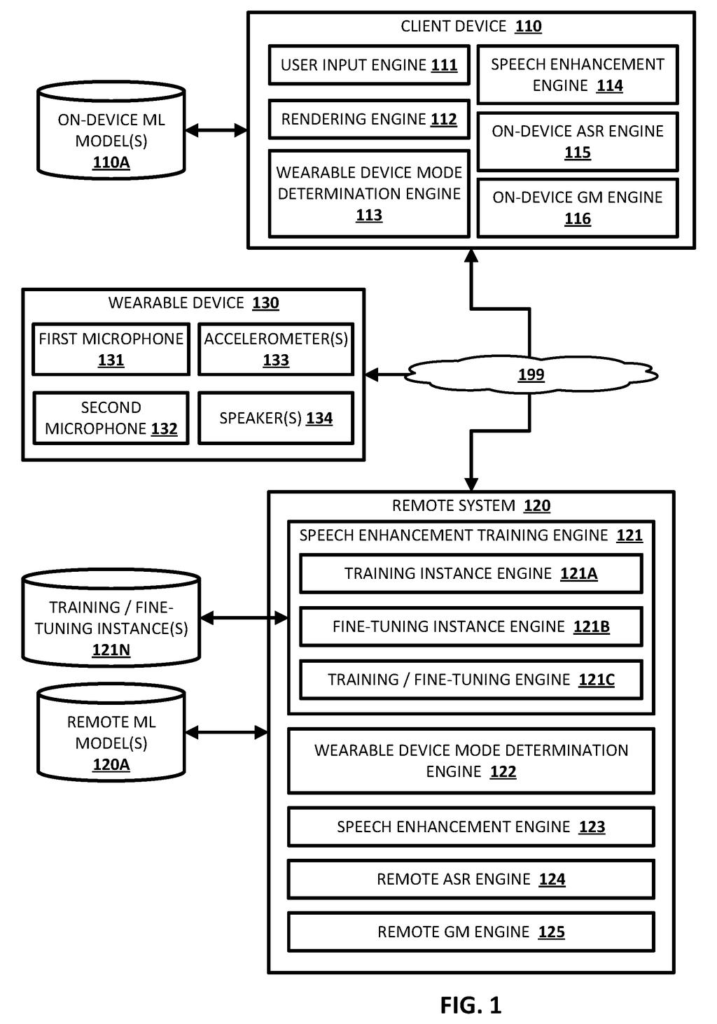
Google's patent application goes after that with two microphones on the earbud. One points out toward the room and hears everything. The other points into your ear and hears a muffled but cleaner copy of your voice. An AI model compares the two, works out which parts of the outside recording are noise, and turns those parts down.
The cleaned-up audio then goes to the assistant that figures out what you said. The filing says this can run on your phone or on a remote server. It also describes a backup that uses the earbud's motion sensor when the second microphone is no help.
… processing, using a speech enhancement machine learning model, the first audio data and the second audio data to generate an auditory mask; applying the auditory mask to the first audio data to generate masked audio data …
Translation: An artificial intelligence model uses dual microphone inputs to build a filter that cleans up the user's voice.
How the model builds its noise-reducing mask
The core is a cleanup step that runs before any voice assistant hears you. On an earbud, one microphone faces outward and records your voice plus the room. Another faces into your ear and records a muffled but less noisy copy of the same words. A speech enhancement model compares both and produces an auditory mask, a map saying how much to turn down each slice of sound. The mask is applied to the outward recording, and the result goes to speech recognition (software that turns speech into text) or a generative AI model.
The model is conformer-based, blending one technique that studies small nearby details in the audio with another, self-attention, that weighs how distant moments in a clip relate.
Training runs in stages:
- First, train on synthesized speech mixed with synthetic noise, scored against the clean original.
- Then fine-tune on real recordings, using a separate microphone that captured the clean voice as the answer key.
- Also score whether a speech recognizer reads the cleaned audio correctly, without changing the recognizer.
When earbuds are in transparency mode, which lets outside sound in, the inward microphone gets noisy too. The filing then swaps in the earbud's accelerometer (a motion sensor), turning its vibration readings into a narrow audio signal.
Implementations described herein are directed to processing audio data from multiple microphones of a wearable device to enhance the audio data prior to processing by additional system(s).
Translation: The system uses multiple built in microphones to improve audio quality before sending it on for further tasks.
Why this matters for voice commands on earbuds
If you talk to your earbuds, you know the failure: you ask for directions on a windy street and the assistant answers a different question. This filing goes after that problem with software that cleans up your voice before the assistant listens, so commands have a better chance of working in the places people actually use them.
It also fits the small size of earbuds. The filing says older multi-microphone methods need a large array and precise knowledge of where you are speaking from, which compact devices cannot offer. Here the two microphones sit close together and the AI does the sorting. The same idea is described for glasses, smartwatches and AR or VR headsets, which matters as more voice AI moves onto things you wear.
Google's 63rd filing we've tracked since May in the AI agents acting for you space connects to the message-sorting assistant and the TV app-learning filing to extend that line of work.
Source: US 2026/0360381 A1 at the USPTO (PDF). Full patent text and figures are in the official publication.
Get our take in your Top Stories
Liked this breakdown? Add Patentlyze as a preferred source on Google, and our plain-English take shows up more often in your Top Stories the next time Google patent news breaks.
Add Patentlyze on Google
One click.
There are more where this came from
We read every patent application Big Tech publishes and send you the ones worth knowing. Plain English, free, every week.
The drawings · 5 sheets
5 drawing sheets from US 2026/0360381 A1 · click any drawing to enlarge


More from Google
All 1,079 Google patents →
More in AI / ML
All 2,637 AI / ML patents →
Samsung
Samsung Files Patent for a Voice Assistant That Checks the Weather Before Cooling Your Home
Adobe
Adobe Patents a Way to Build Graphic Designs by Talking Through Them
Samsung
Samsung Patents a Phone Assistant That Waits on Hold and Gets Firm in Your Voice
Adobe
No comments yet