
Google
Google · Security · Filed Jun 9, 2026 · USPTO published Oct 1, 2026 · Oct 1 release
Google's New Patent Makes Saving Your Fingerprint to a Phone Faster and Easier
Setting up a fingerprint on your phone is oddly frustrating for something you do every day. Google has a patent aimed at fixing that, using the sensor itself to tell you exactly where to move your finger next.
- Publication number
- US 2026/0301474 A1(US20260301474A1)
- Applicant
- Google LLC
- Filed · Published
- Jun 9, 2026 · Oct 1, 2026
- Inventors
- Firas Sammoura, Jean-Marie Bussat
- Status when we published
- Waiting for an examiner
- Document
- 20 claims
- US classification
- 382/125
- Parent application
- Continuation of 18/250,464 (filed Apr 25, 2023)(18250464)
What Google's fingerprint setup guidance actually does
You're setting up fingerprint unlock on a new phone, and the app is asking you to 'lift and move your finger' with no clue which direction to go. You tap the sensor over and over, the progress circle barely moves, and eventually you give up and use a PIN.
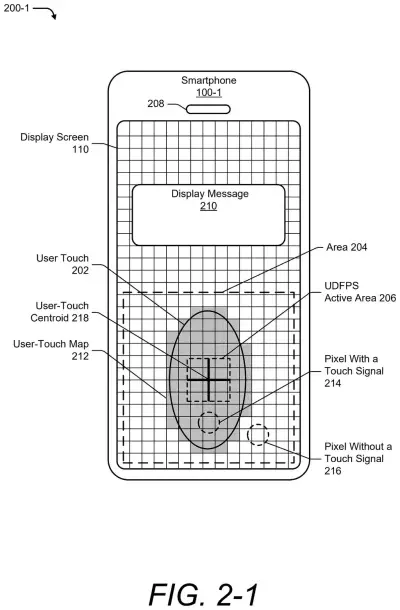
Google's patent describes a system that reads each partial fingerprint scan and figures out which edges of your fingerprint it hasn't captured yet. It then shows you a directional nudge on screen, like an arrow or prompt, telling you to shift your thumb slightly to the left, right, up, or down before the next tap.
The result is that the phone collects a complete fingerprint in fewer taps, because every tap is targeted rather than random. Instead of hoping you move in the right direction, the phone actively coaches you through the process.
… guiding a user during the enrollment process by displaying the directional instruction on a display screen of the computing device, the directional instruction prompting the user to touch in a specific direction relative to the optical UDFPS.
Translation: Your phone will show arrows telling you exactly which way to move your finger next.
How the sensor reads partial prints and issues directions
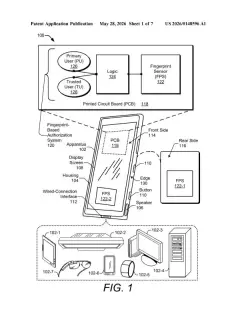
The system relies on an optical under-display fingerprint sensor (UDFPS), the kind hidden beneath a phone's screen rather than mounted on a physical button. During setup, each time you touch the screen, the sensor captures a partial image of your fingerprint.
The software then analyzes that partial image, looking for distinguishing features in the ridge patterns, things like the ends of lines, forks, and loops. From those features it calculates which part of your full fingerprint is still missing.
Based on that gap, the system generates a directional instruction and displays it on screen. The instruction tells you specifically where to place your finger next, so the sensor can capture the uncovered portion.
- Sensor captures partial fingerprint on each tap
- Software identifies which ridge areas have not yet been recorded
- Phone displays a directional prompt (move left, right, up, down)
- User follows the prompt, filling in the missing coverage efficiently
The claim specifically covers the full loop: capture, analyze, decide, display. That last step, putting a concrete directional prompt on screen, is the key piece the patent centers on.
The computing device uses a collocation of a user's touch, for example, a thumb-tap, and a fingerprint sensor's location to guide the user to complete the enrollment process of a full fingerprint with ease and with fewer thumb-taps.
Translation: By tracking where your thumb lands, the device helps you scan your whole fingerprint much faster.
What this means for unlocking your next Android phone
For most people, fingerprint setup is a one-time annoyance, but a bad one-time experience can push someone away from biometric security entirely and back to a less secure PIN or pattern. A setup process that coaches you through it removes that friction at the exact moment it matters most.
There is also a reliability payoff after setup. A fingerprint that was enrolled with full coverage of the print unlocks more consistently across different angles and grip positions. Fewer enrollment taps that are well-targeted beats more random taps for both the setup experience and the day-to-day unlock rate.
Google's 798th filing we've tracked since May in our Google coverage adds to a pattern that includes a drone safety camera and a smarter voice follow-up system.
Source: US 2026/0301474 A1 at the USPTO (PDF). Full patent text and figures are in the official publication.
Get our take in your Top Stories
Liked this breakdown? Add Patentlyze as a preferred source on Google, and our plain-English take shows up more often in your Top Stories the next time Google patent news breaks.
Add Patentlyze on Google
One click.
There are more where this came from
We read the new patents from Big Tech, carmakers and more and send you the ones worth knowing. Plain English, free, every week.
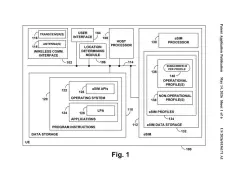
The drawings · 10 sheets
10 drawing sheets from US 2026/0301474 A1 · click any drawing to enlarge


Show the other 2 sheets


More from Google
All 1,127 Google patents →
More in Security
All 354 Security patents →
Qualcomm
Qualcomm Patents a Double-Check System to Stop Hackers From Faking Face and Fingerprint Scans
Qualcomm
Qualcomm Patents a Two-Layer Biometric System That Splits Your Fingerprint Data Across Isolated Chip Zones
Google
Patent: A Controlled System Decides Which Ads Reach Your Screen
Google
No comments yet