
Google
Google · Security · Filed May 13, 2025 · USPTO published Nov 19, 2026 · This week's release
Google Files Patent to Measure How Often Devices Get Replaced Without Tracking You
Google describes a way for a device maker to learn how fast people replace their gadgets without learning who they are. The twist is a lookup service that stops a factory reset from making one device count twice.
- Publication number
- US 2026/0368347 A1(US20260368347A1)
- Applicant
- Google LLC
- Filed · Published
- May 13, 2025 · Nov 19, 2026
- Inventors
- Da Won Lee, Hirthanan Subenderan, Qian Wang, Narendra K. Singhal, Kevin Wei Li Yeo, Aaron Segal, Shreyas Karkhedkar, Gregory M. Levin
- Status when we published
- Examiner raised objections; the company can respond
- Document
- 20 claims
- US classification
- 726/29
- Examiner
- TRUONG, LAN DAI T (Art Unit 2444)
What Google's anonymous device check-in does
Every so often, a device like your laptop or smart TV could send its maker a short, scrambled message that amounts to I'm still switched on. The message carries no name, account or serial number.
Google's patent application describes how a manufacturer could add up thousands of those messages to see how many devices from a group are still in use months later. A drop-off suggests people are replacing them, which helps the company decide how many more to build.
The tricky part is a factory reset. Wipe a device and it forgets it already checked in, so it might report again and get counted as two. Google's fix is a separate lookup service that can tell a device you've already been counted without learning which device is asking.
… determining, based on the first set of surrogate identifiers and the second set of surrogate identifiers, that the respective device of the second set of devices is included in the first set of devices …
Translation: The system figures out if a specific gadget is still being used over time without looking at personal information.
How Google stops a factory reset double-counting
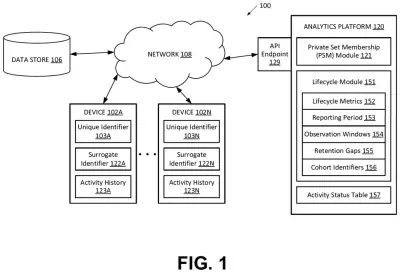
Each device sends its maker a surrogate identifier (a scrambled stand-in ID) once per reporting period, which could be hours, days or months. The ID is made with a cryptographic hash (a one-way scrambling function) from the device's hardware ID and the current period, so the server cannot work backward to a person. A cohort identifier (a group label, such as device type or use case) can be mixed in too.
The server then compares two time windows. It counts the active devices in an early window, counts the active devices in a later one, and checks which of the later devices were also in the first group. The filing's formula gives a lifecycle metric: one minus the share of early devices still active later, which estimates how many have been replaced. Results can also be averaged across several rolling windows.
The catch is factory resets, which erase a device's ID and history so it could report twice. To fix that, the filing adds a private set membership module (a lookup that answers yes or no to 'am I on the list?'). A device that has lost its history sends an encrypted query, and the module replies in a form only that device can read. A brand-new device hands over its hardware ID just once.
A system and method for privacy-preserving lifecycle tracking of computing devices.
Translation: This invention outlines a way to track how long electronics last while keeping user data private.
Why this matters for how many devices get built
For you, nothing changes on screen. The effect is behind the scenes: a manufacturer could judge how many laptops, tablets or TVs to have ready at launch, then raise or cut production as real replacement rates come in, using counts that carry no names. The filing also pitches the approach as a way to spot trends such as rising failure or replacement rates.
Privacy is the selling point. The older method, one permanent ID per device, would also reveal how often a person uses it. The examiner rejected the claims in a first review (routine at this stage), so what ends up covered may narrow. Nothing in the filing says Google will put this into a product.
This is the 1111th Google filing we've tracked since May in our Google coverage, a corpus that includes work like catching bad app updates and AI voice dubbing.
Source: US 2026/0368347 A1 at the USPTO (PDF). Full patent text and figures are in the official publication.
Get our take in your Top Stories
Liked this breakdown? Add Patentlyze as a preferred source on Google, and our plain-English take shows up more often in your Top Stories the next time Google patent news breaks.
Add Patentlyze on Google
One click.
There are more where this came from
We read every patent application Big Tech publishes and send you the ones worth knowing. Plain English, free, every week.
The drawings · 9 sheets
9 drawing sheets from US 2026/0368347 A1 · click any drawing to enlarge


Show the other 1 sheets

More from Google
All 1,127 Google patents →
More in Security
All 353 Security patents →
Apple
Apple Patents a Way to Connect Accessories to Apps Without Leaking Your Identity
Apple
Apple Patents a System That Tracks Who Looked at Your Health Records
Google
Google Patents an Ad System That Checks Your Privacy Before Sharing Your Context
Samsung
No comments yet