
Google
Google · AI / ML · Filed May 13, 2025 · USPTO published Nov 19, 2026 · This week's release
Google Files Patent for Spotting a Buggy App Update From User Complaints
When an app update goes wrong, thousands of users complain in thousands of different ways. Google's patent describes shrinking every complaint to a short summary, grouping the matches, and letting software pause or reverse the update.
- Publication number
- US 2026/0368433 A1(US20260368433A1)
- Applicant
- GOOGLE LLC
- Filed · Published
- May 13, 2025 · Nov 19, 2026
- Inventors
- Joseph Turner, Joseph Chen
- Status when we published
- Waiting for an examiner
- Document
- 19 claims
- US classification
- 704/9
- Examiner
- WONG, LINDA (Art Unit 2655)
What Google's complaint-grouping patent does
Every time an app update goes sideways, the complaints roll in, and no two sound alike. One person writes a long paragraph about their smart thermostat app, another types four angry words, a third rants in slang.
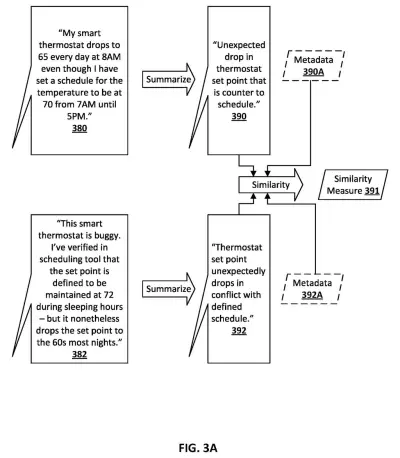
Google's patent describes a way to cut through that. First, an AI model boils each complaint down to a short, standard summary, roughly 10 to 15 words in a set tone. Then it scores how alike each pair of summaries is and groups the ones that describe the same problem.
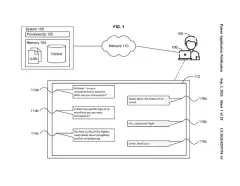
Once enough matching complaints pile up, the system can act on its own. It can alert the right team, pause an update's rollout, or roll the update back. Details like when and where a complaint came from, and which app version it was about, can nudge the match scores too.
Based on these similarity measures, a cluster of summarized text segments is determined to be formed. In response to determining that the cluster is formed, one or more automated actions are performed.
Translation: When enough similar complaints group together, the system automatically triggers a response.
How Google shrinks and scores each complaint
The system treats each piece of user feedback as a text segment. A language model (an AI trained to read and write text) is prompted to shorten each segment into a summary of a given length and tone. The idea is to strip out differences in style so that a rambling complaint and a curt one end up looking alike.
Next, a model compares summaries two at a time and produces a similarity score. In one example the AI is asked for a number from 1 to 10, in another a decimal between 0 and 1. The score can be adjusted using metadata (extra facts about each complaint):
- When it was sent: for example, a 10 percent boost if two complaints arrived within 24 hours of each other.
- Where it came from, such as the same region.
- Which app version it was about.
The scores feed a graph, which is a web of dots (summaries) joined by lines (how alike two summaries are). A clustering method such as affinity propagation (an automatic way to find groups without being told how many to look for) picks out clusters of matching complaints. As new feedback arrives, the graph updates.
When a cluster forms, the model can write an overall summary of it. The system can then send that summary to chosen contacts, disable a feature, halt an update's rollout, or roll the update back.
Why a buggy update could get pulled sooner
If you have ever filed a bug report and wondered whether anyone read it, this is the behind-the-scenes sorting that could decide it. Instead of a person skimming thousands of messages, software would notice that fifty of them describe the same navigation glitch and send one clean summary to the team that owns it. The filing's examples include a map app's navigation feature, a smart thermostat app and a robot vacuum-style product that starts bumping into furniture after an update.
The most consequential part is the automatic response. A cluster of complaints tied to a specific update could trigger a pause or rollback before more people get the bad version. That is useful for any company that ships software updates to millions of devices, and it is why the idea reaches beyond Google's own apps.
This is the 29th Google filing we've tracked since May in our AI guardrails race watchlist, following one on grading its own reasoning and one on vibration-based confidence signals.
Source: US 2026/0368433 A1 at the USPTO (PDF). Full patent text and figures are in the official publication.
Get our take in your Top Stories
Liked this breakdown? Add Patentlyze as a preferred source on Google, and our plain-English take shows up more often in your Top Stories the next time Google patent news breaks.
Add Patentlyze on Google
One click.
There are more where this came from
We read every patent application Big Tech publishes and send you the ones worth knowing. Plain English, free, every week.
The drawings · 7 sheets
7 drawing sheets from US 2026/0368433 A1 · click any drawing to enlarge


More from Google
All 1,127 Google patents →
More in AI / ML
All 2,738 AI / ML patents →
Microsoft
Microsoft Files Patent to Fact-Check Documents Before Its AI Summarizes Them
Adobe
Adobe Files Patent for AI That Highlights Where in Your Document an Answer Came From
Salesforce
Salesforce Patents a Way to Automatically Grade and Kill Bad AI Search Results
IBM
No comments yet