
Google
Google · Software · Filed Jul 3, 2025 · USPTO published Nov 19, 2026 · This week's release
Google Files Patent for Spotting Trending Apps Before They Go Mainstream
Google wants its app store's Trending list to tell you something you don't already know. Its patent application describes a statistical test that separates real surges from random blips, plus a model that guesses which apps will take off.
- Publication number
- US 2026/0368778 A1(US20260368778A1)
- Applicant
- Google LLC
- Filed · Published
- Jul 3, 2025 · Nov 19, 2026
- Inventors
- Zilu Zhou, Dinglong Li, Bruce Ban Herm Chia
- Status when we published
- Examiner raised objections; the company can respond
- Document
- 20 claims
- US classification
- 705/14.52
- Examiner
- VANDERHORST, MARIA VICTORIA (Art Unit 3621)
- Parent application
- National Stage Entry of PCT/US2024/011290 (filed Jan 11, 2024)(PCTUS2024011290)
What Google's trending-app patent actually does
You open the app store and tap Trending, and the list is full of apps you've already heard of, because by the time an app makes the list it's usually a household name. That's not much of a tip-off.
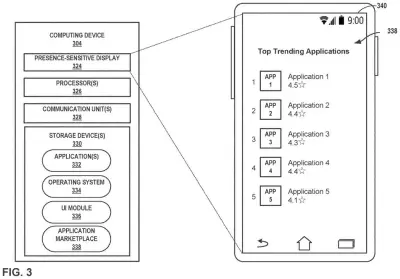
Google's filing describes a fix. The store tracks how much people use each app, and how many people use it, day after day. It then checks whether the latest numbers are higher than earlier ones by an amount too big to be luck. If the answer is yes, the app gets labeled trending and shown that way in the store.
There's a second layer too. A prediction model tries to guess which apps are about to qualify, so the store can feature them early, before most people have noticed.
determining, by a computing system and for each time period from a plurality of time periods, a trending metric for an application available through an application marketplace …
Translation: The system calculates a popularity score for an app across multiple different time frames.
How Google tells a real surge from random noise
The core of the claims is a repeatable test for "is this app really on the rise?" The system measures a trending metric for an app across a series of time periods. It then compares the last period to the first one and asks whether the increase clears a significance level (a statistical bar that rules out random fluctuation). If it does, the app is classified as trending and displayed that way in the marketplace.
The description adds detail on how this could work:
- Two metrics: an engagement metric (time spent using the app) and an active user metric (how many people who have it installed actually used their device in that period).
- Two time scales: a long-term check against the initial period at a level of 0.05, and a short-term check against a middle period at 0.1. The long-term bar is stricter because there is more data behind it.
- Assumed statistics: engagement is modeled with a Gamma distribution and user counts with a Poisson distribution (two standard ways of describing how such numbers normally scatter).
The example windows are 7, 14 or 21 days, and the claims name 21 periods of one day each, either fixed or sliding forward day by day. Data may be smoothed to reduce seasonal swings.
A machine learning model can also predict, before the final period begins, whether an app will be classified as trending. If so, the store can show it as trending right away. The model is trained on its own prediction accuracy.
Why a spot on Google's Trending list matters
If you've ever scrolled a Trending list and found nothing new, this is aimed at you. Showing apps just before they break out could make the store a better place to discover things, and it gives smaller developers a real shot at visibility. The filing itself says a Trending slot has a considerable effect on an app's adoption, which is why it stresses reliability.
For Google, the practical upside is a Trending section people actually trust and use. The examiner's first review rejected the claims as filed, which is routine at this stage and usually followed by amendments.
This is the 1100th Google filing in our Google coverage since May, adding to work like blurry face sharpening and fall detection without face ID.
Source: US 2026/0368778 A1 at the USPTO (PDF). Full patent text and figures are in the official publication.
Get our take in your Top Stories
Liked this breakdown? Add Patentlyze as a preferred source on Google, and our plain-English take shows up more often in your Top Stories the next time Google patent news breaks.
Add Patentlyze on Google
One click.
There are more where this came from
We read every patent application Big Tech publishes and send you the ones worth knowing. Plain English, free, every week.
The drawings · 5 sheets
5 drawing sheets from US 2026/0368778 A1 · click any drawing to enlarge


More from Google
All 1,127 Google patents →
More in Software
All 814 Software patents →
Samsung
Samsung Patent Enables Two Apps to Run Simultaneously in Foreground
Microsoft
Microsoft Files Patent to Let Apps Turn On Your Laptop's Privacy Screen Automatically
Microsoft
Microsoft Files Patent for One Shared Search Page Across Its Different Apps
Samsung
No comments yet