
Google
Google · AI / ML · Filed May 15, 2026 · USPTO published Nov 19, 2026 · This week's release
Google Patents a Fix for Blurry Faces Using Your Other Photos of Them
Google's patent application tackles a familiar annoyance: the one great photo where a face is too blurry to enjoy. Its fix is to check your other, sharper pictures of that person first.
- Publication number
- US 2026/0368863 A1(US20260368863A1)
- Applicant
- Google LLC
- Filed · Published
- May 15, 2026 · Nov 19, 2026
- Inventors
- Hossein Talebi, Peyman Milanfar, Mauricio Delbracio, Kangfu Mei, Viraj Jayminkumar Shah, Mo Zhou, Keren Ye
- Status when we published
- Waiting for an examiner
- Document
- 20 claims
- US classification
- 382/156
- Parent application
- Claims priority from a provisional application 63807436 (filed May 16, 2025)
What Google's reference-photo face fix does
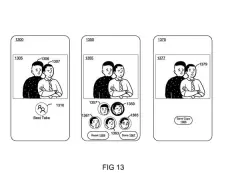
Imagine scrolling through your photo album and finding the perfect shot of your grandmother at a birthday party, except her face is a blurry smear. You have a dozen sharp pictures of her from other years. Existing restoration tools can end up producing a face that doesn't quite look like her.
Google's patent application describes a tool that looks at those sharp photos first. It studies who she is, what her face looks like up close, and the small details of her appearance, then rebuilds the blurry face to match. The goal is a fix that still looks like her.
The filing says this could live inside a photo album or photo archive app, running on your phone or on a server. It could also clean up old, low-quality scans so faces are clear enough for automatic sorting.
receiving an input image that depicts a face of an agent; receiving a set of one or more reference images that each depict the face of the agent …
Translation: The system takes in a blurry photo and a few clear backup photos of the same person.
How Google blends several face models' views
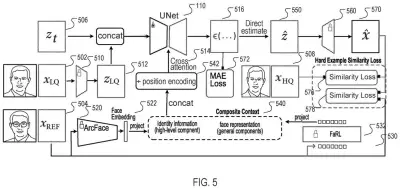
The system takes a degraded face photo plus one or more cleaner photos of the same person, called reference images, and produces a restored version of the degraded photo.
Each reference photo goes through several embedding networks (AI models that turn a picture into a list of numbers describing it). One is trained to capture identity; the filing names a face-recognition model called ArcFace as an example. Another captures both high-level traits, like face attributes, and low-level detail, like visual appearance. The outputs are mapped to a common format and stacked into one composite representation.
A denoising neural network (an AI that cleans up an image in many small steps, starting from random static) then rebuilds the face, guided by the blurry photo and that composite. With several reference photos, their results are averaged, and a setting called classifier-free guidance (a dial that controls how strongly the output follows each clue) balances the clues.
A separate claim covers training. The network is scored on how close its output is to the true clean photo, plus how similar the face is to both the clean photo and the reference. The filing says the reference check keeps training from stalling once the first check gets too easy.
… the image restoration task is performed by conditioning a denoising neural network on one or more reference images of the face of the agent in addition to the degraded image.
Translation: An AI fixes the messy picture by using details borrowed from the clean reference photos.
What this could mean for Google photo albums
If you keep thousands of photos, you probably own plenty where a face is soft or grainy. The filing describes putting this inside a photo album or photos app, restoring faces automatically when it spots a low-quality one, or when you ask, using sharper shots of the same person from your own library.
It also describes restoring faces in old archived photos so automatic sorting and tagging work better, and says the work could run on your device, on a server, or split between the two. The filing adds that users can be given controls over whether their images are collected and used. The pitch is a fix that keeps a face looking like the person you know, which matters because we notice small changes in faces so easily.
This is the 89th Google filing we've tracked since May in the AI photo editing race, following applications like skipping blurred video work and putting your dog in any scene.
Source: US 2026/0368863 A1 at the USPTO (PDF). Full patent text and figures are in the official publication.
Get our take in your Top Stories
Liked this breakdown? Add Patentlyze as a preferred source on Google, and our plain-English take shows up more often in your Top Stories the next time Google patent news breaks.
Add Patentlyze on Google
One click.
There are more where this came from
We read every patent application Big Tech publishes and send you the ones worth knowing. Plain English, free, every week.
The drawings · 5 sheets
5 drawing sheets from US 2026/0368863 A1 · click any drawing to enlarge


More from Google
All 1,127 Google patents →
More in AI vision
All 351 AI vision patents →
Nvidia
Nvidia Files Patent to Keep AI-Altered Faces From Looking Pasted Onto Video
Samsung
Samsung Files Patent to Undo the Stretched Faces in Close-Up Selfies
Qualcomm
Qualcomm Files Patent for Training AI to Erase Objects From Photos Cleanly
Samsung
No comments yet