
Google Patents a Video Call That Sharpens Only What You're Looking At
Your video call has no idea which face you're watching, so it treats the whole screen the same. A new Google patent filing would use your eyes to decide where the picture stays sharp.
What Google's eye-tracking video call does
Every time you join a video call, your internet connection decides how sharp everyone looks, and it has no idea which face you're actually watching. The picture gets the same treatment whether you're hanging on one person's every word or glancing at your inbox.
Google's filing describes a fix. Your device watches where your eyes are pointed (with your consent, according to the filing) and tells the sending side. The sender then keeps the spot you're looking at crisp and lets the edges of the picture go softer, which cuts the amount of data it has to push through. If you look away from the screen altogether, the video can drop in quality and the sound can get cleaner to make up for it.
The same idea covers more than eyes. The filing also describes boosting audio when your surroundings get loud, or when you ask the other person to repeat themselves.
… obtaining, by the sender computing system, one or more receiver perception feedback signals associated with the audiovisual communication stream, the one or more receiver perception feedback signals obtained as output from a gaze detection model at the receiver computing system …
Translation: The system tracks where the viewer is looking and sends that data back to the sender.
How your gaze steers the video and audio
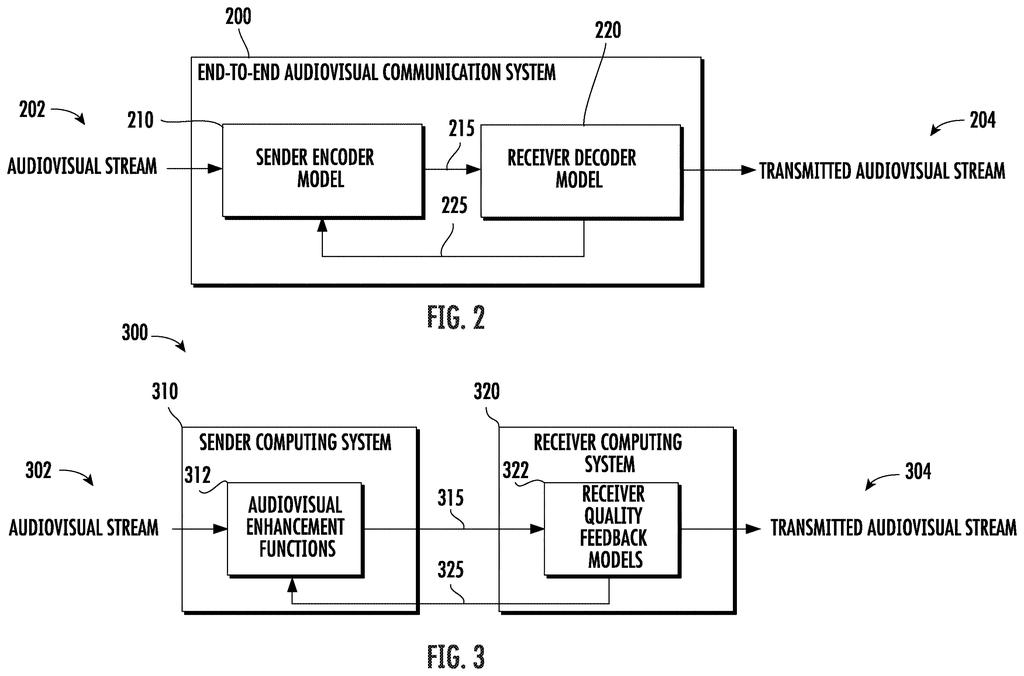
The patent describes a two-way loop between the person sending video and the person receiving it. The sender transmits a stream, and software on the receiving device runs perception feedback models (AI programs that judge how well you can see and hear the call). Their output goes back to the sender continuously, so the sender can adjust in real time.
The claims center on a gaze detection model, which works out which part of the picture your eyes are on. Two cases are claimed:
- If you're looking at a particular spot, the sender keeps or raises the picture quality there and lowers it in the surrounding area. One way is switching the compression scheme (the method used to shrink the video file).
- If you're looking outside the display altogether, the sender lowers video quality to save network bandwidth, and can raise audio quality to compensate.
Dependent claims add other signals. Audio quality can go up for the person shown where you're looking. It can also go up when a reaction model decides you're struggling to follow, when a noise model hears your surroundings get louder, or when a speech recognition model loses confidence in what it's hearing. The description adds that a central server could act as the sender, tailoring the stream for each person on a group call.
… applying, by the sender computing system, one or more audiovisual enhancement functions to the audiovisual communication stream based at least in part on the one or more receiver perception feedback signals.
Translation: The video quality changes automatically based on where the viewer directs their eyes.
What gaze-aware calls could mean for your data
If this ever reached video calls, you could see sharper faces on a weak connection, or use less mobile data on the same call. The filing's pitch is that quality gets spent where your attention is instead of spread evenly across the whole picture. It also points to lower power use, since less data needs processing.
The gaze part has a privacy angle: the system has to watch your eyes through your camera. The filing says this happens with the user's consent, and the signal sent back describes which part of the picture you're watching. How that consent would work in an actual app is a product decision the document leaves open.
Google's 988th filing we've tracked since May in our Google coverage continues a run of video tools, following a viewer drop-off predictor and an AI video quality grader.
Of everything in this filing, the gaze idea sits closest to something you could ship, because it needs no new hardware. A laptop or phone camera already sees your face, and video encoders already know how to spend more detail on one area than another. What is left is software glue: a gaze reader accurate enough to trust, and a way to send its result back to the sender within a fraction of a second.
Group calls are the hard part. Tailoring a separate stream for every viewer means a server doing extra work per person, and the filing only sketches that. A one-on-one call is the shortest route to a product, and any first version would likely start there.
The audio tricks, like louder voices in a noisy café or cleaner sound when you say 'huh?', are even easier, since they only adjust settings a call already has. Expect a modest, useful feature.
Get our take in your Top Stories
Liked this breakdown? Add Patentlyze as a preferred source on Google, and our plain-English take shows up more often in your Top Stories the next time Google patent news breaks.
There are more where this came from
We read every patent application Big Tech publishes and send you the ones worth knowing. Plain English, free, every week.
The drawings
5 drawing sheets from US 2026/0352780 A1 · click any drawing to enlarge


Want this weekly breakdown for a company we don't cover? Patentlyze Pro →
Be the first to weigh in