
Samsung Files Patent to Shrink Video Files With an Extra Compression Step
Every video you stream gets crushed down before it reaches you, and Samsung has filed for a second round of squeezing that adapts to each patch of the picture.
What Samsung's second compression step does
Imagine you're streaming a movie on a train with a patchy signal. The video only plays smoothly because it was shrunk to a fraction of its original size before it ever reached your phone. Every extra bit saved helps.
Samsung's patent application adds a second shrinking step on top of the usual one. After the encoder turns a patch of the picture into a list of numbers, it can reshuffle those numbers using one of several ready-made recipes, chosen to match how that patch was predicted from its neighbors. A short code tells your device which recipe was used, or that none was.
The very biggest patches, the 128 by 128 ones, skip the step entirely, so no code is sent for them. The goal is smaller files with as little extra bookkeeping as possible.
when a width and a height of a current unit are equal to or less than 64, obtaining, from a bitstream, second transform information for the current unit, wherein the second transform information indicates whether and which one among a plurality of second transform matrices is used …
Translation: For smaller video units, the system checks the data stream to see if an extra compression step is applied.
How Samsung's decoder undoes the second step
Video compression works in stages. The encoder (the software or chip that shrinks video) first subtracts a prediction of each patch of the picture from the real thing, leaving a small leftover called the residual. A first transform then converts that leftover into frequency numbers (coefficients), which describe the patch as broad shapes and fine detail.
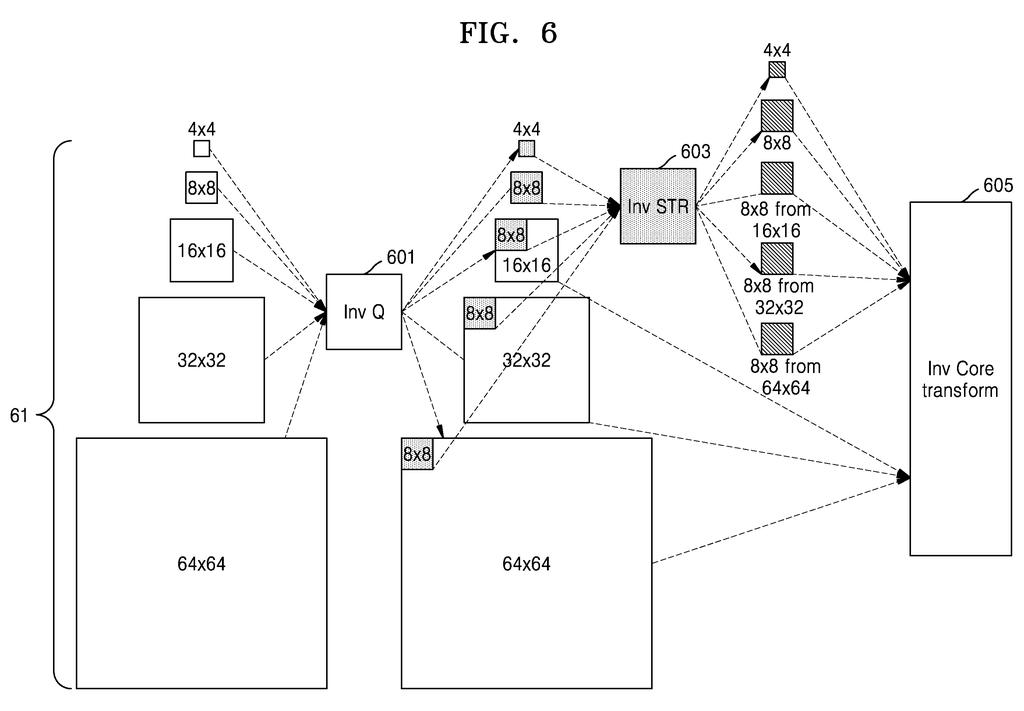
This filing adds a second transform on top. The encoder picks one set of matrices (grids of numbers that reshuffle the coefficients) from several candidate sets. The pick depends on the intra prediction mode, meaning the direction the encoder used when it guessed the patch from nearby pixels. The description says each set acts like a rotation, with one horizontal and one vertical matrix.
The claims spell out the signaling:
- For units whose width and height are both 64 or less, the bitstream carries a number. Zero means no second transform; any other value picks a matrix.
- For 128 by 128 units, no number is sent and the step is skipped.
- The decoder reverses the steps: inverse second transform, then inverse first transform, which recovers the residual.
The description adds that the step can focus on a top-left corner of low-frequency coefficients, such as an 8 by 8 corner of a 16 by 16 block, and that reusing sets across several prediction modes cuts the stored parameters. The claims cover encoding, decoding and storing the resulting bitstream.
… generating a first transform block by inverse-transforming the second transform block based on a plurality of transform matrices included in the selected second transform set …
Translation: The decoder unpacks the heavily compressed data in reverse using a specific set of mathematical formulas.
Why Samsung's video squeeze matters to you
For you, the payoff would be smaller video: less data to stream over a weak connection, less room used by clips on your phone, and a lower bandwidth bill for whoever serves the video. Squeezing a few more percent out of every frame adds up fast when billions of videos are watched.
The filing is a continuation of an application first filed in 2017, and it deals with the low-level mechanics that video standards are built from. Nothing in it names a product, so treat it as groundwork. Whether any of it reaches your screen depends on whether the wider video industry adopts it.
That makes this Samsung's 162nd filing we've tracked since May in our camera sensor work watchlist, after earlier applications on shrinking photo data by color and a one-camera touch projector.
If this ever ships, you would never see it. You would notice the result: a video that loads a little faster, buffers a little less, or takes up a little less room on your phone.
That is also the ceiling. A second compression step trims file size by a modest amount per video, and the rule that the largest blocks skip the step keeps the extra labels from eating the savings. The benefit comes from multiplying small savings across everything people stream.
Whether you benefit depends on whether video standards and device makers adopt it, and nothing in the filing says they will. Treat it as careful, routine plumbing with a small payoff that adds up at scale.
Get our take in your Top Stories
Liked this breakdown? Add Patentlyze as a preferred source on Google, and our plain-English take shows up more often in your Top Stories the next time Samsung patent news breaks.
There are more where this came from
We read every patent application Big Tech publishes and send you the ones worth knowing. Plain English, free, every week.
The drawings
20 drawing sheets from US 2026/0342984 A1 · click any drawing to enlarge


Show the other 12 sheets


Want this weekly breakdown for a company we don't cover? Patentlyze Pro →
Be the first to weigh in