
Qualcomm Files Patent to Keep Film Grain Looking Right on Old and New Video Players
Film grain is the speckled texture that makes a movie look like a movie, and your player has to recreate it on the fly. Qualcomm's filing is about making sure older players and newer ones can read the same video file without their instructions colliding.
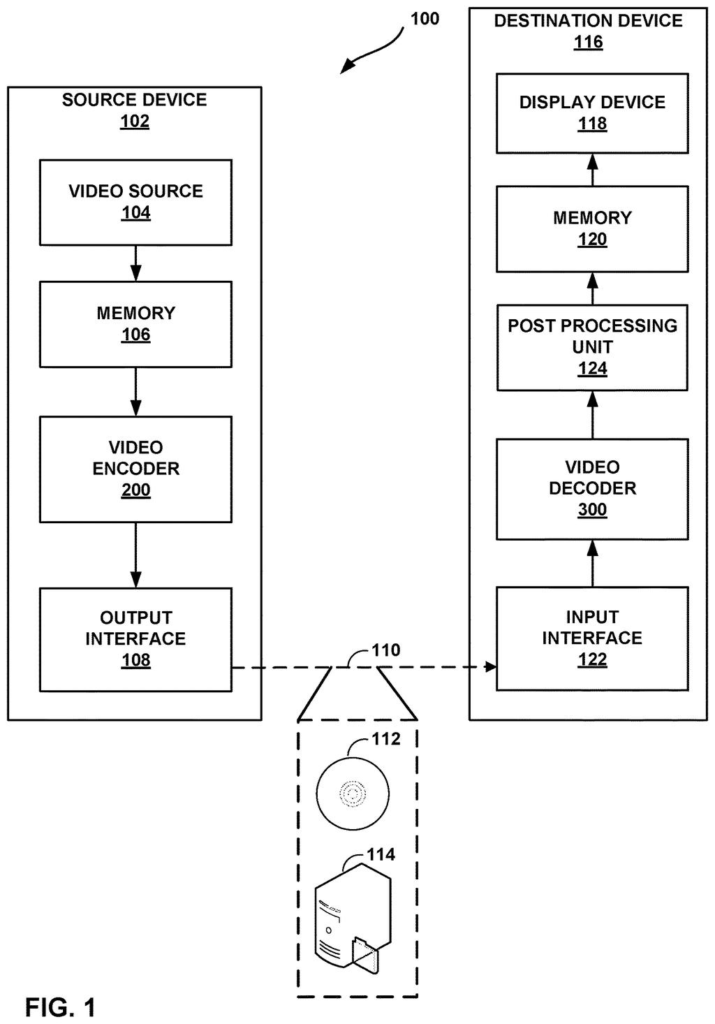
What Qualcomm's film grain patent actually does
Imagine you're watching a movie shot on real film. Storing every speck of grain in a video file is costly, so the file can instead carry a short note telling your player how to paint fake grain back over the picture afterward.
The catch is that grain looks right only at a certain picture size. Settings made for a 4K picture look off when applied to a smaller image that gets stretched up. One file may need different notes for different sizes, but older players can't read the newer, organized kind of note.
Qualcomm's filing lets one file carry both: a plain note that old players can still follow, plus size-specific notes for newer players. It also makes sure the newer notes can't accidentally switch off the plain one.
obtaining a non-processing order nesting (PON)-nested supplemental enhancement information (SEI) message in a bitstream for a processing chain to be performed on video data of the bitstream …
Translation: The system grabs a standard metadata message tucked inside the video stream to guide how the footage gets treated.
How one video file serves old and new players
A video file (called a bitstream in the patent) carries more than pictures. It also carries small notes called SEI messages (supplemental enhancement information, meaning extras that aren't needed to decode the picture but help with display). One of them is the film grain characteristics message: a set of numbers telling the player how to generate fake grain and blend it over the decoded picture.
Newer standards let an encoder bundle several versions of the same note inside a wrapper called a processing order nesting (PON) message, with an SEI processing order (SPO) message pointing to them. That allows, for example, one grain note tuned for 1080p and another tuned for 4K. Older players don't understand the wrapper, and the existing rules didn't let a plain, unwrapped grain note sit alongside wrapped ones in the same chain.
The claims cover a device that does three things:
- Obtains an unwrapped (non-PON-nested) message for a processing chain,
- Obtains a wrapped (PON-nested) message for the same chain, and
- Runs the chain using the unwrapped message's contents, without changing those tasks based on the wrapped one.
So even if a wrapped message says to cancel persistence (stop carrying a setting forward), the unwrapped note stays in effect.
The filing also describes a resolution nesting message that lists picture widths and heights and which notes apply to each, and it applies the same independence rule to other message types, such as neural-network post-filter and display orientation messages.
… perform the processing chain on the video data to form post-processed video data, wherein the processing system is configured to use contents of the non-PON-nested SEI message to perform one or more processing tasks of the processing chain without modifying the one or more processing tasks based on contents of the PON-nested SEI message …
Translation: It applies the video adjustments using the standard metadata instructions while actively ignoring conflicting nested messages.
What this means for streaming on old and new TVs
If a rule like this becomes part of video standards, one file could look right on both an older streaming box and a newer TV. The filing says grain settings made for one picture size look worse when applied to another and then stretched, so matching the settings to the size being shown gives better quality. Sending one file to everyone also takes less bandwidth than preparing separate versions for each kind of device.
The filing comes from the world of video standards, where small rule changes decide whether old and new devices can share the same stream. Nothing in it describes a specific product. The claims are about how a player reads its instructions and which ones win when two of them seem to conflict.
That makes this Qualcomm's 550th filing in our Qualcomm coverage since May, adding to a run that includes the hand-shake camera and the quiet-room earbud mic cutoff.
The problem here is small but real. A film grain note written for one picture size looks wrong at another size, and a video file that works only on the newest players leaves a lot of screens behind. Most viewers will never notice the fix, which is how a fix like this is supposed to go.
The approach matches the size of the problem. The filing adjusts one rule about which note wins, so nobody has to rebuild how video is stored or throw out older players.
Expect no consumer excitement. If a rule like this lands in a video standard, the result is a movie that keeps its film texture on your old streaming box and your new TV alike.
Get our take in your Top Stories
Liked this breakdown? Add Patentlyze as a preferred source on Google, and our plain-English take shows up more often in your Top Stories the next time Qualcomm patent news breaks.
There are more where this came from
We read every patent application Big Tech publishes and send you the ones worth knowing. Plain English, free, every week.
The drawings
6 drawing sheets from US 2026/0343029 A1 · click any drawing to enlarge


Want this weekly breakdown for a company we don't cover? Patentlyze Pro →
Be the first to weigh in