
Google
Google · Security · Filed Apr 20, 2026 · USPTO published Nov 19, 2026 · This week's release
Google Patents a Shared Speaker That Knows Whose Calendar to Read Out
A shared speaker that can tell you from a houseguest, and reads out your calendar only to you, is the idea behind this Google filing.
- Publication number
- US 2026/0369266 A1(US20260369266A1)
- Applicant
- GOOGLE LLC
- Filed · Published
- Apr 20, 2026 · Nov 19, 2026
- Inventors
- Meltem Oktem, Taral Pradeep Joglekar, Fnu Heryandi, Pu-sen Chao, Ignacio Lopez Moreno, Salil Rajadhyaksha, Alexander H. Gruenstein, Diego Melendo Casado
- Status when we published
- Waiting for an examiner
- Document
- 20 claims
- US classification
- 704/246
- Parent application
- Continuation of 18/210,963 (filed Jun 16, 2023)(18210963)
What Google's shared-speaker voice login does
Today, a speaker on the kitchen counter has a hard time telling the people in a house apart. If it answers everything, anyone who walks in can hear your calendar. If it locks everything down, a guest can't even ask what time it is.
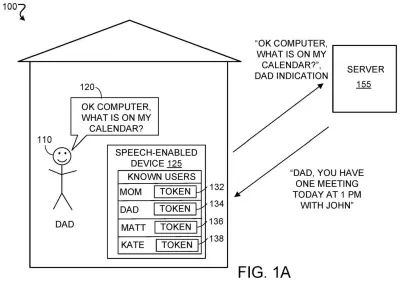
Google's patent filing describes a speaker that works out who is talking, using the sound of your voice or, if the device has a camera, your face. When it knows you, it can pull up your calendar or your music account. When it doesn't, it still answers harmless questions, like the time, and declines personal ones.
If a guest asks for your schedule, the speaker says it can't help and can offer to walk them through signing up as a regular user. The goal is one device that a whole household shares without sharing everything on it.
… generating a query that includes the text transcription and an authentication token that is based on the identity of the user that provided the spoken utterance …
Translation: The system bundles your voice command with a digital ID tag proving who you are.
How the speaker attaches a login token to your voice
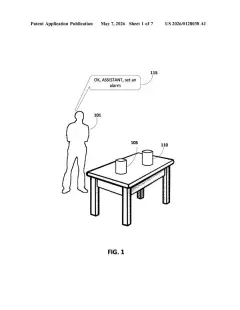
The core claim covers a shared device, such as a table-top speaker with microphones, that at least two people use. When someone talks to it, the device captures the audio, works out who is speaking, and turns the speech into text.
It then builds a query (the request sent off for an answer) that holds the text plus an authentication token, a small piece of data that works as a log-in for that person's account. With the token attached, the answer can use personal details such as calendar appointments or a music streaming account.
Who is speaking can be figured out two ways:
- Voice: the device extracts speaker identification features (a numeric fingerprint of how you sound) and compares them with ones saved at sign-up.
- Camera: if the device has a display and camera, it can match an image of you to a known user.
A guest's request goes out with no token. Non-personal questions still get an answer, while personal ones get an access-denied message and an audible offer to help them register. The filing also describes sending a whole pool of household tokens with a flag marking the speaker, so a guest could play music if one household member has the subscription. The device also keeps refreshing its saved voice samples as people use it.
… determine whether the speaker is a known user of a user device or not a known user of the user device …
Translation: The smart speaker figures out if it recognizes the person currently talking to it.
Why guests still get answers but not your calendar
If you share a speaker with a partner, roommates or kids, you want it to answer your questions without reading your schedule to whoever is in the room. This filing aims at that balance: your personal accounts stay behind a voice or face check, and everyday questions stay open to everyone, including visitors.
It also trims the setup chore. The description says a new speaker could reuse voice recordings you already gave on another device, so you skip repeating the wake phrase, and the speaker keeps learning how you sound as your voice or surroundings change. For Google, the payoff is that one household can share one device and the accounts behind it.
That makes this Google's 69th filing we've tracked since May, adding to work on training AI from corrections and hiding searches from advertisers, in our on-device AI privacy watch.
Source: US 2026/0369266 A1 at the USPTO (PDF). Full patent text and figures are in the official publication.
Get our take in your Top Stories
Liked this breakdown? Add Patentlyze as a preferred source on Google, and our plain-English take shows up more often in your Top Stories the next time Google patent news breaks.
Add Patentlyze on Google
One click.
There are more where this came from
We read every patent application Big Tech publishes and send you the ones worth knowing. Plain English, free, every week.
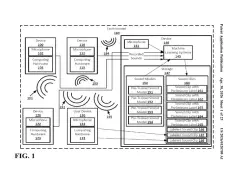
The drawings · 10 sheets
10 drawing sheets from US 2026/0369266 A1 · click any drawing to enlarge


Show the other 2 sheets


More from Google
All 1,127 Google patents →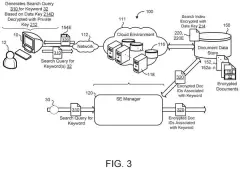
More in Security
All 353 Security patents →
IBM
IBM's New Patent Lets Your Phone Tell Nearby Cameras to Stop Recording You
IBM
IBM Files Patent for Testing Apps With Real Data After Scrubbing Private Details
Microsoft
Microsoft Files Patent for Hiding Your Name From the AI in Group Chats
Microsoft
No comments yet