
IBM Patents a System for Splitting AI Models Across Multiple Storage Nodes
Running a large AI model usually means one machine has to hold the whole thing. IBM's new patent describes a way to slice a model into numbered pieces and spread those pieces across a network of storage hubs, each holding only its assigned chunk.
How IBM wants to distribute AI model storage
Today, when a company wants to deploy a large AI model, it typically needs a single server (or tightly coupled cluster) powerful enough to hold the entire model in memory. That's expensive, inflexible, and hard to scale.
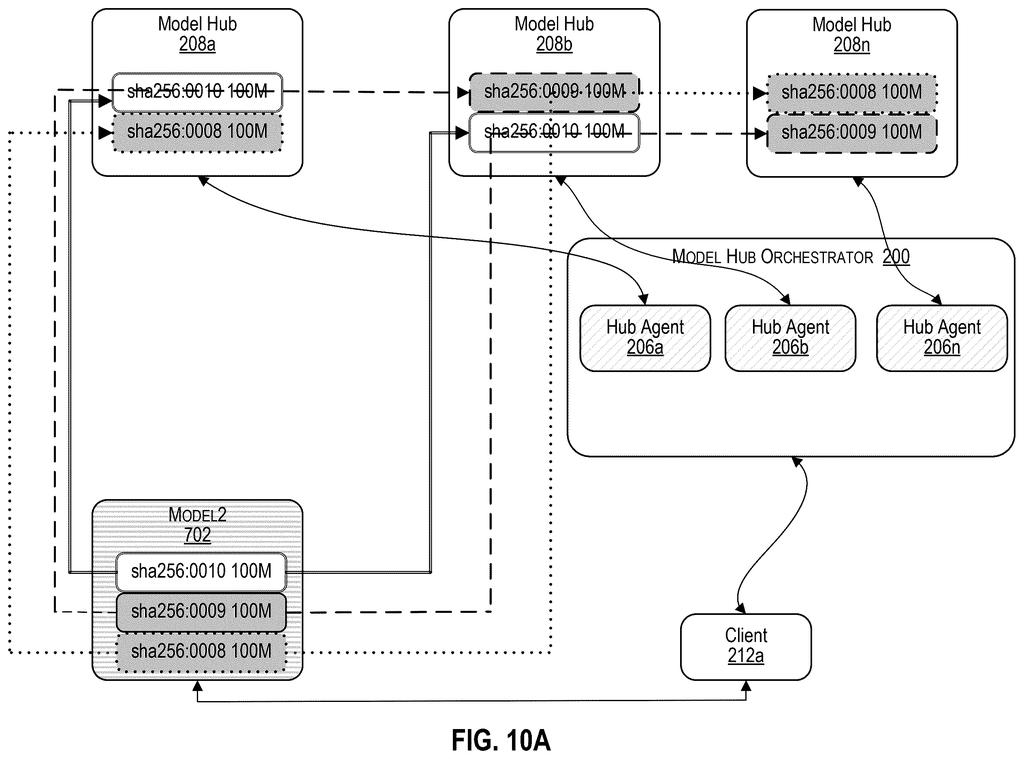
IBM's patent describes a coordinator, called a model hub orchestrator, that chops an AI model into sections and farms each section out to a different storage node on the network. Each section gets a number so the system always knows what order the pieces go in. When the AI needs to run, it pulls the right pieces from the right nodes in sequence.
The idea is to make it easier to deploy large models without requiring any single machine to carry the full load. Think of it like breaking a very long book into chapters and storing each chapter in a different filing cabinet. You can still read the whole book; you just grab one chapter at a time.
… assigning each processing block an index indicating a position of the processing block within a sequential arrangement of the plurality of processing blocks of the machine learning model …
Translation: The system breaks the AI model into numbered pieces so it knows exactly how to reassemble them later.
How the model scheduler indexes and places blocks
The patent centers on a model hub orchestrator, a software coordinator that sits between a client device (the machine submitting an AI model for deployment) and a collection of model hubs (network-connected storage nodes).
Here is the core sequence the patent describes:
- The orchestrator's model scheduler receives a request from a client and identifies all the processing blocks that make up a machine learning model. A processing block is essentially a discrete layer or functional segment of the model.
- Each block is assigned an index, a number that records its position in the model's sequential order, so the system can reconstruct the full pipeline at inference time.
- The scheduler then picks which model hubs will store which blocks, spreading the model across multiple nodes rather than keeping it on one machine.
- Finally, the blocks are transferred from the client device to their assigned hubs.
The patent does not describe in detail how the model runs inference once it is distributed; its focus is the placement and transfer phase. The indexed ordering is the key mechanism: without knowing which block comes first, second, or third, a distributed system cannot execute the model correctly.
The model scheduler selects one or more model hubs communicatively coupled with the model hub orchestrator to store different ones of the plurality of processing blocks.
Translation: A central manager decides which remote servers will hold the specific parts of the AI model.
What distributed AI model storage means for enterprise
For enterprises running large AI models, storage and memory costs are a real constraint. If IBM can make it practical to spread a single model across cheaper, commodity storage nodes rather than a single high-memory server, that could lower the barrier for companies that want to self-host AI instead of paying for cloud inference APIs.
The patent sits squarely in the infrastructure layer of AI deployment, an area where IBM has historically competed with cloud providers like AWS and Azure. It is early-stage work, covering the orchestration logic without specifying the hardware or the inference runtime, and that gap between a placement patent and a finished product is not trivial. Still, IBM's push into AI model distribution is part of a broader wave of enterprise AI infrastructure filings tracked among the newest Big Tech patents across the industry.
A software-only filing is its own fastest path to shipping: no custom silicon, no new network protocol, just an orchestration layer that could in principle run on storage infrastructure IBM already sells. The main open question is inference: the patent covers model placement but stays silent on how a distributed model actually executes requests across those hubs, and that second layer is where the real engineering work lives. If IBM files follow-on patents covering the inference side, this becomes a credible product building block; on its own, it reads as foundational IP staking out the distribution mechanism before the rest of the system is built.
There are more where this came from
We read every patent application Big Tech publishes and send you the ones worth knowing. Plain English, free, every week.
The drawings
13 drawing sheets from US 2026/0236306 A1 · click any drawing to enlarge


Want this weekly breakdown for a company we don't cover? Patentlyze Pro →
Be the first to weigh in