
IBM
IBM · Security · Filed May 16, 2025 · USPTO published Nov 19, 2026 · This week's release
IBM Files Patent for Training AI on Data It Never Reads in Plain Text
IBM describes an AI model that learns from scrambled text and answers scrambled questions, so the readable version never sits on the server. Only a device with the right key can read the reply.
- Publication number
- US 2026/0368625 A1(US20260368625A1)
- Applicant
- International Business Machines Corporation
- Filed · Published
- May 16, 2025 · Nov 19, 2026
- Inventors
- Hirenkumar Ashokbhai THUMMAR, Linda Ha KATO, Chad Eric DeLUCA, Daniel GRUHL, Shubhi ASTHANA, Pawan Raghunath CHOWDHARY, Steven R. WELCH, Anna Lisa GENTILE, Bing ZHANG, Alfredo ALBA
- Status when we published
- Waiting for an examiner
- Document
- 20 claims
- US classification
- 706/12
What IBM's scrambled-data AI training does
Right now, teaching an AI model with sensitive documents usually means unlocking them first. That puts things like medical records, personal details or company secrets in readable form on servers that may belong to someone else. IBM's patent application describes a way to skip that unlocking step.
The system scrambles the training text with a secret key, then trains the AI on the scrambled version. When you ask a question, your question gets scrambled the same way, the AI works out an answer, and the answer comes back still scrambled. Only a device holding the right key can turn it into readable words.
If your device lacks the key, you get an error message instead of an answer. The filing also describes handing different groups different keys, so each group can read only the pieces meant for it.
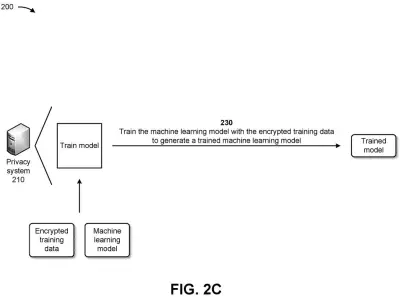
… training a machine learning model with the encrypted training data to generate a trained machine learning model …
Translation: The system teaches the AI using only scrambled information so it never sees the raw data.
How a scrambled question reaches an answer
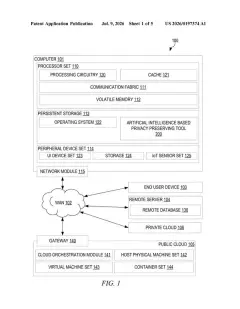
The core claim is a pipeline with encryption on both ends. The system encrypts training data, trains a machine learning model on that encrypted version, encrypts each incoming query, runs it through the model, and sends back an encrypted result. The user's device then decrypts that result with its private keys.
The favored scrambling method is format-preserving encryption (scrambled text keeps the same shape as the original, so a string of characters becomes another string of characters). The filing names a Feistel-based version, which splits the data into two halves and runs it through rounds of substitution and shuffling that a secret key can reverse. Because the shape survives, a simple bag-of-words model (one that tracks which words appear and ignores their order) can still learn from it.
Search works by scrambling a keyword the same way, then matching it against the scrambled text without decrypting anything. The filing also describes:
- Encrypting with multiple keys, so different user groups can read only their own portions
- Splitting the training data into segments, each locked with a different set of keys
- Swapping characters or sensitive items like card numbers for tokens (stand-in values)
- Homomorphic encryption (doing math directly on locked data) as another option
Why medical and secret records come into it
If it works as described, a hospital, a company or a government office could let an AI model learn from sensitive files on shared cloud servers without readable text ever sitting there. The filing names medical records, classified documents and personal details like card and Social Security numbers as target uses. For you, that means fewer places where your private information is exposed in readable form.
The filing also says the approach could cover large language models (the technology behind chatbots), and could protect a shrunken model downloaded to a smartphone, so a stolen copy would be useless without the key. It extends the idea to features pulled from images and sound too. Keep in mind this is an application with no performance numbers, so how well a model actually learns from scrambled data remains open.
This is the 14th IBM filing we've tracked since July in our on-device AI privacy watchlist, after earlier applications to shield company data from AI and test apps on scrubbed real data.
Source: US 2026/0368625 A1 at the USPTO (PDF). Full patent text and figures are in the official publication.
Get our take in your Top Stories
Liked this breakdown? Add Patentlyze as a preferred source on Google, and our plain-English take shows up more often in your Top Stories the next time IBM patent news breaks.
Add Patentlyze on Google
One click.
There are more where this came from
We read every patent application Big Tech publishes and send you the ones worth knowing. Plain English, free, every week.
The drawings · 9 sheets
9 drawing sheets from US 2026/0368625 A1 · click any drawing to enlarge


Show the other 1 sheets

More from IBM
All 481 IBM patents →
More in Security
All 353 Security patents →
Microsoft
Microsoft Files Patent for AI Training Data That Guards Riskiest Personal Details Hardest
Google
Google Patents a System That Tracks Users Without Ever Seeing Who They Are
Google
Google Patents a Camera Sensor That Counts People Without Keeping a Single Photo
Qualcomm
No comments yet