
Intel Files Patent for Cutting the Lag When You Turn Your Head in VR Video
When you whip your head around during a streamed 360-degree video, the server often has to wait for the next restart point before it can show your new view. Intel's patent application adds restart points in the middle of the video so that wait mostly disappears.
What Intel's mid-video view-switch patent does
You're wearing a VR headset, watching a live 360-degree concert, and you snap your head toward the stage. For a beat, the picture lags, blurs or shows the wrong thing. The reason is that the server feeding you video usually has to wait for a special restart frame before it can send the new view.
Intel's patent application goes after that wait. The video is prepared with extra starting points in the middle of each stretch of footage, so the server can jump to your new view almost right away instead of waiting for the next full restart.
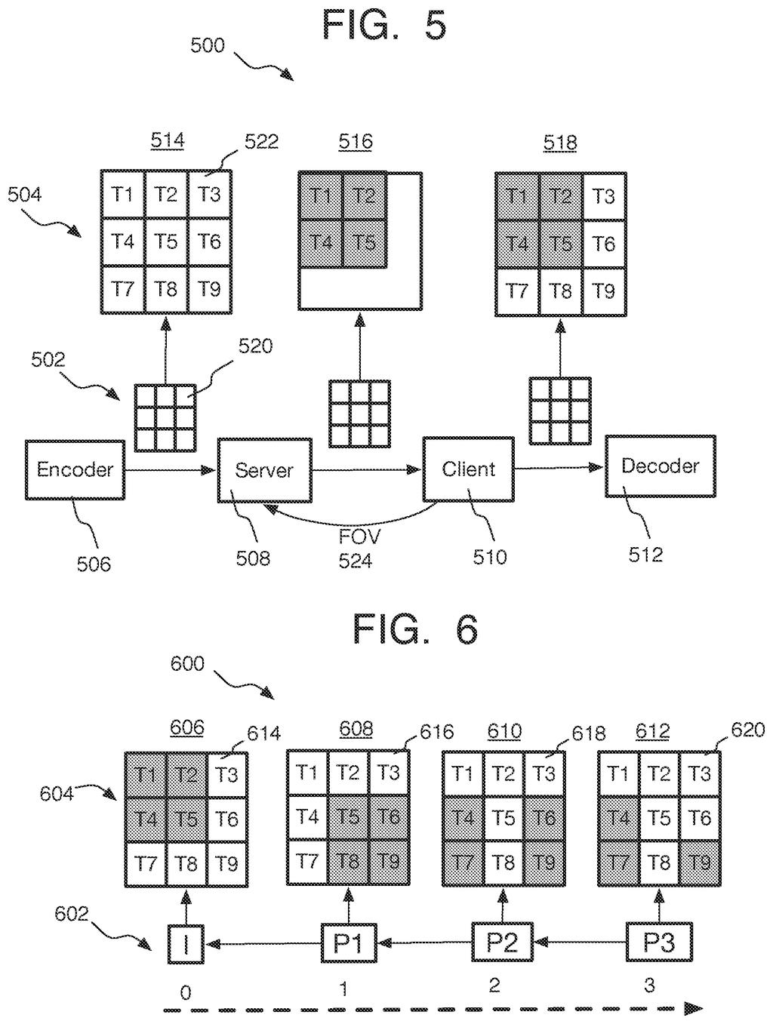
The filing puts numbers on it. In its eight-frame example, the average wait drops from four frame intervals to half of one.
access a first video bitstream including pictures in a group of pictures (GOP), the GOP including an instantaneous decoder refresh (IDR) picture to define a start of the GOP and a second picture to define a viewport switching point in the GOP …
Translation: The server reads a video file that contains specific markers to help switch angles quickly.
How Intel's anchor frames skip the wait
Streaming video is sent in groups of pictures (GOPs), short chunks that begin with an IDR frame, a complete picture that depends on no other frame. Every later frame stores only changes from earlier ones, which saves space but means you can't join halfway through. A server that sends just the slice of a 360-degree picture you're looking at normally has to wait for the next chunk whenever you look somewhere new.
The claims cover a server that receives a stream where each chunk has an IDR frame at the start plus a second picture partway through, built from the IDR frame and marked as a viewport switching point. The server gets viewport data from the headset (the claims mention angles), then does bitstream rewriting (repackaging already-compressed video without compressing it again) to produce a new stream for that view, starting at the switching point.
The description calls these switching points anchor frames. The new stream starts with the chunk's IDR frame, then jumps to the next anchor and skips the frames in between. With a two-layer setup, only a low-resolution copy of the IDR frame is sent, and it is never shown. Claims and description add variations:
- The anchor can be a P frame (a frame stored as changes from an earlier one).
- The server can pick only the tiles that match your view, using a higher-resolution track.
- The switching point can sit at the midpoint of the chunk.
If your switch lands in the last stretch of a chunk, the server just waits for the next IDR frame.
Why VR streaming lag is such a hard problem
If you watch 360-degree video or use a headset, the payoff is a view that catches up faster when you turn. The filing also says the same trick works on flat video, such as flipping between live channels or joining a broadcast late, where waiting for the next restart frame can stretch to seconds or more.
It also suits companies that serve many viewers at once. The filing describes rewriting already-compressed video as a lightweight job, so one server can handle many clients without re-compressing video for each one. This is a patent application, so nothing in it says when, or whether, the idea reaches a product you can use.
Intel's 175th filing in our Intel coverage since May follows applications like lane paint quality grading and camera-based darkness detection.
A third of a second sounds trivial until you put on a headset and turn your head. Your body registers the lag before your brain does, and for many people nausea follows within minutes. Intel puts the comfort threshold at around 25 milliseconds, and most headsets today sit at ten times that.
One chunk of that delay, roughly half a second on its own, accumulates every time the video stream hiccups and has to restart cleanly. That is not an edge case. It happens constantly, and each instance resets the sickness clock.
Intel's approach cuts that restart penalty down to a frame or two, and requires nothing from the person wearing the headset to make it work. The full 25-millisecond target still depends on solving other problems in the chain, but a half-second penalty that fires repeatedly is exactly the right size of problem to go after first.
Get our take in your Top Stories
Liked this breakdown? Add Patentlyze as a preferred source on Google, and our plain-English take shows up more often in your Top Stories the next time Intel patent news breaks.
There are more where this came from
We read every patent application Big Tech publishes and send you the ones worth knowing. Plain English, free, every week.
The drawings
9 drawing sheets from US 2026/0323044 A1 · click any drawing to enlarge


Show the other 1 sheets

Want this weekly breakdown for a company we don't cover? Patentlyze Pro →
Be the first to weigh in