
Intel Patents Technology to Reconfigure Its Security Hardware During Operation
Fully Homomorphic Encryption is the technology that lets computers do math on data they're never allowed to see in plain form. The catch is that it's brutally slow, and Intel's latest patent attacks that problem by letting the chip reorganize itself mid-task.
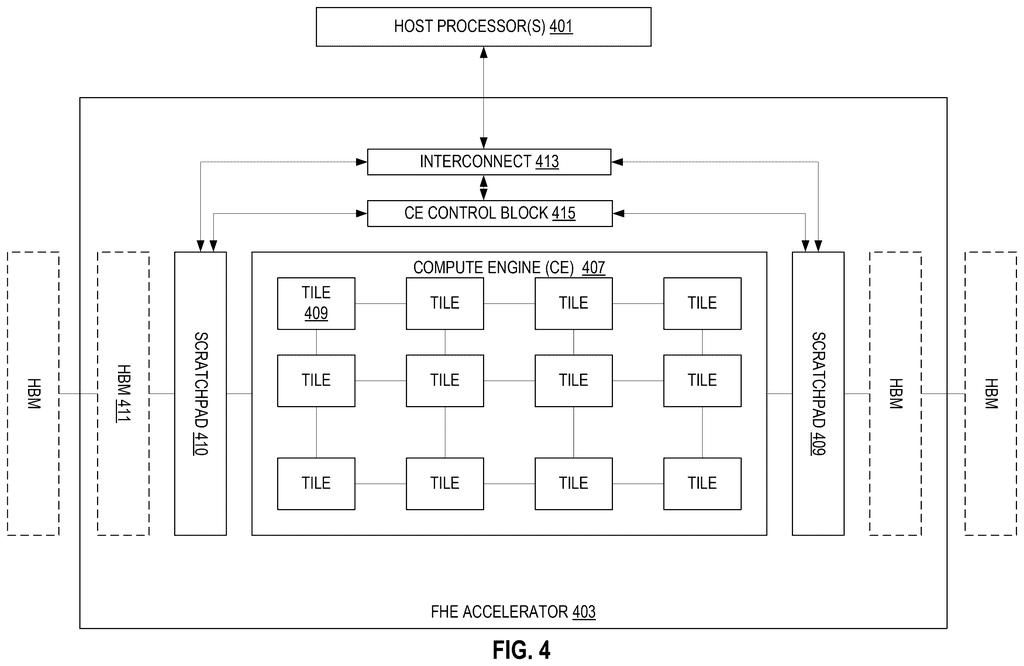
What Intel's reconfigurable encryption chip actually does
Ever tried to split a big job among a group of workers, only to find you can't reassign anyone once things get started? That's the problem at the heart of modern encryption chips.
Intel's patent describes a chip made of many small computing blocks, called tiles, that can be tagged with programmable ID numbers on the fly. Instead of hardwiring which tiles work together, a central controller broadcasts an instruction that assigns each tile its ID, then uses those IDs to form working groups for any given task. You get flexible teams instead of fixed squads.
The target workload is Fully Homomorphic Encryption (FHE), a technique that allows a server to crunch numbers on your data without ever seeing the underlying information. FHE is extraordinarily demanding, and having a chip that can fluidly reassign its compute resources to match each FHE operation is a meaningful step toward making private cloud computing practical.
… the plurality of compute tiles to execute a corresponding plurality of instances of the instruction to associate the plurality of compute tiles with a corresponding plurality of tile identifiers (IDs), each compute tile to be associated with one of the tile IDs …
Translation: The processing blocks run a command to assign unique identification numbers to each individual tile.
How tile IDs let the chip redraw its own compute groups
The patent describes a Fully Homomorphic Encryption Compute Engine built from a grid of identical compute tiles, all wired together over an interconnect network (think of it as an internal highway).
The key innovation is programmable Tile IDs. Normally, chip designers decide at fabrication time which processing blocks belong to which functional group. Here, a compute tile control circuit can broadcast a single instruction that every tile executes simultaneously, with each tile writing its own unique ID into local storage. From that point forward, the controller can say "run this operation using all tiles whose IDs fall in range X" and the chip responds accordingly.
This gives the hardware a kind of software-like flexibility:
- Groups can be formed, dissolved, and reformed between operations without physically rerouting anything.
- Different FHE operations (which vary widely in how much parallelism they need) can be matched to group sizes that fit them.
- A tile that fails can be logically excluded by simply not assigning it an ID that any scheduled group uses.
Fully Homomorphic Encryption works by wrapping data in a mathematical structure so thick that a processor can add and multiply it correctly without ever seeing the raw values. The math is correct, the data stays hidden, but the operations are orders of magnitude more expensive than normal arithmetic, which is exactly why dedicated, reconfigurable hardware matters here.
… the compute tile control circuitry to schedule an operation to be executed collectively by a group of the compute tiles, the group of compute tiles to be indicated, at least in part, based on the tile IDs …
Translation: A master controller directs specific sets of tiles to team up for tasks based on their ID numbers.
What this means for processing data without ever decrypting it
FHE is the dream technology for privacy-sensitive computing: hospitals could run AI diagnostics on patient records without exposing those records, and cloud providers could process your financial data without ever holding the keys. The barrier has always been raw speed; FHE can be thousands of times slower than working on unencrypted data.
a growing pile of Intel FHE compute filings suggests the company sees specialized silicon as the path past that barrier. A chip that can dynamically reassign its compute blocks means fewer wasted cycles when an FHE operation needs a different team size than the last one, which compounds into real throughput gains at the system level. For enterprises exploring confidential computing, that difference could determine whether FHE stays a research curiosity or becomes a deployable service.
Intel's 46th patent we've tracked since May in the AI chip race continues a run that includes one on built-in fault detection and one on self-shutting processing units.
The design trades physical simplicity for runtime flexibility. A chip where every tile is generic and group membership is set by software instruction is more complex to control than one with fixed-function blocks; the controller has to be correct every time it assigns IDs, or the wrong tiles execute the wrong pieces of an operation. That's a real fault surface.
The upside is proportional. FHE workloads are famously irregular: different mathematical steps within a single encrypted computation want different degrees of parallelism. A fixed-partition chip wastes silicon on steps that don't need a big team, while this design can resize on demand. That tradeoff reads as worth it specifically for FHE, where the cost of rigidity is measurable in orders-of-magnitude slowdowns.
The tile-failure angle is the sleeper benefit. Being able to logically retire a bad tile by simply not assigning it a working ID is a cheap path to fault tolerance, especially important in a datacenter context where chips run for years. Whether Intel's engineers can keep the ID-assignment logic airtight under real production workloads is the open question this patent doesn't answer.
There are more where this came from
We read every patent application Big Tech publishes and send you the ones worth knowing. Plain English, free, every week.
The drawings
66 drawing sheets from US 2026/0299960 A1 · click any drawing to enlarge


Want this weekly breakdown for a company we don't cover? Patentlyze Pro →
Be the first to weigh in