
Intel Patents a Dashboard That Holds Its Messages Until You Can Handle Them
Your car's display already knows you're in bumper-to-bumper traffic, Intel's new patent would let it use that knowledge to decide whether now is a good time to show you that navigation update, or whether it should wait.
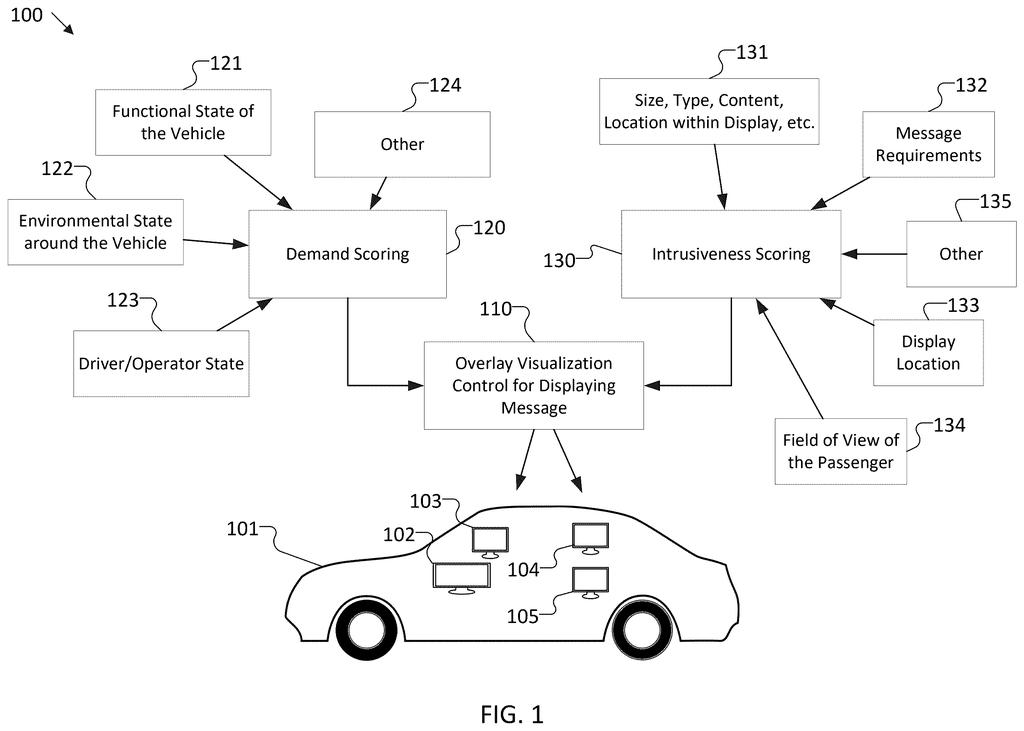
What Intel's driver-demand display system actually does
A driver approaches a busy intersection in the rain, a notification pops up on the dashboard, and their attention splits at exactly the wrong moment. That scenario is the problem Intel is trying to solve with this patent.
The system works by pulling together three things at once: what the car itself is doing (braking hard, merging, cruising), what the road and weather look like around it, and cues about how alert and focused the driver appears to be. It combines all of that into a single number, a demand score, that estimates how much mental load you're already carrying.
Based on that score, the system decides how to handle any message that wants to appear on the display. A low-demand moment might get you a full-size popup. A high-demand moment might delay it, shrink it, or skip it entirely until things calm down. The goal is to let the car pick its moments, instead of interrupting you at the worst possible ones.
determine a functional state of a vehicle; determine an environmental state of an environment in which the vehicle is located; determine an operator state of an operator of the vehicle; …
Translation: The system checks how the car, the weather, and the driver are doing.
How the demand score shapes what appears on your screen
The patent describes a processor-and-memory apparatus that monitors three separate data streams at once and combines them into a single output that controls how dashboard messages are displayed.
Functional state covers the vehicle's own behavior: speed, steering angle, whether the brakes are active, whether the car is in a complex maneuver. Environmental state covers the world outside: road type, weather conditions, traffic density, and similar external factors the vehicle can sense or receive. Operator state covers the human: gaze direction, head position, physiological signals, or other indicators of how focused and alert the driver currently is.
These three inputs feed into an algorithm that generates a demand score, a single numeric estimate of how cognitively loaded the driver is at any given moment. That score then drives an overlay visualization scheme, which is essentially a rulebook for how a message should appear on the in-vehicle display. Parameters inside that scheme could include message size, screen position, opacity, timing, or whether to display the message at all versus queuing it for later.
The claim is written at a high level of abstraction. It covers any apparatus that (1) reads those three states, (2) generates a demand score from them, and (3) uses that score to control how overlay messages are presented on a vehicle display.
What this means for distracted-driving tech in vehicles
Distracted driving is one of the more tractable safety problems in consumer vehicles, and the dashboard display is a major source of that distraction. A system that can delay or downsize a message during a hard merge, then surface it at the next red light, could reduce the number of moments where a driver's eyes leave the road for something non-urgent.
The practical question is how well the three-state model actually captures real driver load in edge cases, since a driver who looks alert can still be cognitively overwhelmed. Still, the design approach puts the vehicle in charge of communication timing rather than the app developer or the navigation system, which shifts a meaningful amount of safety logic into a layer closer to the driver.
Intel files its third patent we've tracked since September in our self-driving sensing race watchlist, building on earlier Mobileye applications covering safe inner lane paths and distance from road slope.
Claim 1 covers any device that reads three inputs, vehicle condition, surroundings, and driver state, combines them into a single score, and uses that score to decide how warning or information messages appear on a screen. The claim does not require any particular sensors, math, or software approach to do this. That leaves the legal boundary very wide.
In practice, any car software that adjusts what drivers see on screen based on how busy or stressed they appear could fall inside this claim. That includes everything from a system that dims a navigation popup during heavy rain to one that holds off on a media alert when the driver seems tense.
If granted as written, this claim would give Intel legal reach over a broad category of adaptive display behavior in vehicles, with very few technical requirements standing between the claim and a huge range of real products.
There are more where this came from
We read every patent application Big Tech publishes and send you the ones worth knowing. Plain English, free, every week.
The drawings
7 drawing sheets from US 2026/0301024 A1 · click any drawing to enlarge


Want this weekly breakdown for a company we don't cover? Patentlyze Pro →
Be the first to weigh in