
Hyundai & Kia
Mercedes-Benz · Automotive · Filed Jun 6, 2025 · USPTO published Nov 19, 2026 · This week's release
Mercedes-Benz Files Patent for Keeping Water Out of a Motor Inside the Wheel
Putting an electric motor inside a wheel puts it right in the path of puddles, road salt and grit. Mercedes-Benz describes a set of ring seals that close the motor off, and it reuses the wheel bearing's own seal to keep friction down.
- Publication number
- US 2026/0365008 A1(US20260365008A1)
- Applicant
- MERCEDES-BENZ GROUP AG
- Filed · Published
- Jun 6, 2025 · Nov 19, 2026
- Inventors
- Fabian SCHWED, Michael SCHMIDT, Arthur ADAM, Johannes DEHN, Jessica ROOSZ
- Status when we published
- Waiting for an examiner
- Document
- 12 claims
- US classification
- 180/65.51
- Examiner
- DANG, TINH (Art Unit 3655)
- Parent application
- National Stage Entry of PCT/EP2023/081954 (filed Nov 15, 2023)(PCTEP2023081954)
What Mercedes-Benz's sealed wheel motor does
Ever driven through a deep puddle and wondered what all that splashing did to the machinery underneath? Now consider a motor that sits inside the wheel, right where the spray, road salt and grit land.
That is the setup in this Mercedes-Benz patent application. An electric motor, a brake mount and the wheel bearing are packed together at the wheel. The trouble is that a motor hates dirt and water, and a wheel bounces, tilts and twists with every corner. The filing describes a set of ring-shaped barriers, called seals, that close off the motor's inner chamber so nothing gets in and no grease leaks out.
There is a shortcut too. The wheel's own bearing seal does double duty as one of the barriers, so only two extra seals are needed around the motor itself. Fewer seals means less rubbing, and less rubbing means less wasted energy.
… a first seal configured to seal a rotor space that includes an intermediate space between the rotor and stator, wherein the first seal is arranged coaxially to the rotor carrier in such a way that a first intermediate gap is filled by the first seal between the rotor carrier and the stator carrier …
Translation: A special seal blocks water from entering the electric motor components inside the wheel.
How the seals close off the wheel motor
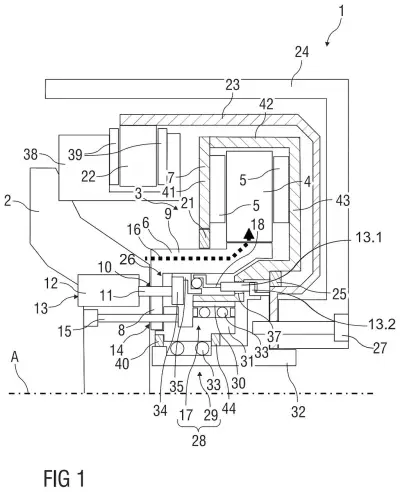
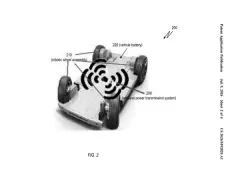
This is an electric wheel hub drive: the motor, the brake mount and the wheel bearing are packed together at the wheel itself. The motor has a stator (the fixed part) and a rotor (the part that spins). The small space between them, called the rotor space, has to stay closed off.
A decoupler (a disconnect unit with interlocking claw teeth) joins the rotor to the wheel only when the motor is driving. When the car coasts, it opens, so the rotor stays still and the motor wastes no power. The brake disc carrier, by contrast, always turns with the wheel.
The claims cover the sealing layout:
- First seal: fills the gap between the rotor carrier (the frame holding the rotor) and the stator carrier (the frame holding the stator).
- Second seal: fills the gap between the rotor carrier and the brake disc carrier. The description says it is advantageously a shaft sealing ring, a ring that seals around a turning part.
- Optional third and fourth seals: sit between the two rings of the wheel bearing, on opposite sides.
The filing says these radial seals keep the spaces separate even while the parts rotate and tilt under sideways force on the wheel. The main example uses an axial flux machine, a flat motor design where the magnetic force runs along the axle direction.
Why a wheel motor needs to stay watertight
For you, the payoff is a motor you never have to think about. A motor at the wheel sits in the spray zone and takes bumps and sideways forces, so water or grit getting in, or grease getting out, would be a real problem. The filing treats keeping foreign bodies and fluids out as the basic requirement.
There is an efficiency angle too. Every seal that rubs on a turning part causes drag losses, meaning energy burned on friction. By counting the wheel bearing's seal as part of the barrier, Mercedes-Benz says only two additional seals are needed, and the disconnect lets the motor stand still while the car rolls. That combination points to less energy wasted on friction.
Source: US 2026/0365008 A1 at the USPTO (PDF). Full patent text and figures are in the official publication.
Get our take in your Top Stories
Liked this breakdown? Add Patentlyze as a preferred source on Google, and our plain-English take shows up more often in your Top Stories the next time Mercedes-Benz patent news breaks.
Add Patentlyze on Google
One click.
There are more where this came from
We read the new patents from Big Tech, carmakers and more and send you the ones worth knowing. Plain English, free, every week.
The drawings · 2 sheets
2 drawing sheets from US 2026/0365008 A1 · click any drawing to enlarge


No comments yet