
Hyundai & Kia
Hyundai & Kia · Automotive · Filed Nov 17, 2025 · USPTO published Nov 19, 2026 · This week's release
Kia Patents a Charging Plug Hidden in the Center of Your Car's Wheel
Kia has filed a patent application that moves an electric car's charging port from the body panel to the middle of the wheel. A robotic arm at the charging station then opens the port and plugs in for you.
- Publication number
- US 2026/0365052 A1(US20260365052A1)
- Applicant
- Kia Corporation
- Filed · Published
- Nov 17, 2025 · Nov 19, 2026
- Inventors
- Sang Heon LEE, Jin Ho HWANG
- Status when we published
- Waiting for an examiner
- Document
- 20 claims
- US classification
- 320/109
How Kia's wheel-hub charging port works
Imagine pulling into your garage after work and just leaving the car there. No cable to drag out, no plug to jam in, no fumbling around in the rain. By morning the battery is full.
Kia's patent application puts the charging port somewhere unexpected: the center of the wheel. A small cover sits over the port, a bit like a hubcap. When you park at a matching station, a mechanical arm unscrews the cover and holds it aside. A charging plug then slides out and connects to the port.
When charging ends, the whole routine runs in reverse and the cover goes back on. The filing says the goal is convenience, with the station doing every step so you don't have to.
… an attachment and detachment unit being movable toward the wheel to selectively attach the cover to the wheel or detach the cover from the wheel …
Translation: A mechanical arm moves toward the wheel to automatically take off or put back the protective cover.
How the station unscrews the wheel cover
The filing describes three main parts. The first is a wheel with a connector wired to the car's battery, plus a removable cover that protects the connector. The second is an attachment and detachment unit, a robotic arm at the station that grabs the cover and takes it off or puts it back. The third is a charging unit, the plug itself, which moves toward the wheel and connects once the cover is off.
In the main example, the cover screws onto threads around the wheel's center. The arm grips it, then turns it to unscrew it. The connector can be fixed to the wheel's knuckle (the part that holds the wheel in place) so it doesn't get in the way of the wheel turning.
The station sits on a movable docking interface with two separate compartments, one for the arm and one for the plug. Three sensors guide the process:
- The first finds the cover.
- The second helps the arm tilt to the right angle to grab it.
- The third finds the connector so the plug lines up.
While the arm is busy, its gripper can swing over and close the plug's compartment to protect it. Each wheel can have its own connector, and the car carries a power converter that changes AC electricity to DC. The claims also cover the vehicle alone and the station alone.
What wheel-hub charging means for Kia drivers
If this idea ever reached a real car, charging would mean parking in the right spot and walking away. That could appeal to anyone who dislikes handling cables, especially in bad weather. The filing also says the car and station could share power in both directions, so a car could in principle send electricity back to a house.
The catch is that your car and the charging station would have to be built for each other. Today's public chargers use cables and ports on the car body, so a wheel-hub design would need purpose-built stations. Nothing in the filing says Kia plans to sell this, and a patent application is only a statement of an idea.
Hyundai's eighth patent application we've tracked since November, joining our Hyundai coverage that already includes a battery warm-up before charging and a delayed low-battery alert.
Source: US 2026/0365052 A1 at the USPTO (PDF). Full patent text and figures are in the official publication.
Get our take in your Top Stories
Liked this breakdown? Add Patentlyze as a preferred source on Google, and our plain-English take shows up more often in your Top Stories the next time Hyundai & Kia patent news breaks.
Add Patentlyze on Google
One click.
There are more where this came from
We read the new patents from Big Tech, carmakers and more and send you the ones worth knowing. Plain English, free, every week.
The drawings · 13 sheets
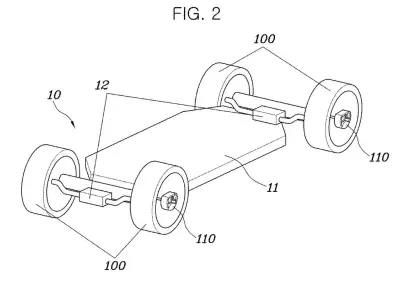
13 drawing sheets from US 2026/0365052 A1 · click any drawing to enlarge


Show the other 5 sheets


More from Hyundai & Kia
All 15 Hyundai & Kia patents →
More in Automotive
All 432 Automotive patents →
Samsung
Samsung Files Patent for an AI Chip That Double-Checks a Car's Warning Alerts
Intel
Intel Files Patent for Robots That Turn Down Their Own Noise Near Hospitals and Schools
Waymo (Google)
Waymo Files Patent for Truck Stops Where Self-Driving Vehicles Exchange Cargo Loads
Amazon
No comments yet