
Ford
Ford · Automotive · Filed May 15, 2025 · USPTO published Nov 19, 2026 · This week's release
Ford Patents a Steering Wheel That Leans Toward the Curve During Self-Driving
When a car steers itself, its wheel loses the natural spring-back toward straight. Ford's patent application gives the wheel a new resting position that follows the road's curve, so a nudge from you feels natural.
- Publication number
- US 2026/0365234 A1(US20260365234A1)
- Applicant
- Ford Global Technologies, LLC
- Filed · Published
- May 15, 2025 · Nov 19, 2026
- Inventors
- Ashrit Das, Rohan Divekar
- Status when we published
- Approved; patent expected soon
- Document
- 20 claims
- US classification
- 701/42
- Examiner
- BRAUCH, CHARLES JOSEPH (Art Unit 3747)
What Ford's self-driving steering wheel now does
When a car steers itself, the wheel stops behaving like a normal one. In an ordinary car, the steering springs back toward straight on its own. In Ford's setup, motors are steering all the time, so that spring-back may not happen, and the wheel has no sense of where it ought to point.
Ford's patent application adds a new resting angle. Instead of always pulling toward straight ahead, the wheel is nudged toward whatever angle matches the path the car plans to take. On a gentle right-hand bend, a slightly turned wheel becomes the home position.
So if you grab the wheel mid-curve, you feel it push back toward the planned path rather than toward straight. You push only when you want to leave that path, and you never have to hold the curve for the car. Let go, and the wheel eases back on course.
… determine a return-to-center (R2C) angle for the steering wheel based on the trajectory plan and a vehicle speed; and cause the steering motor to bias the steering angle of the steering wheel towards the R2C angle in response to the steering wheel receiving a torque input from a driver.
Translation: It calculates where the wheel should naturally point for a turn and gently pulls it there if the driver touches it.
How Ford works out where the wheel should rest
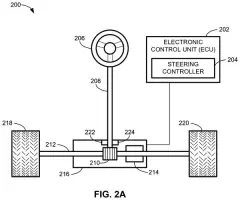
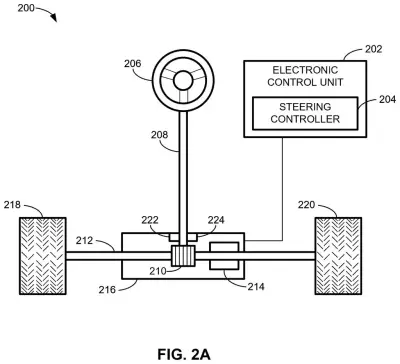
While the car is in its assisted driving mode, a steering controller reads a trajectory plan (the path the car intends to follow, including how sharply it curves) and the car's speed. From those it computes a return-to-center (R2C) angle, the wheel position that matches the planned path. On a straight road that is still dead center. On a bend, it is a turned wheel.
When you push on the wheel, the steering motor resists. The resistance is measured against the R2C angle, so pushing one side of it meets a pushback in one direction and the other side meets it in the opposite direction.
How the angle is found depends on what the car is doing:
- Lane keeping: uses a reference path from a map or from camera lane markings (fitted with a cubic polynomial, a smooth curve equation), plus the car's wheelbase, steering ratio and understeer gradient (how much a car tends to drift wide in a turn).
- Lane change: picks a lookahead point on the car's path and calculates the curve toward it with the pure pursuit law (a standard path-tracking formula).
- Evasive maneuver: sets the R2C angle equal to the path follower's own steering request, so the wheel guides the car back toward its path after a swerve.
What this means for drivers who take over mid-curve
If you ever drive a car that steers itself, the handoff between you and the machine is where trust is won or lost. A wheel that settles on the planned path gives you a predictable feel when you nudge it, and the filing says it also shortens the delay in returning to the planned line after a swerve. The filing shows an SUV only as an example and names no model.
The patent office has approved this application and Ford has paid the fee to have it issued, so it should become a granted patent soon. It has not been granted yet. Whether the idea ships in any Ford vehicle is not something the filing says.
Ford's fourth filing we've covered since November in our Ford coverage follows patents like the calmer steering handoff and the voice-moved vehicle tray.
Source: US 2026/0365234 A1 at the USPTO (PDF). Full patent text and figures are in the official publication.
Get our take in your Top Stories
Liked this breakdown? Add Patentlyze as a preferred source on Google, and our plain-English take shows up more often in your Top Stories the next time Ford patent news breaks.
Add Patentlyze on Google
One click.
There are more where this came from
We read the new patents from Big Tech, carmakers and more and send you the ones worth knowing. Plain English, free, every week.
The drawings · 12 sheets
12 drawing sheets from US 2026/0365234 A1 · click any drawing to enlarge


Show the other 4 sheets


More from Ford
All 8 Ford patents →
More in Automotive
All 432 Automotive patents →
Qualcomm
Qualcomm Patents a Steering Torque System That Signals When Autopilot Is Active
BMW
BMW Patents a Self-Learning Steering Limit That Adapts to Each Car
Qualcomm
Qualcomm Patents a System That Detects When You Grab the Wheel
Tesla
No comments yet