
Meta Patents a Way to Track Your Body's Fitness Through Sensors in Smart Glasses
Meta is patenting a system that turns sensors in a pair of smart glasses into a full workout monitor, inferring what your body is doing from data collected at your head.
What Meta's head-sensor fitness tracking actually does
You're out for a run wearing a pair of Meta's smart glasses, no chest strap, no wrist sensor, no extra gear. The glasses are reading signals from your head, and from those readings alone, the system figures out what your body is doing, how hard your heart is working, how your movement patterns are changing.
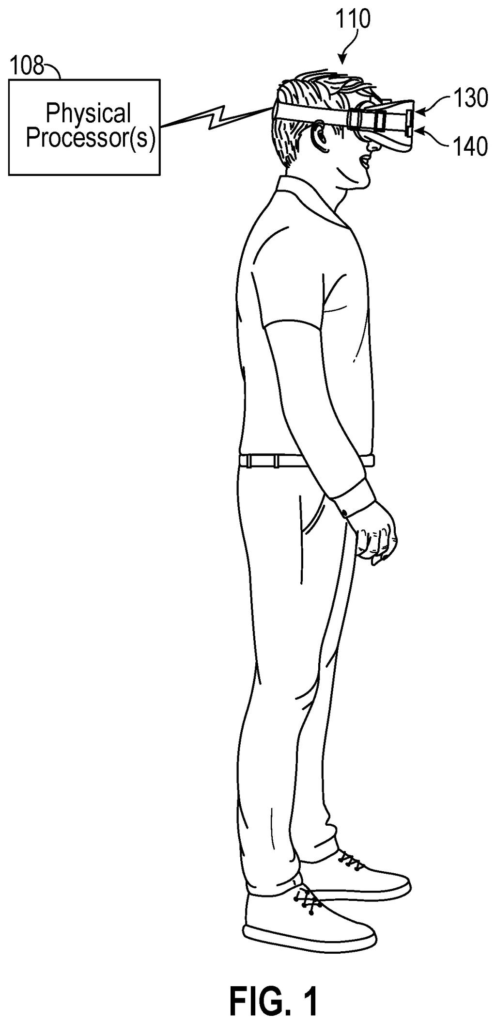
The patent describes a head-wearable device (think AR or XR glasses) loaded with multiple sensors. Those sensors collect data about your head, and the device's processor translates that head-level data into body-level fitness metrics. If your numbers drift too far from what the system expects for your workout, it flags you with an alert.
The key idea is that your head gives away a surprising amount about your body. Blood flow, motion, temperature, and other signals at the head mirror what's happening below the neck, and Meta's system bets it can decode all of that without any sensor touching your chest, wrist, or anywhere else.
… determining whether a difference between the metric and an expected metric corresponding to the attribute of the body of the user satisfies a predetermined threshold …
Translation: The system compares actual fitness measurements against standard goals.
How head-worn sensors translate to full-body fitness data
The patent's first claim describes an extended-reality (XR) device, a head-worn frame with sensors that collect data about the user's head, and a processor that does three things in sequence.
First, the processor receives raw sensor data from whatever is measuring the head. The patent doesn't lock in a specific sensor type, which means the claim covers a wide range of inputs: motion, optical, thermal, or biometric sensors could all qualify.
Second, the processor infers a body-level metric from that head data. This is the core leap: the device doesn't measure your heart rate or stride cadence directly at the source. It reads signals at your head and uses those to derive what's happening lower in your body. A concrete example would be using optical sensors on the frame to detect blood-pulse timing at the temple, then computing heart rate from that signal.
Third, the processor compares that inferred metric against an expected value (a personal baseline or a workout target). If the gap between what it's seeing and what it expects crosses a set threshold, it triggers an alert for the user. The claim doesn't specify how that alert is delivered, so it could be audio, visual overlay in an AR display, or haptic feedback.
What this means for XR headsets as health devices
For most people today, fitness tracking means a device on your wrist. Meta's filing is an argument that your glasses can do the same job, and maybe more, since the head is rich with physiological signals that wrist sensors can't always capture cleanly. If this system works well enough to be practical, it removes friction: you'd get workout monitoring just by wearing glasses you might already have on.
Meta's long bet on XR as an everyday platform is visible here. Turning health tracking into a feature of smart glasses, rather than a separate wearable, is a way to make XR hardware more essential to daily life. Whether the underlying sensor accuracy holds up during real exercise is the question patents don't answer.
Meta's 69th filing we've tracked in our smart glasses watchlist since May adds to work like the single-beam eye and room tracker and eye and hand object selection.
Claim 1 is written at a high level of generality. It covers any head-worn XR device, any sensor collecting any head-attribute data, and any processor that infers any body metric from that data and alerts the user when a threshold is crossed. That's a broad footprint.
In practice, that breadth matters. If granted as written, the claim could cover nearly any XR headset that adds health monitoring, regardless of which specific sensors are used or which body metrics are being tracked. Competitors building AR glasses with fitness features would have to look carefully at whether their implementation falls inside this perimeter.
The claim's weakness is also its breadth: very broad, functional claims face harder scrutiny from patent examiners, who tend to demand more specific language when the underlying idea isn't novel in narrow form. Whether this survives examination without significant narrowing is the real open question.
There are more where this came from
We read every patent application Big Tech publishes and send you the ones worth knowing. Plain English, free, every week.
The drawings
13 drawing sheets from US 2026/0295365 A1 · click any drawing to enlarge


Want this weekly breakdown for a company we don't cover? Patentlyze Pro →
Be the first to weigh in