
Meta Files Patent for a VR Headset Strap That Resizes With a Dial
Meta has filed for a VR headset strap that resizes with a dial, letting its two ends slide past each other inside the housing. The goal is one strap that fits a whole household's worth of heads.
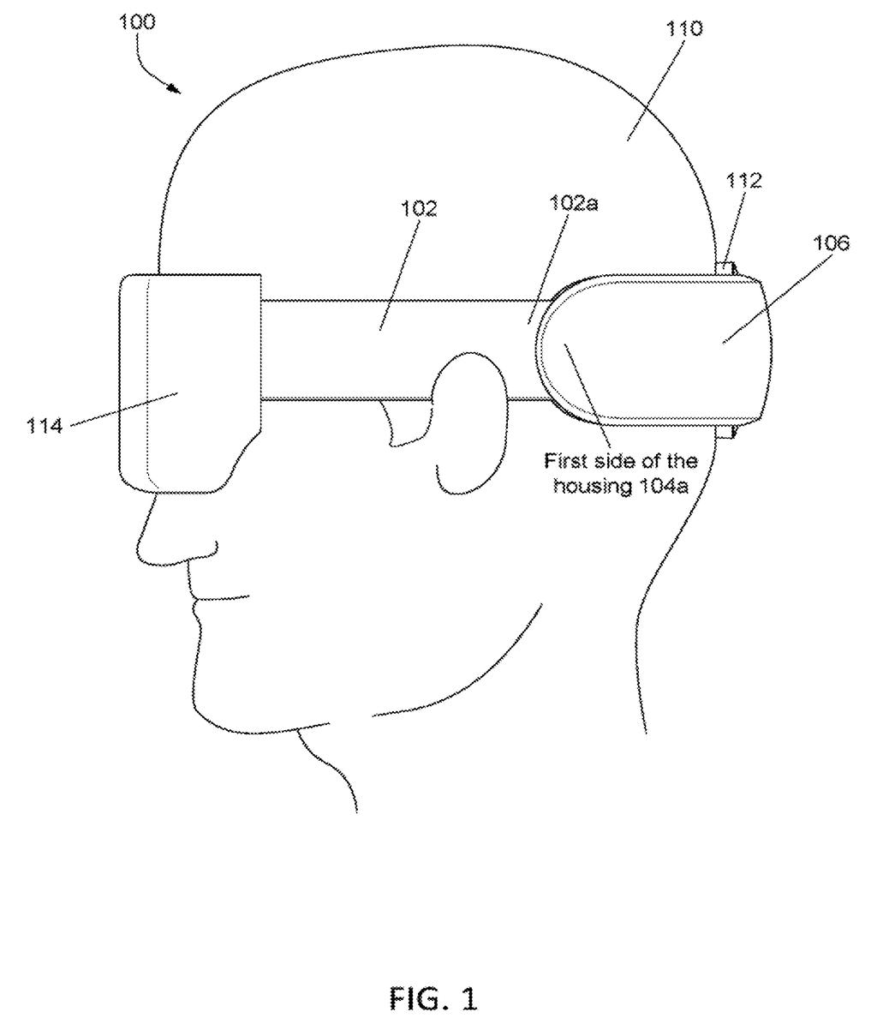
What Meta's pulley-driven headset strap does
Every time a friend tries on your VR headset, the fit is off. The strap that sits snug on your head slides around on theirs, or squeezes too tight on someone with a bigger one. Many headsets handle this by letting you swap in a different strap, which is a hassle.
Meta's filing describes a single strap that resizes itself instead. A dial on the side of the headset pulls a thin cable around small pulleys inside the housing, and the cable drags the two ends of the strap toward each other or apart. Turn one way and the headband tightens. Turn the other way and it loosens.
The clever part is that the two ends of the strap can slide past each other inside the housing, so the strap can retract much farther than usual. That lets one strap length cover a wide range of head sizes.
… actuation of the adjustment mechanism causes a first portion of the cable to move around the first cable-engagement portion at a first rate in a first direction, and wherein actuation of the adjustment mechanism causes a second portion of the cable to move around the second cable-engagement portion at a second rate in a second direction.
Translation: Turning the dial moves the internal cables in opposite directions at different speeds to adjust the fit.
How the cable pulls two strap ends together
The claims cover a headset with a display and a retractable side strap that slides in and out of a housing. A handwheel (a small dial that sticks out of the housing) turns a gear, which turns a spool. A cable is wound onto two sections of that spool, which the claims call cable-engagement portions.
When you turn the wheel, one section of the spool takes in cable while the other lets it out, and the claims say the two move at a first and second rate in opposite directions. The cable runs around anchor points (fixed pulleys, moving pulleys or static posts) and attaches to each end of the strap, so the two ends move together or apart.
The filing also describes several supporting details:
- A spring, placed at the wheel, a pulley or the cable itself, keeps the cable at a set tension so it does not slip or go slack.
- The strap ends overlap, with one passing over the other, so each end can travel up to 240 mm, or about 75 to 80% of the housing length.
- Guide channels, friction pads and low-friction materials such as PTFE cut down wear on the cable.
- You could store your preferred size and have the wheel set itself to it automatically.
When the adjustment mechanism is adjusted, the cable winds/unwinds around the first or second cable-spooling portion of the adjustment mechanism, adjusting the exposed length of the retractable side strap to accommodate for different head sizes for users of the head-wearable device.
Translation: Turning the dial winds the cable to tighten or loosen the strap for different head sizes.
Why a shared Meta headset could get easier to fit
If a headset gets passed around a household or a workplace, a strap that adjusts in seconds beats hunting for a different strap. The filing says one uniform strap length can cover many head sizes, and that letting the ends overlap means the housing can be smaller and more compact than existing designs.
It is also a durability story. Much of the description is about keeping the cable from rubbing, stretching or fraying, since a cable that wears out would turn a convenience into a repair. The filing names no product, and it is a continuation of an application first filed in 2024, so treat it as a mechanical detail Meta wants protected rather than a hint at a specific headset.
This is the 182nd Meta filing in our Meta coverage since May, adding to a body of wearable work that includes smart clothing advice and tap-reading wristbands.
Headset fit is a real annoyance. A device that sits on your face for an hour has to feel right, and heads come in a lot of sizes. Swapping straps for every guest or family member adds a small chore to what should be a pick-up-and-play gadget.
A dial, a cable and a handful of pulleys is a proportionate answer to that problem. It is plain mechanical engineering, and the 240 mm of travel the filing mentions is what lets one strap cover a wide range. The spring that keeps the cable taut matters too, since a slack or frayed cable would turn a convenience into a repair.
The ambition is modest, and that suits the size of the problem. It could make a shared headset less fussy, which is a fair goal for a strap. Whether the cable survives thousands of turns is something a patent cannot answer.
Get our take in your Top Stories
Liked this breakdown? Add Patentlyze as a preferred source on Google, and our plain-English take shows up more often in your Top Stories the next time Meta patent news breaks.
There are more where this came from
We read every patent application Big Tech publishes and send you the ones worth knowing. Plain English, free, every week.
The drawings
20 drawing sheets from US 2026/0339391 A1 · click any drawing to enlarge


Show the other 12 sheets


Want this weekly breakdown for a company we don't cover? Patentlyze Pro →
Be the first to weigh in