
Meta Files Patent for a Wristband That Reads Finger Taps on Whatever You're Holding
Your hands are full, your wrist buzzes, and this Meta patent application says a tap on the cup you're holding could be enough to answer. The wristband in the filing treats that tap like a pinch.
What Meta's wristband does when your hands are full
Every time you carry a coffee cup in one hand and your phone buzzes, you face the same small puzzle: put the cup down, or ignore the message. Smart glasses and smartwatches have the same problem, because many of their hand controls, like pinching your thumb and finger together, need a free hand.
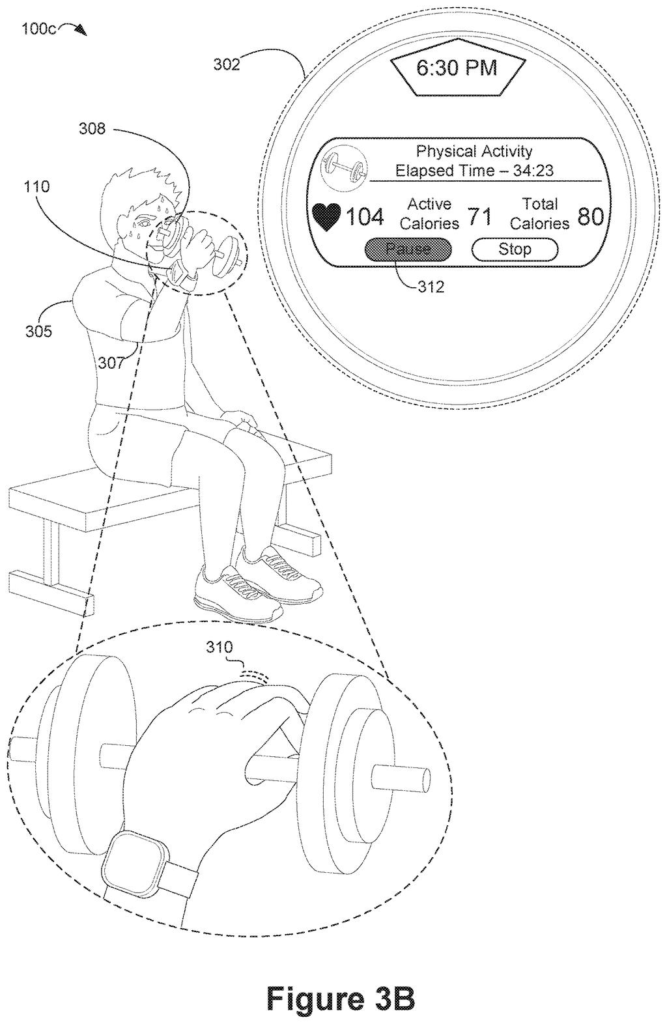
This Meta patent application describes a wristband that notices when you press or tap a finger against whatever you're holding, and treats that as the same command as a pinch. A tap on a can could pause your music. A press on a book could pull up a translation.
The wristband reads the faint electrical signals your muscles give off, so the movement can be tiny. You squeeze the object a little, nothing visibly moves, and your device gets the message. The filing also says the system should ignore ordinary moves, like lifting a can to take a sip.
while a hand of a user is holding a physical object having a surface: in accordance with a determination, using data from one or more biopotential-signal sensors of a wrist-wearable device worn by the user, that the user is performing a gesture on the surface: causing performance of an action at the wrist-wearable device or a communicatively coupled device …
Translation: The wristband triggers an action when it detects you tapping on a physical object you are holding.
How the wristband tells a tap from a sip
The wristband carries biopotential-signal sensors (electrodes that pick up the tiny electrical activity of your muscles, the same family as the EMG sensors used in medical tests). Claim 1 covers two cases. While your hand is holding an object, the device checks whether you made a gesture on the object's surface, such as a tap, press or squeeze with your fingers. It also checks whether you made a digit-to-digit gesture, meaning fingers touching each other, like a pinch. Either one triggers the same action on the wristband or a connected device.
The filing describes how detection works:
- The device looks for a sequence of muscle pulses above a baseline level that matches a set pattern, such as a double tap.
- That pattern can be effector-agnostic (it counts no matter which finger or wrist muscle makes the pulses), so you can use whichever finger your grip leaves free.
- The description says the baseline can be lower when your hand is full, so lighter presses still register.
Dependent claims add extras: glasses with a camera that work out what you are holding and offer an action for that type of object, like a translation for a foreign-language book, and screenless glasses that confirm with a sound. The description also says the system should ignore ordinary motions, such as lifting a can to drink.
What this means for glasses with no screen
Wearables that need a free hand fall short exactly when you most want them, like when you are carrying groceries, holding a leash or lifting weights. If a tap on whatever is in your hand works like a pinch, you could pause a song, dismiss a call or log a set without stopping what you are doing, and without waving your hand around in public.
It also suits glasses that have no screen, since the claims cover an audio confirmation. The filing pairs a wrist sensor with glasses: the wrist reads your intent, and the glasses show or say the result. Whether it works reliably on a real wrist, with real grips, is the open question.
That makes this Meta's 22nd filing we've tracked since May in our muscle-reading wristband watchlist, building on earlier applications covering wrist-roll cursor steering and muscle coaching for controls.
The hardware has to come first. A wristband that reads muscle signals through the skin needs to exist and work before any of this software runs on top of it, so the starting line is already further out than a pure app idea.
Once that wristband exists, teaching it to treat a tap on a coffee cup the same as a finger pinch is mostly a question of updating how it reads signals, not building anything physical and new. That is a real shortcut to a product.
The catch the document itself names is that tapping a held object misfires more often than pinching fingers together, and every proposed fix adds a small daily friction. A version that also uses glasses to recognize what you are holding adds a second device entirely, which puts it much further from any shelf.
Get our take in your Top Stories
Liked this breakdown? Add Patentlyze as a preferred source on Google, and our plain-English take shows up more often in your Top Stories the next time Meta patent news breaks.
There are more where this came from
We read every patent application Big Tech publishes and send you the ones worth knowing. Plain English, free, every week.
The drawings
47 drawing sheets from US 2026/0339435 A1 · click any drawing to enlarge


Show the other 39 sheets


Want this weekly breakdown for a company we don't cover? Patentlyze Pro →
Be the first to weigh in