
Samsung Files Patent to Make Digital Furniture Match the Lighting in Your Room
Samsung's patent has your phone drop an imaginary mirror ball into your living room, then uses AI to work out exactly how the light falls there. The goal is a digital object that looks like it belongs in the room.
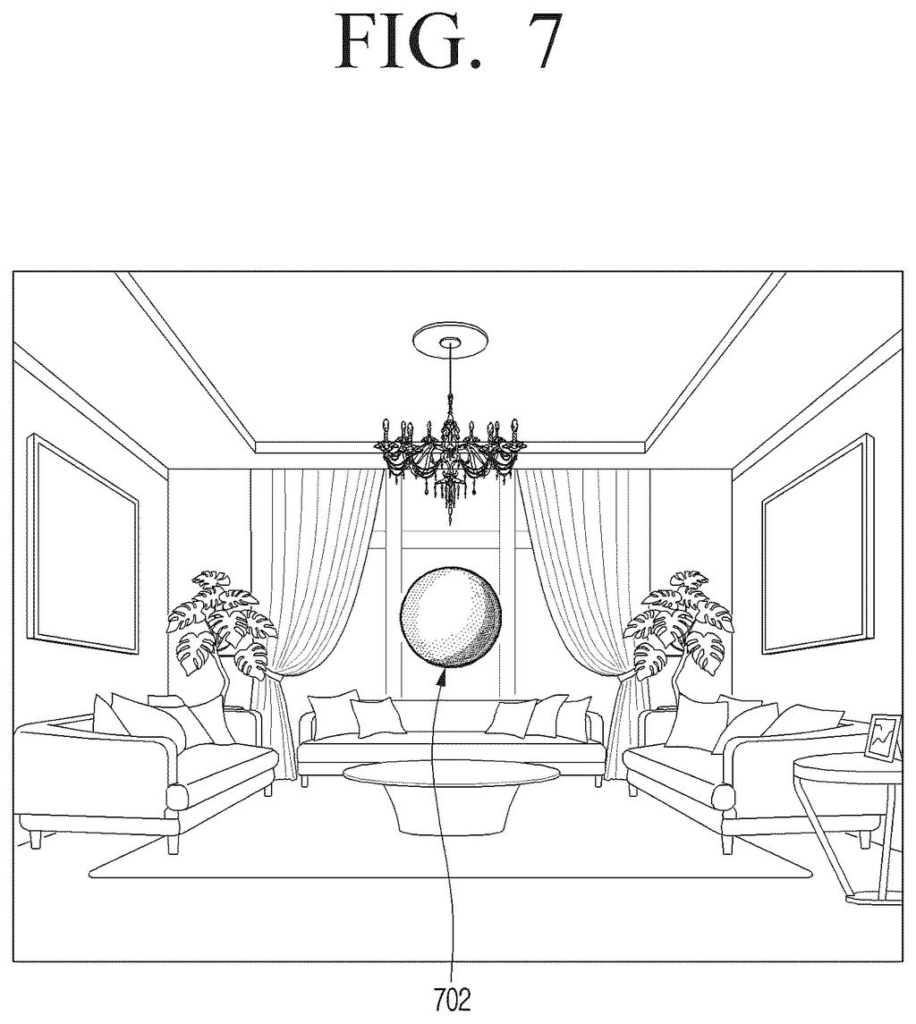
What Samsung's virtual mirror ball actually does
Every time you preview a virtual lamp or sofa in your living room through your phone, the app has to guess how the real light in the room would fall on it. Guess wrong and the object looks pasted on, too bright or too flat, like a sticker.
Samsung's filing describes a way to take the guesswork out. Your device's camera (or several cameras) photographs the room from different angles, and software builds a 3D copy of the space. It then places an imaginary mirror ball right where the object will sit and reads what that ball would reflect.
That first reflection comes out grainy, so an image-generating AI cleans it up into a crisp, believable version. The result tells the app where light is coming from, so the virtual object gets highlights and shading that match your room. Photographers have long used real mirror balls as lighting probes, but they are a hassle to set up. Samsung wants software to do the job.
… positioning a virtual sphere within the generated 3D representation of the real-world scene; estimating a coarse light map of the real-world scene on the virtual sphere; …
Translation: It places a digital ball inside the 3D room model to calculate how light hits objects.
How the grainy reflection gets cleaned up by AI
Several cameras (or one camera at several angles) photograph a room. A neural radiance field (NeRF, a neural network that learns a scene's 3D shape and colors from photos) turns those pictures into a 3D model of the space.
The system then places a virtual sphere, a pretend mirror ball, where the digital object will sit. In the filing's example, a kettle goes on a living-room table, so the sphere goes on or near that table. Tracing light rays bouncing off the sphere gives a coarse light map: a low-resolution, noisy picture of the surroundings.
A pre-trained diffusion model (the family of AI that generates images from text) then cleans up that picture. The filing names Stable Diffusion paired with a helper called ControlNet, guided by:
- An inpainting mask, which outlines the area to fill in or fix
- A text prompt such as 'Hyper-realistic reflections, Remove noise'
Finally, the cleaned sphere is converted back to 3D, reflections are traced again, and the resulting light map is used to re-light the virtual objects.
… estimating an enhanced virtual sphere by operating the at least one generated 2D image based on a pre-trained diffusion model, and estimating the light map of the real-world scene based on the enhanced virtual sphere.
Translation: An artificial intelligence model then cleans up the lighting details so digital objects match the room.
Why virtual try-on and room design could benefit
The filing points to virtual try-on and virtual interior design as uses. If you have ever placed a digital sofa in your room through your phone and noticed it looked glued on, bad lighting is a big reason. Matching the room's real light could make previews of furniture, clothes or decor more believable before you buy.
It also removes a chore. The filing describes physical mirror balls as cumbersome to set up and prone to wear and tear. It says earlier AI that guessed the sphere from a single photo only worked on scenes similar to its training data, and could produce noisy results or false lighting. Samsung's answer is to feed in several photos so the AI cleans up data from your actual room.
Samsung's 1519th filing in our Samsung coverage since May joins work like the AR mirror fix and the hidden color photo patent in a growing set of perception-focused applications we track.
No new hardware is needed here. The filing describes a phone-class device with a camera, plus software that can run on the phone or on a remote server, so the shortest route to a product is an app update.
The catch is the workload. Building a 3D copy of a room from photos and then running an image-generating AI to clean up a reflection takes real computing power, and the filing gives no timing or speed figures. Until that cost looks small, a cloud-based feature in a shopping or room-design app looks like the most plausible first stop.
The payoff is easy to picture: a virtual kettle on your actual table that looks like it belongs. Whether it works fast enough to feel instant is the open question, and the document does not answer it.
Get our take in your Top Stories
Liked this breakdown? Add Patentlyze as a preferred source on Google, and our plain-English take shows up more often in your Top Stories the next time Samsung patent news breaks.
There are more where this came from
We read every patent application Big Tech publishes and send you the ones worth knowing. Plain English, free, every week.
The drawings
12 drawing sheets from US 2026/0330753 A1 · click any drawing to enlarge


Show the other 4 sheets


Want this weekly breakdown for a company we don't cover? Patentlyze Pro →
Be the first to weigh in