
Meta Files Patent for AR Glasses That Show a Wider View Through Cheaper Glass
Meta's latest filing slants the tiny light-bending patterns inside an AR glasses lens. Its own simulations say that tilt could widen the view from about 27 degrees to 90 on plain glass.
What Meta's tilted-layer AR lens actually does
Ever tried to watch a movie through a mail slot? That is roughly what many AR glasses offer today: digital images float in a small window in front of you, and everything outside it goes blank.
The trouble is physics. The glass that carries the image to your eye limits how wide that window can be, and the glass that makes it wide is rare and very expensive. Meta's patent filing gets around the limit by placing tiny light-bending patterns inside the lens, tilted at a slant, instead of laying them flat like a sticker. The tilt squeezes a wide view into the narrow range of angles ordinary glass can carry.
The filing says this could give a 90-degree view in low-cost glass, for one color of light, where flat designs top out around 27 degrees. The same trick could also help the glasses watch your eyes.
… a plurality of grating elements physically tilted inside the waveguide media such that none of the grating elements are planarly parallel to the opposed outer surfaces of the waveguide media.
Translation: Tiny internal optical structures are intentionally slanted at an angle instead of running flat along the glass.
How light bends inside Meta's slanted lens
The core piece is a waveguide, a thin see-through plate that carries light from a tiny projector at the edge of the frame to your eye. Inside it sit gratings (microscopic patterns that bend light). Claim 1 covers placing them at a slant inside the plate, so that none sits flat and parallel to the plate's two outer faces.
A flat grating can only handle the range of angles the glass can trap and carry, and that range shrinks as the glass gets cheaper (its index of refraction, a measure of how strongly it bends light, is lower). A tilted grating squeezes a wide set of incoming angles into that smaller range. The claims mention glass with an index no higher than 1.52, and a view at least fifty degrees wide.
The same plate can do two jobs:
- Showing the image: copying it many times across the plate (pupil replication) so you still see it when your eye moves.
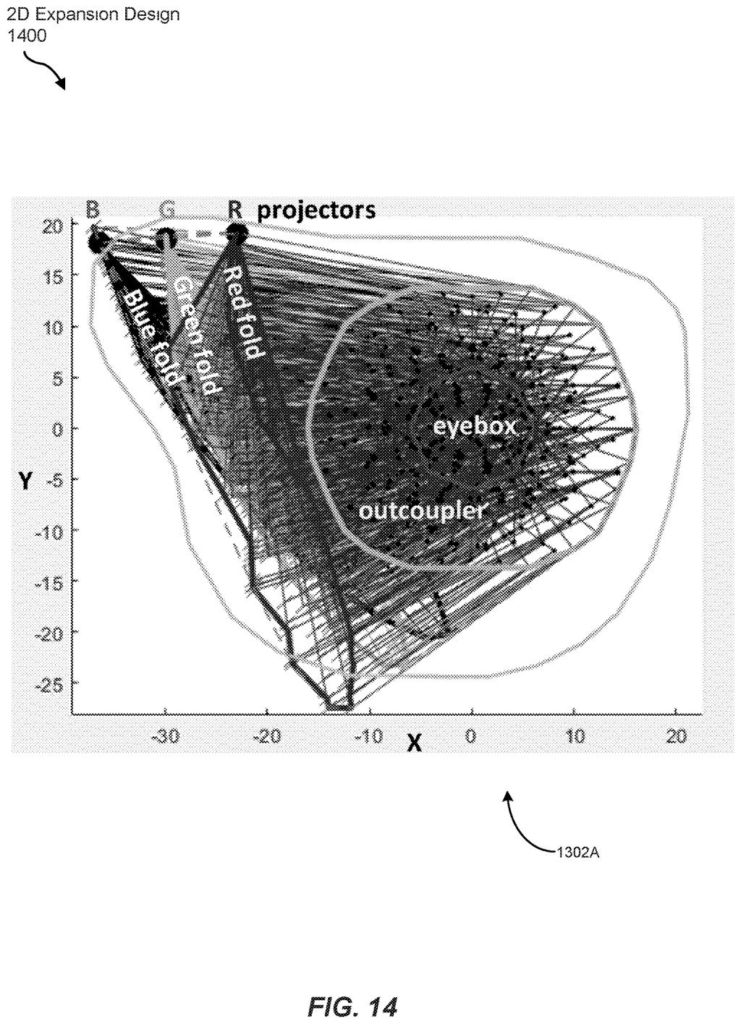
- Eye tracking: catching light bounced off your eye and steering it to a tiny camera. The filing's example images eight test points, against four for a flat design.
The filing sketches three ways to build it: stacking and slicing, molding two halves, or exposing light-sensitive material. Two other independent claims cover a backlight film with unevenly spaced pyramids that cuts interference ripples on a headset's LCD screen, and a way to print lenses onto glass over a pre-applied adhesive layer.
Why a cheaper lens matters for AR glasses
If you have ever tried AR glasses, you know the catch: you get either a tiny floating window or a bulky, pricey headset. A wider view on ordinary glass points toward lighter, cheaper glasses that show more of the digital world at once, which is what most people expect from them.
The eye-tracking side matters too. A camera that stays out of your sight yet still sees your whole eye could help glasses adjust what they show based on where you look. Keep in mind this is a patent application, so none of it is a product, and the headline numbers come from simulations.
Meta's 80th filing we've tracked in our AR glasses work since May adds to a run that includes a detachable menu bar and a tiny vibrating mirror.
The narrow field of view in AR glasses is not a minor annoyance. It is the reason most people who try them feel like peering through a mail slot, and it is the core reason the technology stays a curiosity rather than becoming something people actually wear.
Meta's approach here attacks the geometry of the glass layer itself, which is the right place to look for a problem this fundamental. The wide view shown in the filing comes from computer simulation at a single color, and the target shrinks considerably once a full color image is required, so the gap between promising diagram and wearable product remains large.
The smaller fixes in the filing, for screen ripple and lens warping during production, are modest and practical. The main idea carries a much heavier burden and has much further to travel before someone can wear the result to the grocery store.
Get our take in your Top Stories
Liked this breakdown? Add Patentlyze as a preferred source on Google, and our plain-English take shows up more often in your Top Stories the next time Meta patent news breaks.
There are more where this came from
We read every patent application Big Tech publishes and send you the ones worth knowing. Plain English, free, every week.
The drawings
62 drawing sheets from US 2026/0349260 A1 · click any drawing to enlarge


Show the other 52 sheets


Sheets 61 to 62 are in the full USPTO filing.
Want this weekly breakdown for a company we don't cover? Patentlyze Pro →
Be the first to weigh in