
Meta Files Patent for Glasses That Turn Your Hike Into a Highlight Reel
Camera glasses make it easy to record your whole hike and tedious to watch any of it. Meta's patent has the glasses listen to what gets said and cut the footage down to the moments worth keeping.
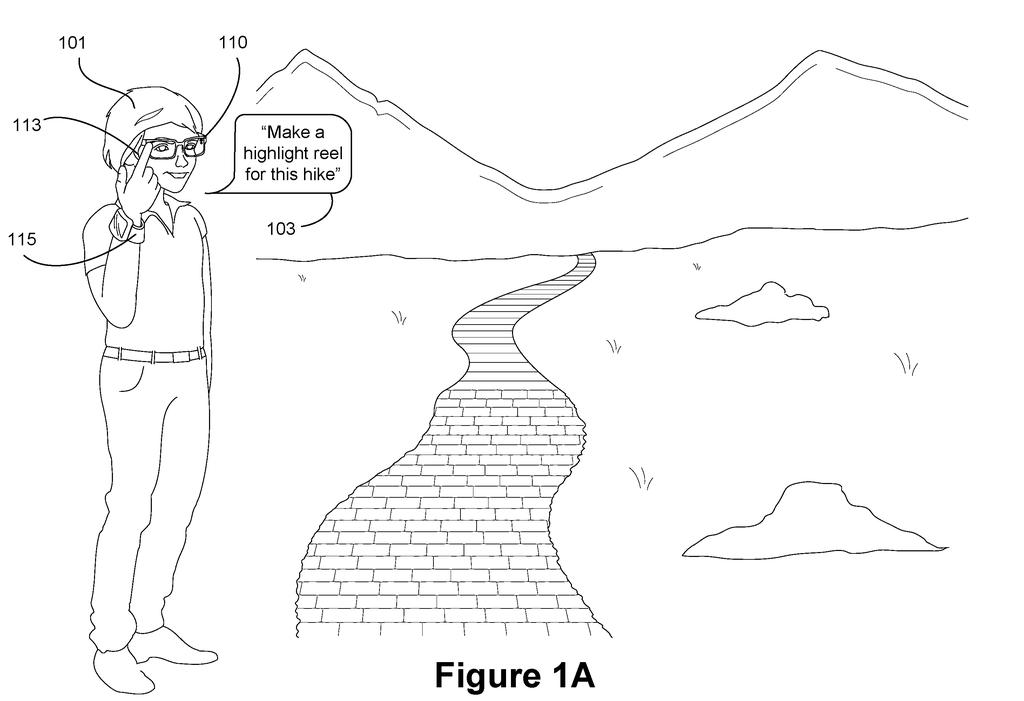
What Meta's highlight-reel glasses actually do
A couple spends half an hour on a trail wearing camera glasses. Most of the footage is boots and dirt. Then one of them says, 'Hey, look at that bird,' and the other answers, 'I think it's an eagle.'
You know how this usually ends: a long video nobody watches again. Meta's patent describes glasses that do the editing for you. You say something like 'Make a highlight reel of this hike,' and the glasses record, chop the footage into short chunks, and write out what was said in each one. Chunks with something worth keeping stay. The rest get thrown away.
What counts as worth keeping depends on what you asked for. A hike reel looks for waterfalls and a 'wow.' A basketball reel listens for cheering and a buzzer. You end up with a short video of the best bits that you can watch or share.
… cause the image data to be divided into a plurality of image segments; cause the audio data to be divided into a plurality of audio segments, each audio segment of the plurality of audio segments corresponding to a respective image segment of the plurality of image segments; …
Translation: The glasses slice up your video and audio into matching little blocks to process them more easily.
How the glasses decide which clips make the cut
Once you give a capture command (a voice request, a touch on the frame, or a hand gesture), the glasses record video and sound over a stretch of time. The filing's example is thirty minutes. The footage is split into short segments, five to thirty seconds each, with sixteen seconds given as an example. Each segment's audio goes through automatic speech recognition (software that turns spoken words into text). The claims hinge on that transcript: a segment joins the highlight video only if the transcript shows it deserves to.
The filing lists other signals that can be added to the decision:
- Keywords such as 'Cool' or 'That's awesome,' picked based on your request
- Emotion tags, meaning a score for moods like happy, calm or angry
- Background noise and number of speakers, for example skipping a clip where a loud river passes 80 decibels
- Image captions, a text description of what the camera sees
- Heart rate and gaze, as signs you were excited or focused
A large language model (an AI that works with text) weighs these inputs. The filing also describes a points system: 'Cool' might earn 0.5 and 'That's awesome' 1.0, and a segment makes the cut if its total passes a threshold. Segments that fail are discarded, and the survivors are stitched together in time order. In one example, the AI works out an eagle is in the shot only because someone says so out loud.
… in accordance with a determination, based on the respective transcription, that a respective audio segment is a highlight segment, add the respective audio segment and a corresponding image segment to a highlight video.
Translation: When the system spots exciting spoken words in the transcript, it automatically drops that clip into your reel.
Why a transcript-driven editor matters for glasses
Camera glasses make recording effortless, but nobody wants to scrub through hours of footage afterward. A feature that hands you a one-minute summary of your hike, party or game could be what makes you actually use the camera. Because you describe the occasion in your request, the glasses know what to look and listen for.
The filing also raises the obvious question: these glasses are listening to you and the people around you. The document says data collection happens with user consent, with options to opt out and to request deletion. It also allows the work to run on the glasses, a paired phone, or a server, so where your audio goes is a design choice that will matter.
Meta's 75th filing we've tracked in our smart glasses watch since May adds to a run that includes a multi-band antenna and a nose-aimed laser mic.
Few filings sit this close to a finished feature. The hardware is a pair of glasses with a camera and a microphone, which the claims take as given. The rest is software: speech-to-text, scene descriptions and a language model that picks the best clips. Each of those pieces already exists in some form, so the shortest route to a product is mostly engineering and a choice about where the processing runs.
What has to come first is battery and storage room, since the filing's example records for half an hour before it edits anything. A phone or a server can do the heavy lifting, and the document explicitly allows both.
The harder question is social. Glasses that listen to and transcribe everything nearby will meet resistance from the people standing next to you, and the filing's consent language is only a short paragraph. The technology looks like the easy part, and trust is the longer road to shipping.
Get our take in your Top Stories
Liked this breakdown? Add Patentlyze as a preferred source on Google, and our plain-English take shows up more often in your Top Stories the next time Meta patent news breaks.
There are more where this came from
We read every patent application Big Tech publishes and send you the ones worth knowing. Plain English, free, every week.
The drawings
7 drawing sheets from US 2026/0321292 A1 · click any drawing to enlarge


Want this weekly breakdown for a company we don't cover? Patentlyze Pro →
Be the first to weigh in