
Meta Files Patent for One Tiny Antenna That Handles Several Wi-Fi Bands in Smart Glasses
The hardest part of putting Wi-Fi in smart glasses may be the antenna. This Meta patent fits several of them into a space about 20 mm long and 5 mm wide, all driven by one shared feed.
What Meta's glasses antenna actually does
Every time a pair of smart glasses connects to your phone or your home Wi-Fi, a tiny antenna in the arm has to do the talking. That antenna has very little room to work with, and it still needs to cover more than one radio frequency band, the way a car radio needs to pick up both AM and FM.
Meta's patent application describes an antenna built for exactly that squeeze. Instead of wiring a separate connection to each antenna piece, it uses a single feed on the back of a small circuit board. That feed passes the signal along, with no direct contact, to several differently shaped pieces on the front. Each piece is tuned to a different set of frequencies.
The filing also says it keeps the radio energy your head absorbs under the legal safety limit, which matters when the antenna sits right next to your temple.
a parasitic feed element; a first resonance section fed by the parasitic feed element and configured to resonate within a low frequency band; and a second resonance section fed by the parasitic feed element and configured to resonate within a high frequency band; …
Translation: A single tiny power source feeds two different sections to handle multiple Wi-Fi frequencies.
How one feed powers three antenna shapes
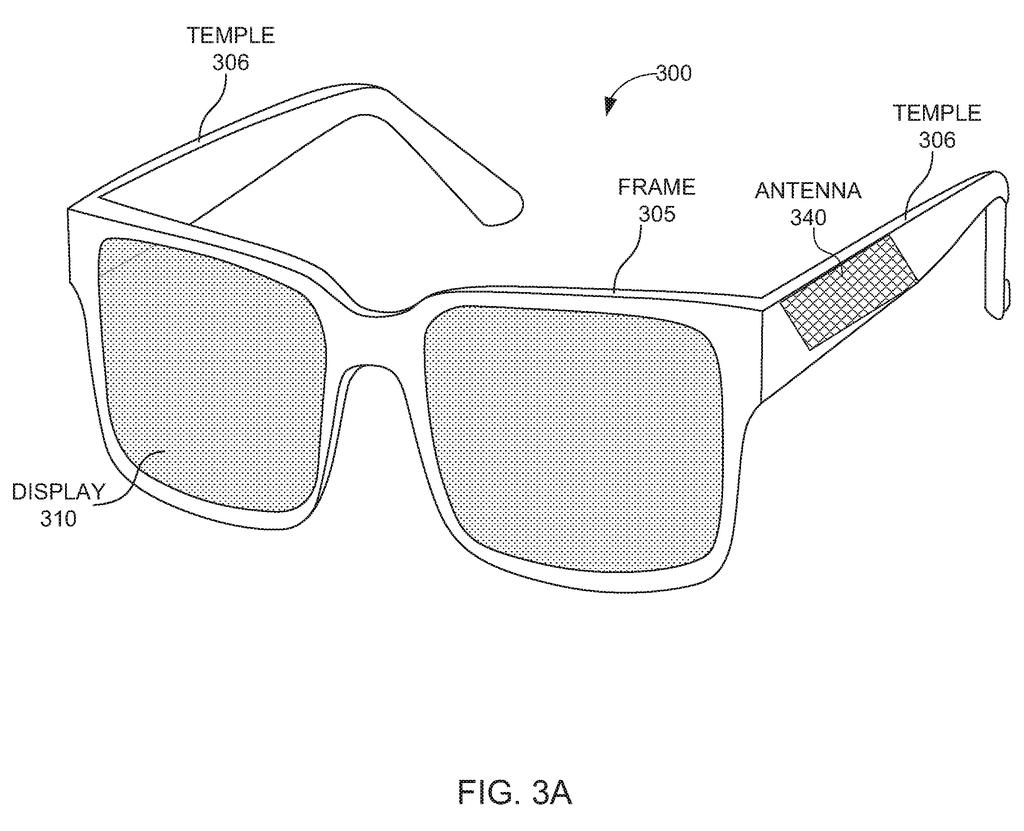
The claims cover a near-eye device (smart glasses or a headset) with an antenna system built around a parasitic feed element. That is a metal piece that is not wired straight to the radio. It passes the signal to nearby metal through electromagnetic coupling instead. This one feed powers at least two resonance sections (parts shaped to respond to a particular range of radio frequencies). One covers a low band around 2.4 GHz, and the other covers a high band of roughly 5 to 8 GHz.
In the main example, three shapes share the feed:
- An open-ended slot antenna (an L-shaped cut in the metal) handles about 2.4 to 2.5 GHz.
- A monopole (a short straight radiating piece) would normally resonate at 7 to 8 GHz.
- A floating dipole (a two-sided piece that has no wired connection of its own) covers about 5 to 6 GHz, and its coupling pulls the monopole down to about 6 to 7 GHz.
The shapes sit on one face of a printed circuit board, and the feed sits on the opposite face. A matching impedance network (a small tuning circuit) deepens the low-band response so the antenna works better at 2.4 GHz. In the example, the whole antenna measures about 20 mm by 5 mm and sits in a glasses arm.
The filing also reports simulated specific absorption rate (SAR, the rate at which your body absorbs radio energy) values from about 1.0 to 1.9 W/kg across four frequencies. All are under the 2 W/kg limit cited from the FCC. One claim covers a method of manufacturing a device with this antenna.
… an open-ended slot antenna section that resonates within a 2.4 GHz frequency band. In one example, the antenna has a monopole section and a dipole section which both resonate within a 5 GHz to 7 GHz frequency band.
Translation: The design covers both standard 2.4 GHz Wi-Fi and the faster 5 to 7 GHz bands.
Why this matters for thinner smart glasses
Smart glasses have to look and feel like glasses, and antennas take up room. A design that covers the 2.4 GHz band and the higher Wi-Fi bands from a 20 mm by 5 mm slice of the arm leaves more room for batteries, cameras and the rest. The filing itself lists longer range, better efficiency, lower radio exposure and a more compact design as the possible benefits.
Keep in mind that the performance figures come from simulations in the patent, not from a shipping product. It is a component filing for near-eye devices in general, and it does not name any specific Meta glasses or headset.
Meta's 74th filing we've tracked since May in our smart glasses watch adds to a body of work that includes laser nose audio and pulse reading cameras.
You will never see this antenna, and that is the point. If it works as described, you notice it only when nothing goes wrong: no dropped connection while you stream from your phone, and no extra bulk in the arm of the frames.
The safety numbers are what matter most to anyone wearing the device all day. An antenna sitting against your temple has to stay under the legal exposure limit, and the filing reports simulated values below it at all four frequencies it tests. Those are simulations, so real glasses would still need real testing.
Otherwise this is a routine piece of hardware engineering. It has no new feature to show off, just a smaller part that helps a pair of glasses keep its connection and its slim shape.
Get our take in your Top Stories
Liked this breakdown? Add Patentlyze as a preferred source on Google, and our plain-English take shows up more often in your Top Stories the next time Meta patent news breaks.
There are more where this came from
We read every patent application Big Tech publishes and send you the ones worth knowing. Plain English, free, every week.
The drawings
16 drawing sheets from US 2026/0321993 A1 · click any drawing to enlarge


Show the other 8 sheets


Want this weekly breakdown for a company we don't cover? Patentlyze Pro →
Be the first to weigh in